

Bell Ringer
Instructions: Select one of the Bell Ringers for students to reflect on and answer.
Vocabulary
Instructions: Go over important terms and their definitions before watching the Science of Nuclear video. The student vocabulary list can be found in the Student Guide and Science of Nuclear – Starter Pack.
| Word | Definition | Example |
|---|---|---|
| Uranium | noun; a heavy, radioactive metal used as fuel in nuclear reactors because it can release a lot of energy when its atoms are split. | “Here we have our solar system models again representing atoms, but this time of uranium.” |
| Nucleus | noun; the center of an atom, where most of its mass is found | “To unleash the energy, we shatter the nucleus.” |
| Neutrons | noun; an uncharged elementary particle that has a mass nearly equal to that of the proton | “This tiny but very powerful explosion releases neutrons . . . that collide with another nucleus . . .” |
| Chain Reaction | noun phrase; a sequence of reactions where a reactive product or by-product causes causes additional reactions | “This chain reaction makes the uranium extremely hot, which heats the water around it . . .” |
| Turbine | noun; a machine with blades that spin when moved by steam, water, or air to create mechanical energy | “ . . . creating steam which turns a turbine and turns the generator.” |
| Generator | noun; a machine that turns mechanical energy into electricity | “ . . . creating steam, which turns a turbine and turns the generator.” |
| Megajoule | noun; a unit for measuring energy, equivalent to 1,000,000 Joules | “[Wood] has an energy density of 16 megajoules per kilogram . . .” |
| Nuclear Reactor | noun phrase; a machine where controlled nuclear reactions take place to produce energy | “One nuclear reactor could power an entire city.” |
| Full Capacity | noun phrase; the highest or maximum level at which something can operate or perform | “They can run at full capacity, always on, for a year-and-a-half, on just one load of fuel . . .” |
| Spent Fuel | noun phrase; nuclear fuel that has been used and is no longer efficient in a reactor | “We’ll start with spent fuel, also called nuclear waste.” |
| Dry Cask | noun phrase; large containers used to safely store used radioactive fuel | “ . . . [we] store [spent fuel] for decades at the reactor site in large metal and concrete containers called dry casks.” |
| Radioactivity | noun; the process by which unstable atoms release energy in the form of particles or waves | “[Spent fuel] still contains a huge amount of energy, heat, and radioactivity.” |
| Breeder Reactor | noun phrase; a type of nuclear reactor that makes more fuel than it uses by turning non-fuel material into usable fuel | “There are also proposed breeder reactors, which would burn completely through the fuel, leaving almost no waste at all.” |
| Proliferation | noun; the rapid spread of nuclear materials or technology that can be used to make weapons | “Minimizing proliferation requires diplomacy, cooperation and the sharing of safer technologies . . .” |
| Thorium | noun; a radioactive metallic element that is obtained especially from monazite and is usually associated with rare earths | “Thorium and fusion reactors also produce much less waste, but they are decades away from commercial deployment.” |
| Fusion | noun; a nuclear reaction where two small atoms combine to form a larger atom, releasing energy | “Thorium and fusion reactors also produce much less waste, but they are decades away from commercial deployment.” |
Quiz
Instructions: Review key concepts after watching the Science of Nuclear video. The Student Guide and Science of Nuclear – Starter Pack contain the quiz and cloze notes.
Answer Key: Q1:C Q2:C Q3:B Q4:D Q5:B Q6:C Q7:D Q8:D
Reading and Extended Reading
Instructions: Provide students with the Science of Nuclear – Reading or Extended Reading info sheet for an in-depth exploration of the topic.
Reading Answer Key:
- Nuclear energy is energy produced from the nucleus (center) of atoms through nuclear reactions like fission.
- Nuclear fission is the process in which an atom’s nucleus splits into two smaller nuclei, releasing a large amount of energy.
- Uranium-235 (U-235) is the primary fuel used in most nuclear reactors.
- Control rods absorb neutrons to slow down or stop the nuclear fission reaction, helping to control the amount of energy produced.
- The cooling tower releases excess heat into the atmosphere, usually as water vapor, to regulate the temperature of the plant.
- The water in the primary loop is kept under high pressure, which prevents it from boiling, even at high temperatures.
- After passing through the turbines, the steam is cooled in a condenser and turned back into water.
- Heat from nuclear fission is used to create steam, which spins turbines connected to a generator that produces electricity.
- Nuclear energy produces very little direct air pollution, such as carbon dioxide, compared to fossil fuels like coal and natural gas.
- Nuclear waste remains radioactive for long periods of time and needs to be carefully stored and managed to prevent harm to people and the environment.
- Safety systems, like containment structures and emergency cooling systems, are designed to control the fission process, prevent overheating, and contain radiation in case of an accident.
- Spent fuel pools store radioactive fuel, cool it, and shield radiation until it becomes safer to handle.
- Natural uranium has too little U-235 to sustain a chain reaction efficiently. Enriching uranium increases the concentration of U-235, which makes it suitable for use in reactors.
- Understanding half-life helps predict how long radioactive materials remain dangerous, which is important for determining how long nuclear waste must be stored safely.
- These accidents show the importance of safety systems, the risks of nuclear energy, and the need for better safety measures, especially in disaster-prone areas.
Extended Reading Answer Key:
- Nuclear fission is the process of splitting the nucleus of an atom into two smaller nuclei, releasing energy.
- Uranium-235 (U-235) is the primary fuel used in most nuclear reactors.
- Heat from the reactor core is transferred to water in a primary loop, which then flows through a heat exchanger to a secondary loop, where water in the secondary loop turns to steam that powers the turbine.
- Control rods and the concentration of boron in the reactor coolant are used to absorb neutrons and manage the rate of the fission reaction, allowing operators to control reactor power.
- The separate loops prevent radioactive material from contaminating the steam that powers the turbine, ensuring that only the water in the primary loop is exposed to radioactivity.
- The cooling tower releases excess heat from the system, usually in the form of water vapor, to regulate the temperature of the plant.
- Nuclear power produces significantly lower carbon emissions compared to fossil fuels like coal and natural gas, making it a cleaner option in terms of greenhouse gas emissions. However, the long-term management of radioactive waste remains a challenge.
- Control rods absorb neutrons, slowing down or stopping the fission process when necessary. This allows operators to safely regulate the power output and prevent the reactor from becoming too hot or unstable.
- The major risks include the potential for nuclear accidents and the long-term management of radioactive waste. These risks can be mitigated through robust safety systems, strict regulations, and secure storage solutions.
- Uranium must be enriched to increase the concentration of U-235, which is the isotope capable of sustaining fission. This is done through gas diffusion or gas centrifugation to separate U-235 from U-238.
- Breeder reactors can convert U-238 into plutonium-239, effectively producing more fuel than they consume. This can extend fuel availability and reduce reliance on enriched uranium.
- France recycles spent nuclear fuel to recover uranium and plutonium for reuse, reducing waste and improving energy security. In contrast, many countries store spent fuel without recycling, resulting in more waste.
- The Chernobyl disaster raised global concerns about nuclear safety, leading to stricter regulations and a decline in nuclear energy development in several countries.
- Understanding half-life helps predict how long radioactive materials remain hazardous, which is essential for determining safe storage durations.
- Fukushima showed the need for better safety measures in response to natural disasters and the importance of reliable backup systems.
Computation
Instructions: Provide students with the Science of Nuclear – Computation activity for math integration and practice.
Answer Key: Q1: 886 kWh/month x 12 months/year x 1.12 pounds coal/kWh = 11,900 pounds of coal
Q2: 886 kWh/month x 12 months/year x 1 MWh/1000 kWh x 0.007 pounds Uranium/MWh = 0.074 pounds of uranium
Q3: % difference = difference between values/average of values x 100
79,999,945 MJ/kg40,000,028 MJ/kg x 100 = 200%
Q4: % difference = difference between values/average of values x 100
39 MJ/kg35.5 MJ/kg x 100 = 110%
Q5: c) 10 grams
Explanation: 7,190 ÷ 5,730 = 3 half-lives
80 → 40 → 20 → 10 grams
Q6: c) 8 days
Explanation: 160 → 80 → 40 grams = 2 half-lives
16 days ÷ 2 = 8-day half-life
Q7: b) 3
Explanation: 10 → 5 → 2.5 → 1.25 → 3 halvings = 3 half-lives
Q8: c) 8 grams
Explanation: 13.5 ÷ 4.5 = 3 half-lives
64 → 32 → 16 → 8 grams
Data Set
Instructions: Provide students with the Science of Nuclear – Data Set for data literacy and analysis practice.
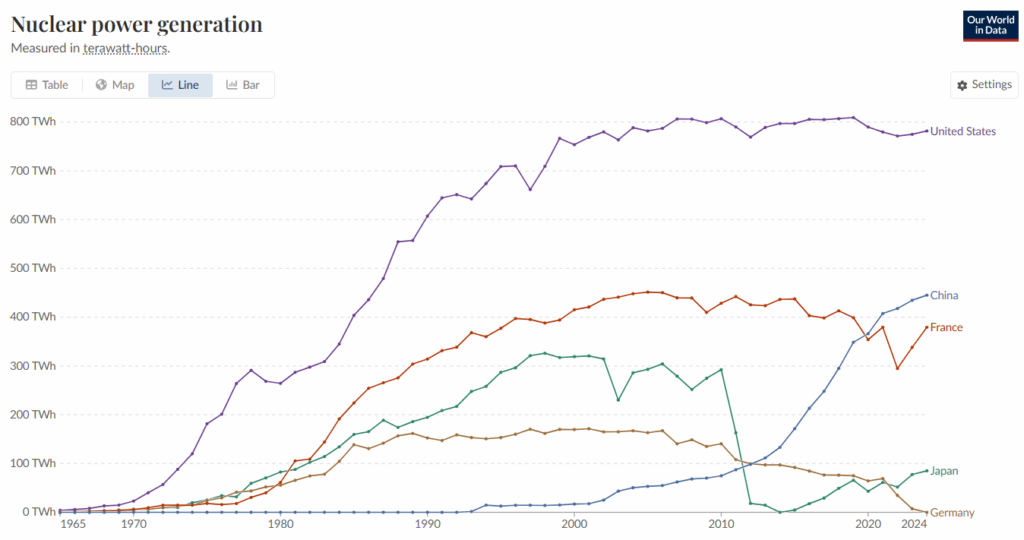
Source: Our World In Data
Data Table
| 1980 | 2000 | 2020 | 2024 | |
|---|---|---|---|---|
| China | 0 TWh | 16.74 TWh | 366.20 TWh | 445.17 TWh |
| France | 61.25 TWh | 415.16 TWh | 353.83 TWh | 379.27 TWh |
| Germany | 55.59 TWh | 169.61 TWh | 64.38 TWh | 0 TWh |
| Japan | 82.59 TWh | 319.12 TWh | 43.00 TWh | 84.91 TWh |
| United States | 264.33 TWh | 753.89 TWh | 789.88 TWh | 781.98 TWh |
Answer Key: Question 1: Germany’s nuclear power output declined after 2000, and dropped to 0 by 2023, showing a move away from nuclear energy. China rapidly increased its nuclear output, showing strong investment in nuclear for future energy needs.
Question 2: Answers will vary. (Example: Most U.S. reactors are old, and few new ones have been built due to high costs, long timelines and stricter safety regulations.)
Question 3: Answers will vary. (Example: The Fukushima disaster in 2011 was a major nuclear accident caused by an earthquake, and it caused Japan to shut down many reactors and rethink its energy strategy for safety.
Question 4: Answers will vary. (Example: China is most likely to grow its nuclear share because of high demand for energy and government’s support for expanding nuclear energy.)
Question 5: Answers will vary. (Example: The global trend will likely lean toward expansion as countries seek low-carbon energy, though safety concerns and high cost will make this expansion slow.)
Nuclear Energy Town Hall Simulation Hands-On
Instructions: Use the Nuclear Energy Town Hall Hands-On – Student Handout and the following Teacher Guide to conduct the lab activity.
Introduction
This lesson invites students to explore the complexities of nuclear energy through a town hall simulation. By taking on stakeholder roles and debating a local nuclear issue, students will engage in critical thinking, civil discourse, and evidence-based reasoning while considering environmental, economic, and social trade-offs.
Student Objectives
Students will be able to
- Evaluate multiple perspectives on nuclear energy by analyzing stakeholder viewpoints and trade-offs.
- Develop and defend a structured, evidence-based argument based on their assigned stakeholder’s role and priorities.
- Collaborate and engage in respectful, civil discourse to explore complex community decisions.
- Reflect on how values, evidence, and identity influence real-world policy and science decisions.
Materials
- Student Handout
- Town Hall Simulation Role Cards
- Moderator Preparation Sheet
Teacher Preparation
- Select a Town Hall Scenario
Choose one scenario to serve as the focus of the simulation. Options include:- Construction of a new nuclear power plant near the town
- Retirement of an aging nuclear power plant that has served the town for decades
- Expansion of energy output from an existing nuclear plant to meet rising demand from data centers
- Construction of a regional nuclear waste storage facility
- Prepare Stakeholder Roles
- Print and cut out Role Cards in advance. Duplicate roles as needed to form collaborative student groups (e.g., “3 Local Residents,” “2 Scientists,” etc.).
- Each student should receive one Role Card assigning them to a stakeholder group.
- Roles provide light background information but do not state a clear position. This encourages students to research or reason out their stakeholder’s likely perspective.
- Assign the Moderator Role
One student (or the teacher) will serve as the Town Hall Moderator. Their role is different from the others:- They do not argue a position.
- They are responsible for keeping time, asking guiding questions, and ensuring respectful discussion.
- Provide the moderator with a Moderator Preparation Sheet (included below).
Simulation Structure
Note: An optional alternative format is to assign roles and have students do collaborative research for one class period, and conduct the town hall simulation in the next class period.
- Intro & Scenario Setup (5–10 minutes)
- Begin by reviewing the lesson purpose and structure from the Student Handout.
- Introduce the selected nuclear energy scenario.
- Assign Role Cards to each student (or let students draw randomly or select).
- Explain the Town Hall format and objectives: evidence-based discussion, respectful engagement, and informed decision-making.
- Stakeholder Group Preparation (15–20 minutes)
- Students gather in stakeholder groups to:
- Discuss their likely position based on their role’s interests and concerns.
- Use the handout’s Graphic Organizer to outline key evidence, arguments, and rebuttals.
- Choose 1–2 spokespersons to represent the group during the town hall.
- The moderator reviews their question set and timing plan with the teacher and practices managing turn-taking and neutrality.
- Students gather in stakeholder groups to:
- Town Hall Discussion (25–30 minutes)
- Facilitated by the moderator (or teacher if needed).
- Structure:
- The moderator introduces the scenario and ground rules.
- The moderator asks 3–4 guiding questions (e.g., risks, benefits, alternatives, long-term impact).
- Each stakeholder group has up to 30 seconds per response per question (or more time at teacher’s discretion).
- After all questions, open the floor to inter-group discussion or cross-group Q&A.
- Closing Vote & Reflection (5–10 minutes)
- Conduct a mock council vote (optional: guest teachers or students act as council members), or a private student vote.
- Students complete a short reflection on their learning using the Student Handout prompts.
Assessment Rubric
| Criteria | Exceeds | Proficient | Developing | Needs Work |
|---|---|---|---|---|
| Argument Quality | Strong claim with multiple, credible pieces of evidence | Clear claim and evidence | Some evidence, weak reasoning | Little to no evidence |
| Perspective Representation | Deeply understood stakeholder goals and tradeoffs | Good understanding | Partial understanding | Confused or inconsistent |
| Collaboration and Discourse | Respectful and built on others’ ideas | Participated respectfully | Minimal or off-topic contribution | Disruptive or absent |
| Reflection | Deep insight, personal reflection, clear connection to evidence | Thorough summary | Basic thoughts | Vague or missing |
Nuclear Energy Town Hall Simulation Role Cards
Each card gives just enough background to frame the role without stating a position. This allows students to discuss and reason what their character would likely believe.
| Town Hall Moderator You are a neutral facilitator overseeing the public forum. You are not aligned with any stakeholder group. – Responsibilities: ask guiding questions, manage time, ensure all groups get a fair chance to speak, maintain respectful discussion – Preparation: review the Moderator Prep Sheet, practice delivering opening/closing statements, stay neutral throughout (your role is to guide, not decide) |
| Local Resident You live within 5 miles of the proposed nuclear facility or site. You’ve been a resident of the area for 15 years. – Concerns: health and safety risks, property values, impact on local wildlife or environment – Opportunities: job creation, community investment, reliable electricity Guiding Prompts – How much do you trust the technology and companies involved? – Would safety assurances or financial compensation change your opinion? – Do you think the risks outweigh the benefits, or vice versa? |
| Nuclear Engineer You work for the energy company proposing or operating the facility. You understand the science and safety systems behind nuclear technology. – Concerns: public misunderstanding or fear of nuclear energy, delays due to opposition – Opportunities: advanced reactor design, low emissions, and high energy output Guiding Prompts – How can you explain complex science in simple, convincing terms? – What evidence shows that nuclear technology is safe and effective? – How do you respond to concerns about nuclear waste or past accidents? |
| Environmental Scientist You study ecosystems, water systems, and the long-term environmental impacts of energy production. You consider both local and global effects. – Concerns: nuclear waste storage and land use, thermal pollution or water usage, climate change, and sustainability – Opportunities: reducing carbon emissions, comparing alternatives, technological improvements Guiding Prompts – Is nuclear energy a short-term or long-term solution? – What environmental safeguards are necessary? – How does nuclear energy compare to alternatives, like fossil fuels, or solar or wind? |
| Utility Company Representative You work for the regional utility company and are responsible for providing reliable, cost-effective energy to homes and businesses. – Concerns: rising demand (especially from tech/data centers), power outages or instability – Opportunities: grid reliability and expansion, stable pricing, meeting future demand Guiding Prompts: – Can your grid support population or business growth without this project? – What other energy sources are feasible or affordable? – How do you address public fears? |
| Health Official You monitor public health trends and risks in the area, including emergency preparedness and long-term health outcomes. – Concerns: radiation exposure in case of accidents, emergency response plans, water and air quality – Opportunities: community safety standards, investment in health infrastructure Guiding Prompts – Are there known health risks from past nuclear facilities? – What would a strong emergency plan look like? – How do you communicate safety to the public? |
| Business Owner You own and operate a local business that depends on reliable, affordable electricity for daily operations. – Concerns: rising electricity costs, potential public backlash, disruptions from construction – Opportunities: economic growth, lower operating costs, attracting new industries Guiding Prompts – Would this project bring in more customers or workers? – How do you balance community opinion with business needs? – Are short-term disruptions worth long-term gains? |
| Federal Energy Regulator You represent a national agency responsible for ensuring nuclear safety, regulatory compliance, and alignment with federal energy goals. – Concerns: compliance with safety and inspection standards, coordination between local and national priorities, maintaining public trust – Opportunities: national energy targets, improved technology oversight, policy innovation Guiding Prompts – What does federal law say about this project? – How do local decisions affect national strategy? – What best practices must be followed? |
| Climate Advocacy Group Representative You work with a non-profit focused on reducing greenhouse gas emissions. – Concerns: delayed action on emissions, environmental justice – Opportunities: zero-carbon energy generation, cross-sector partnerships Guiding Prompts – How urgently does your group believe we must act on climate? – Does nuclear energy support or slow that timeline? – What other energy sources should be prioritized? |
| Taxpayer Advocate You represent a local watchdog group that monitors public spending and government accountability. – Concerns: high upfront construction costs, long-term debt or tax increases, transparency in public-private partnerships – Opportunities: fiscal responsibility and cost-benefit clarity, smart long-term investment, alternative funding models Guiding Questions – Who pays for this, and when? – Is there a more affordable solution? – What safeguards can ensure taxpayers aren’t overburdened? |
Moderator Preparation Sheet
As the moderator, you help the town hall run smoothly. You will:
- Stay neutral — you do not take a stance or represent a stakeholder.
- Guide the discussion by asking prepared questions.
- Make sure all groups have equal time to speak.
- Encourage respectful, focused dialogue.
- Keep track of time and enforce speaking limits.
Simulation Agenda
| Stage | Time | Your Task |
|---|---|---|
| Opening | 2-3 min | Welcome everyone, introduce the scenario, review ground rules |
| Group Statements | ~15 min | Ask guiding questions. Allow each group ~30 seconds to respond. Repeat for each question. |
| Open Discussion | ~10 min | Invite cross-group responses. Ask follow-up questions if needed. |
| Closing | 2-3 min | Thank participants, introduce voting, and turn over to the teacher. |
Sample Opening Script
“Good evening, and welcome to our town hall meeting. Today we’re discussing a proposed [insert scenario, e.g., nuclear waste storage facility in our region]. Each stakeholder group will share their perspective, using evidence to support their viewpoint.
Our goal is to explore the risks, benefits, and trade-offs involved in this decision. Please be respectful, stay within your time limits, and listen actively. Let’s begin!”
Guiding Questions
Use these to prompt group responses. Ask one question at a time and rotate through the groups:
- Please introduce yourselves and share your stakeholder group’s main concerns related to this proposal.
- Is your group in favor of, opposed to, or undecided about the proposal? What is your reasoning?
- What would your group need to see changed or guaranteed in order to support this proposal?
- How do you respond to what another group has shared? Do you agree, disagree, or have a different priority?
- What does your group believe is the most important factor the town council should consider before making a decision?
Suggested speaking time: 30 seconds per group per question
Sample Follow-Up Prompts (for Open Discussion)
Use these if time allows and to deepen discussion:
- “Does anyone have a response to what Group X just said?”
- “What concerns do you have about another group’s viewpoint?”
- “Can anyone suggest a compromise or solution that meets multiple needs?”
- “Is there a concern you think the town is overlooking?”
Timekeeping Tips
- Use a stopwatch or timer app.
- Politely cut off if a group goes over time. Example:
“Thank you, your time is up. Let’s move to the next group.”
Exit Ticket
Instructions: Access the Exit Ticket and have students reflect on and answer the prompt.