

Bell Ringer
Instructions: Select one of the Bell Ringers for students to reflect on and answer.
Vocabulary List
Instructions: Go over important terms and their definitions before watching the Introduction to Bioenergy video. The student vocabulary list can be found in the Student Guide and Introduction to Bioenergy – Starter Pack.
| Word | Definition | Example |
|---|---|---|
| Agriculture | noun; the practice of growing or raising food, usually by taking care of plants or other living things that will later be eaten | “Birds build houses, monkeys make tools, and ants grow agriculture.” |
| Biomass | noun; organic material from plants and animals that can be used as an energy source | “Even today, 1/10 of global energy comes from burning biomass.” |
| Savanna | noun; a grassy plain with few trees, often found in warm regions | “Burning biomass . . . allowed humans to walk off the savanna, through the Ice Age, and into the modern era.” |
| CO2 | noun; short for carbon dioxide, a gas found in Earth’s atmosphere that is released when fuels are burned | “Biomass essentially provides them life, but it also produces huge volumes of CO2.” |
| Equivalent | adjective; equal in value, amount, or meaning | “Inhaling the smoke of a wood fire in a closed hut for an hour is the equivalent of smoking 400 cigarettes.” |
| Carbon Neutral | adjective phrase; describes an activity or product that releases the same amount of carbon dioxide into the air as it removes or offsets, resulting in no overall increase in carbon emissions | “If the crops are replanted, then the CO2 emissions are offset by the new crop, making it carbon neutral.” |
| Industrial | adjective; related to factories or large-scale production of goods or energy | “This works especially well if the crop or lumber waste can power industrial processes right where it’s grown . . .” |
| Fermenting | verb; the process of breaking down sugars by bacteria or yeast, often to make fuel or food | “In fact, it’s made in the very same way as fermenting sugar.” |
| Emissions | noun; gas or particles released into the air, especially by cars, factories, and power plants | “. . . they’re mostly carbon neutral since their CO2 emissions may be absorbed by new plans . . .” |
| Domestically | adverb; within a country; not from another country | “ . . . [biofuels] can be grown domestically, reducing energy imports.” |
| Energy Density | noun phrase; the amount of energy stored in a given volume or mass of a fuel or battery | “But [biofuels’] biggest challenge is low energy density.” |
| Algae | noun; simple plant-like organisms that grow in water and can be used to make fuel | “Growing special algae that produces a lot of oil for biodiesel . . .” |
| Enzyme | noun; a substance made by living things that helps speed up chemical reactions | “ . . . then using a high-tech enzyme process to break down that entire crop into sugars that can be fermented.” |
| Commercial | adjective; related to buying, selling, or making something for profit | “These, and other new technologies . . . are not quite commercial, and still very expensive . . .” |
Note: Biomass = the raw material (input); Bioenergy = the result (output); Biofuels = the fuels (subset of output)
Quiz
Instructions: Review key concepts after watching the Introduction to Bioenergy video. The Student Guide and Introduction to Bioenergy – Starter Pack contain the quiz and cloze notes.
Quiz Answer Key: Q1:C Q2:D Q3:A Q4:B Q5:A Q6:C Q7:A Q8:D
Cloze Notes Answer Key: biomass, wood, carbon dioxide, carbon neutral, environmental, technologies, biofuels
Data Set
Instructions: Provide students with the Introduction to Bioenergy – Data Set for data literacy and analysis practice.
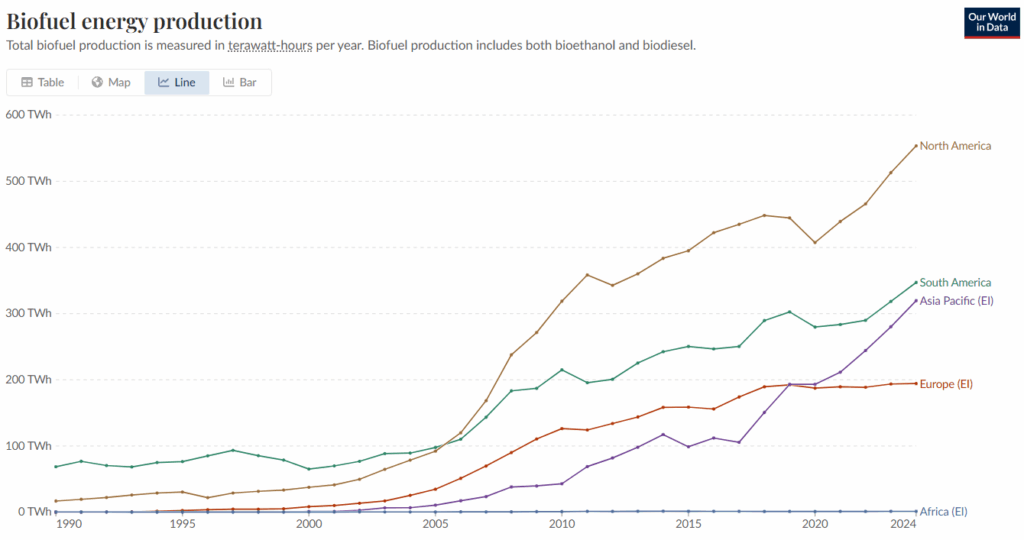
Source: Our World in Data
Data Table
| 1990 | 2000 | 2010 | 2020 | 2024 | |
|---|---|---|---|---|---|
| Africa | 0.31 TWh | 0.07 TWh | 0.82 TWh | 0.97 TWh | 1.15 TWh |
| Asia Pacific | 0.00 TWh | 1.00 TWh | 42.82 TWh | 193.14 TWh | 319.57 TWh |
| Europe | 0.07 TWh | 8.13 TWh | 126.24 TWh | 187.47 TWh | 194.29 TWh |
| North America | 16.73 TWh | 37.57 TWh | 318.85 TWh | 407.46 TWh | 553.64 TWh |
| South America | 68.51 TWh | 65.07 TWh | 215.08 TWh | 279.75 TWh | 347.18 TWh |
Answer Key: Question 1: From 1990 to 2000, South America had the highest biofuel energy production. From 1990 to 2024, South America increased its production by 278.67 TWh (347.18 – 68.51 = 278.67).
Question 2: Answers may vary. (Example: In 2020, Europe only increased its biofuel energy production by 6.82 TWh (194.29 – 187.47 = 6.82). In the same time frame the Asia-Pacific region increased its production by 126.43 TWh (319.57 – 126.43 = 126.43), a much bigger jump! This suggests that Asia-Pacific is focused on increasing biofuel production and technology, while Europe may be already stable or focusing on other energy sources.)
Question 3: Answers will vary. (Example: Africa may not have as much technology or funding to turn crops into biofuels. The main use of crops may also be for food, not energy. Also, there may not be enough factories, equipment, or trained workers to produce biofuel on a large scale.)
Question 4: Answers will vary. (Example: I think biofuel energy will keep growing, because the graph shows that every region increased its production since 1990, and some regions are growing very fast.)
A Bioenergy Challenge Hands-On
Instructions: Use the A Bioenergy Challenge Hands-On – Student Handout and the following Teacher Guide to conduct the activity.
Introduction
In this hands-on activity, students will analyze real-world data to design a feasible plan to increase the use of bioenergy in a town. They will evaluate trade-offs, select technologies, calculate energy output, and present their plans visually.
Student Objectives
Students will be able to
- Analyze biomass resources and processing technologies.
- Apply basic math to estimate energy output.
- Evaluate trade-offs and limitations of bioenergy.
- Collaboratively develop and present a realistic energy plan.
Materials
- Student Handout
- Poster paper or tools to make a digital poster
- Markers, calculators
Overview
Build a Bioenergy Plan for Springville (included in Student Handout)
The town of Springville wants to expand its energy sources by using more bioenergy—energy made from organic waste and plant materials. Your team’s job is to create a plan that shows:
- How Springville can turn local waste or crops into useful energy, like electricity or fuel.
- What equipment or technology the town will need to make that energy.
- What kind of investment or partnerships the town might need to build or share this infrastructure.
Use Springville’s energy profile and available resources to design a plan that’s realistic, efficient, and benefits the community.
Procedure:
- Divide students into groups of 2 or 3, and provide each group with the Student Handout. Introduce bioenergy and key terms (Optional: Watch Introduction to Bioenergy video). Show students the town profile (below and also included in the Student Handout) and explain that the town wants to diversify its energy sources by increasing biofuel use.
| Town Energy Profile: Springville |
|---|
| – Population: 5,000 – School community greenhouse: 1; uses an average of 30 kWh of electricity per day – School buses: 8; each uses an average of 10 gallons (38 litres) of diesel per day – Municipal FFV (Flex-Fuel Vehicles*): 8; each uses an average of 2.5 gallons (9.5 litres) of E85 fuel per day – Fast food restaurants: 3; each produces an average of 20 lbs (9 kg) of grease per day – Dairy cows: 200; each produces an average of 100 lbs (45 kg) of manure per day – Corn farms: 300 acres; produces an average of 3 U.S. tons (2.7 metric tonnes) of stalks per acre, per year |
*A flex-fuel vehicle is a type of car or truck that can run on more than one type of fuel—usually a blend of gasoline and ethanol, such as E85, which is 85% ethanol and 15% gasoline. These vehicles have specially designed engines and fuel systems that can automatically adjust to different fuel mixtures, allowing drivers to use either pure gasoline, E85, or any mix in between. This flexibility can reduce reliance on fossil fuels and lower greenhouse gas emissions.
- All student groups will work from the same town profile (Springville), but choose different investigations (below and also included in the Student Handout).
| Springville Bioenergy Investigations |
|---|
| 1. Can the school greenhouse run on cow manure biogas? 2. Can restaurant grease biodiesel fuel Springville’s school buses? 3. Can ethanol from corn stalks fuel the town’s municipal FFV vehicles? 4. Create your own investigation question! Make sure to get it approved by the teacher first, before moving to the next step. |
- Also included in the Student Handout are data tables with more information about the biomass resources and system costs. Each group will choose an investigation, and then follow the Student Handout to build a bioenergy plan for the town of Springville.
- Once completed, students will create a visual model or diagram of their Springville bioenergy proposal (using physical poster paper or making a digital poster, at teacher discretion), showing how bioenergy will flow from source to processing to use, including their calculations and reasoning.
- As an optional extension, each team can present their plan to the class, explaining and defending their plan and decisions. Each group can share how their bioenergy plan works, their calculations and reasoning, benefits and trade-offs, and why their group’s plan is a smart choice for Springville.
Assessment Rubric
| Criteria | Excellent | Good | Developing | Needs Work |
|---|---|---|---|---|
| Data Usage | Uses data accurately in calculations and decisions; demonstrates strong understanding of quantities and units | Minor errors or omissions in data use; shows understanding of quantities and units | Data used inconsistently or with major errors; shows lack of understanding of quantities and units | Limited or no use of data; inaccurate or missing calculations |
| Design Logic | Plan is realistic and well thought-out; parts fit together logically and choices are clearly explained | Plan mostly makes sense with minor gaps in reasoning or explanations | Plan includes unrealistic, unclear or weakly connected elements | Plan is confusing or impractical; poor to no explanation of reasoning |
| Design Challenges | Plan clearly identifies and explains key limitations and trade-offs | Plan mentions at least one trade-off or limitation with some explanation | Touches on challenges but lacks depth or clarity in explanation | Ignores potential challenges; plan appears overly ideal or unrealistic |
| Visual Plan | Diagram poster is clearly detailed, well-labeled, and creatively presented; energy flow is easy to follow | Diagram poster is mostly clear and complete with some creative elements; minor labeling issues | Diagram poster lacks clarity or visual organization; limited creative elements | Visual is messy, unclear, or incomplete; lacks effort or originality |
| Collaboration | Group worked together efficiently and respectfully; all members contributed and shared ideas | Group worked mostly well together and participated equally, with minor issues | Some collaboration occurred; uneven participation | Little to no collaboration |
| (Optional) Presentation and Defense | Clear, confident presentation, with strong explanation and defense of decisions | Clear presentation with good explanations of reasoning and defense of decisions, with minor omissions | Weak presentation, with limited explanation or unclear defense | Poor or no explanation or defense of choices |
Answer Key
The Student Guide contains the A Bioenergy Challenge – Student questions.
Student investigation answers will vary based on their investigation question. Below are sample student answers using the investigation question, “Can ethanol from corn stalks fuel the town’s municipal FFV vehicles?”
4. Can ethanol from corn stalks fuel the town’s municipal FFV vehicles?
5A. Corn stalks
5B. There are 300 acres, and each acre produces 3 U.S. tons of corn stalks per year. 300 x 3 = 900 U.S. tons of corn stalks per year.
6A. Ethanol
6B. Ethanol refinery
6C. No, Springville doesn’t have the financial resources to build its own ethanol refinery. Springville would need to partner with nearby towns, a company, or a regional facility to share the cost and processing.
7. Springville produces 900 U.S. tons of corn stalks per year, and 20 gallons of ethanol can be produced per ton of corn stalks. 900 x 20 = 18,000. Springville can produce 18,000 gallons of ethanol per year from its corn stalks.
8A. The town has 8 municipal FFV vehicles, which altogether use 20 gallons of E85 fuel per day (8 x 2.5 = 20). The total demand of E85 fuel per year for municipal vehicles is 7,300 gallons (20 x 356 = 7,300). Since E85 is 85% ethanol, the ethanol demand per year is 6,205 gallons (7,300 x 0.85 = 6,205).
8B. Yes. Using all its corn stalks, Springville could produce 18,000 gallons of ethanol a year, but only needs 6,205 gallons for its FFV fleet. That means the town could meet 100% of its ethanol demand for FFVs, and have plenty left over.
9A. Access to an ethanol refinery, as well as a collection and transport system for corn stalks from farms.
9B. Outside support is needed. Springville needs to partner regionally or apply for state or federal funding to access a refinery.
9C. Government grants, regional partnerships and local investment.
9D. (1) Apply and (hopefully receive) state and federal government grants that can help with building up local systems (such as a collection and transport system for corn stalks from farms). (2) Contact neighboring towns to form a regional bioenergy partnership to build an ethanol refinery. (3) Reach out to local farms and businesses to invest in the project, and host a community meeting to educate and build support.
10. Advantages: Results in less vehicle emissions compared to regular fuel; uses agricultural waste, no new crops needed; potential local jobs; economic and business opportunities
Disadvantages: Big expense of building an ethanol refinery; regional cooperation needed; transportation of stalks may add cost and logistics; it will take time to plan and build partnerships
11. To power its municipal FFV vehicles, Springville can use corn stalks from its 300 acres of farms to make ethanol, a fuel that burns with fewer emissions than regular fuel. With about 900 tons of stalks per year, the town can produce 18,000 gallons of ethanol, which is more than enough to cover the 6,205 gallons needed by its FFV fleet annually. There is huge potential for local farmers and businesses to switch to FFV vehicles using the extra ethanol produced. However, Springville does not have the resources to build a full ethanol refinery alone, so we recommend forming a regional partnership with neighboring towns, who also want to process their corn stalk waste into ethanol. We can also apply for government grants to access an ethanol refinery and build a transportation system. This plan has a high upfront cost, but will be cost-effective over time, and help Springville lower emissions and support its local agricultural community.
Exit Ticket
Instructions: Access the Exit Ticket and have students reflect on and answer the prompt.