

Bell Ringer
Instructions: Select one of the Bell Ringers for students to reflect on and answer.
Vocabulary List
Instructions: Go over important terms and their definitions before watching the Introduction to the Electric Grid video. The student vocabulary list can be found in the Student Guide and Introduction to the Electric Grid – Starter Pack.
| Word | Definition | Example |
|---|---|---|
| Generator | noun; a machine that converts mechanical energy into electrical energy | “Ninety-nine percent of the electricity for homes, schools, buildings and factories is made in power plants by generators.” |
| Transmit | verb; to send or carry energy or signals from one place to another | “Then it’s transmitted across a massive network we call the electric grid.” |
| Electric Grid | noun phrase; a network of power plants, wires, and equipment that distribute electricity to homes and businesses | “Then it’s transmitted across a massive network we call the electric grid.” |
| Voltage | noun; the force that pushes electric current through a wire or circuit | noun; the force that pushes electric current through a wire or circuit “The generator makes electricity, which gets stepped up into extremely high voltage . . .” |
| Power Lines | noun phrase; wires that carry electricity over large distances from power plants to homes and businesses | “ . . . and then moved across long distances by large power lines.” |
| Distribution Center | noun phrase; a facility in the electric grid that steps high-voltage electricity down and sends it to smaller substations for local delivery | “These go to a distribution center, which steps the voltage down, and sends it out to many smaller substations.” |
| Substation | noun; a facility that lowers voltage from high-voltage transmission lines so electricity can be safely used | “These go to a distribution center, which steps the voltage down, and sends it out to many smaller substations.” |
| Transformer | noun; a device that increases or decreases the voltage of electricity | “Transformers step it down yet again to a household voltage, where it finally goes in your home for use.” |
| Utility Operator | noun phrase; a person or company that manages the delivery of electricity to customers | “This long journey is controlled by utility operators . . .” |
| Regulator | noun; a person or organization that sets and enforces rules for energy systems | “ . . . which are overseen by a regulator.” |
| Quantities | noun; amounts or numbers of something that can be measured | “Remember that electricity can’t be stored in huge quantities, so we have to generate it right when we need it.” |
Quiz and Cloze Notes
Instructions: Review key concepts after watching the Introduction to the Electric Grid video. The Student Guide and Introduction to the Electric Grid – Starter Pack contains the quiz and cloze notes.
Quiz Answer Key: Q1:D Q2:C Q3:B Q4:A
Cloze Notes Answer Key: power plants, generators, grid, stepped up, stepped down, stored, predict, direct
Data Set
Instructions: Provide students with the Introduction to Introduction to the Electric Grid – Data Set for data literacy and analysis practice.
Data Table 1: Electricity Total Net Generation, Annual (billion kWh)
| Region | 2021 (billion kWh) | 2022 (billion kWh) | 2023 (billion kWh) |
|---|---|---|---|
| Africa | 893 | 904 | 909 |
| Eurasia | 1,652 | 1,599 | 1,587 |
| Europe | 3,736 | 3,635 | 3,522 |
| Asia and Oceania | 13,672 | 14,271 | 14,946 |
| Middle East | 1,372 | 1,418 | 1,463 |
| Central & South America | 1,366 | 1,386 | 1,403 |
| North America | 5,148 | 5,248 | 5,194 |
Data Table 2: Total (Electricity) Distribution Losses, Annual (billion kWh)
Distribution losses are defined as all losses due to transport of electrical energy and heat through electric grids. Note: The standard for countries for which data are not available, electricity transmission and distribution losses are estimated as being about 7% of total net electricity generation.
| Region | 2021 (billion kWh) | 2022 (billion kWh) | 2023 (billion kWh) |
|---|---|---|---|
| Africa | 141 | 143 | 144 |
| Eurasia | 142 | 139 | 138 |
| Europe | 263 | 250 | 251 |
| Asia and Oceania | 819 | 810 | 853 |
| Middle East | 169 | 181 | 192 |
| Central & South America | 205 | 209 | 209 |
| North America | 278 | 278 | 265 |
Reference List: Major Countries & Territories in Each Region*
Africa includes: Angola, Congo Brazzaville, Algeria, Egypt, Gabon, Ghana, Equatorial Guinea, Kenya, Libya, Morocco, Mozambique, Nigeria, Sudan, South Sudan, Chad, Tunisia, Tanzania, Uganda, South Africa
Eurasia includes: Azerbaijan, Georgia, Kazakhstan, Moldova, Russia, Turkmenistan, Ukraine, Uzbekistan
Europe includes: Cyprus, Germany, Spain, Estonia, France, UK, Italy, Lithuania, Latvia, Netherlands, Norway, Poland, Romania, Turkiye
Middle East includes: UAE, Bahrain, Iran, Iraq, Israel, Jordan, Kuwait, Lebanon, Oman, Palestinian Territories, Qatar, Saudi Arabia, Syria, Yemen
Central and South America includes: Argentina, Bolivia, Brazil, Chile, Colombia, Cuba, Ecuador, Guyana, Panama, Peru, Puerto Rico, Trinidad and Tobago, Venezuela, U.S. Virgin Islands
North America includes: Canada, Mexico, United States
*Countries with available analysis on EIA.gov
Answer Key: Question 1: Overall, global electricity generation is generally increasing because most regions show growth from 2021 to 2023. However, there are two regions that show a decrease from 2021 to 2023: Eurasia (1,652 to 1,587 billion kWh) and Europe (3,736 to 3,522 billion kWh). While North America’s electricity generation increased overall from 2021 to 2023, it decreased from 2022 to 2023 (5,248 to 5,194 billion kWh).
Question 2: The region with the biggest increase in electricity generation from 2021 to 2023 is Asia and Oceania, increasing by 1,247 billion kWh. The region with the biggest increase in distribution losses is also Asia and Oceania, with a loss increase of 34 billion kWh.
Question 3: Regions losing less than 7% of their electricity during distribution in 2023 are Asia and Oceania (853/14,946 = 5.7%) and North America (265/5,194 = 5.1%).
Question 4: Regions with more than 10% losses in 2023 are Africa (144/909 = 15.8%), the Middle East (192/1,463 = 13.1%), and Central and South America (209/1,403 = 14.9%). Some possible reasons for higher losses include aging or poorly maintained infrastructure, energy theft or illegal connections, extreme heat, and economic constraints.
Question 5: Answers will vary.
Designing an Electric Grid Hands-On
Instructions: Use the Designing an Electric Grid Hands-On – Student Handout and the following Teacher Guide to conduct the activity.
Introduction
Designing an Electric Grid is a hands-on, creative STEM activity that helps students demonstrate their understanding of how electricity travels from power plants to homes, schools, and businesses. Using colored yarn to represent different voltage levels, students construct a visual model of an electric grid while applying key concepts such as generation, transmission, substations, transformers, and distribution. This activity supports systems thinking, engineering design, and energy literacy.
Student Objectives
Students will be able to
- Identify and describe the major components of the electric grid.
- Illustrate how voltage changes as electricity moves through the grid.
- Construct a simplified model of an electric grid using labeled elements and color-coded lines.
- Explain how transformers step voltage up or down depending on grid needs.
- Communicate their design choices through presentation and discussion.
Materials
- Student Handout
- Yarn in 4 colors:
- Red: highest voltage (230-765 kV)
- Orange: high voltage (10-30 kV)
- Yellow: medium voltage (5-25 kV)
- Green: low voltage (120-480 V)
- Large poster paper or cardboard box opened up to lay flat
- Tape
- Scissors
Electrical Power Transmission System
(also included in the Student Handout)
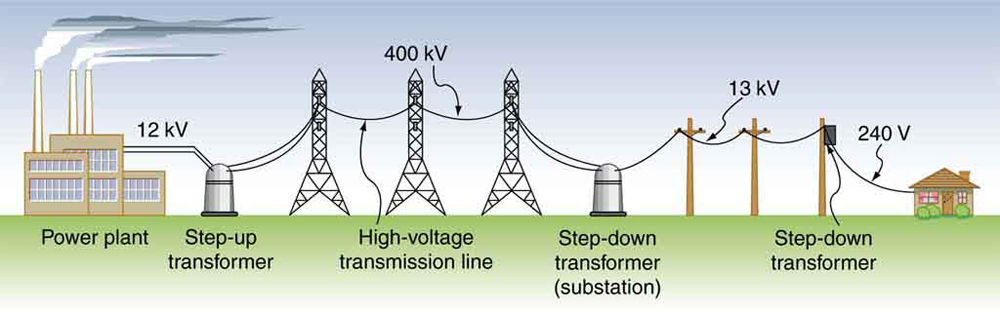
Transformers adjust electrical voltages at different stages of the power grid. Electricity is produced at power plants at voltages typically between 10 and 30 kilovolts (kV). For long-distance transmission, the voltage is increased to very high levels, often 230 kV to 765 kV, and sometimes even higher for special long-distance HVDC lines, to reduce energy losses.
When electricity reaches a regional substation near the point of use, the voltage is stepped down and sent through local distribution lines at about 5 to 25 kV. Finally, smaller transformers reduce the voltage again to the levels needed for homes and businesses, such as 120-240 volts for residences or 208–480 volts for commercial and industrial users.
High voltage is great for moving electricity efficiently over long distances, but it’s not safe to use directly in neighborhoods or buildings. Very high voltage can jump through the air (arc), overheat equipment, and seriously injure people. That’s why the grid includes multiple transformers and substations: they gradually lower the voltage to safe levels before it reaches homes, schools, and other places where people live and work.
Key Terms
Transmission Lines: High-voltage lines that move electricity long distances.
Distribution Lines: Lower-voltage lines that bring electricity to homes and buildings.
Transformer: A device that changes (steps up or steps down) voltage.
Substation: A facility where voltage is transformed and electricity is routed.
Voltage: The electrical “pressure” that pushes electrons through wires.
Grid: A system of connected power plants, lines, and equipment that delivers electricity to users.
Procedure
- Set-Up
- Decide whether students will work on this project individually, in pairs, or in larger groups. Provide each student or student group with a copy of the Student Handout.
- Arrange yarn, scissors, and tape on a materials table for student access.
- Introduction
- Direct student attention to the first part of the Student Handout that shows a diagram and explanation of the Electrical Power Transmission System.
- Ask a guiding question:
- What happens at each stage of the grid?
- Why does voltage change as electricity moves through the system?
- What do you notice about where high vs. low voltage is used?
- Guide students to the materials’ table and introduce the project using the Student Handout.
- Electric Grid Activity
- Starting with the poster paper or cardboard, students sketch their electric grid, creating transmission and distribution pathways.
- Students label all the required elements from the Electric Grid Components Table.
Required Electric Grid Components Table
| Component | Quantity | Notes |
|---|---|---|
| Power Plants | 2-3 | Label energy sources (e.g., natural gas, solar, hydro, etc.) |
| Step-Up Transformers | 2-3 | One per power plant |
| Transmission Lines | 3-4 | Red yarn; long distance |
| Regional Substations | 2-3 | Connect to population areas |
| Distribution Transformers | 3-5 | Step down to safe voltages |
| Medium Voltage Lines | 2-3 per substation | Yellow yarn |
| Low Voltage Lines | 1-2 per transformer | Green yarn |
| Houses | 6-10 | Residential loads |
| Schools | 1-2 | Higher-demand buildings |
| Commercial Buildings | 4-6 | Mixed energy needs |
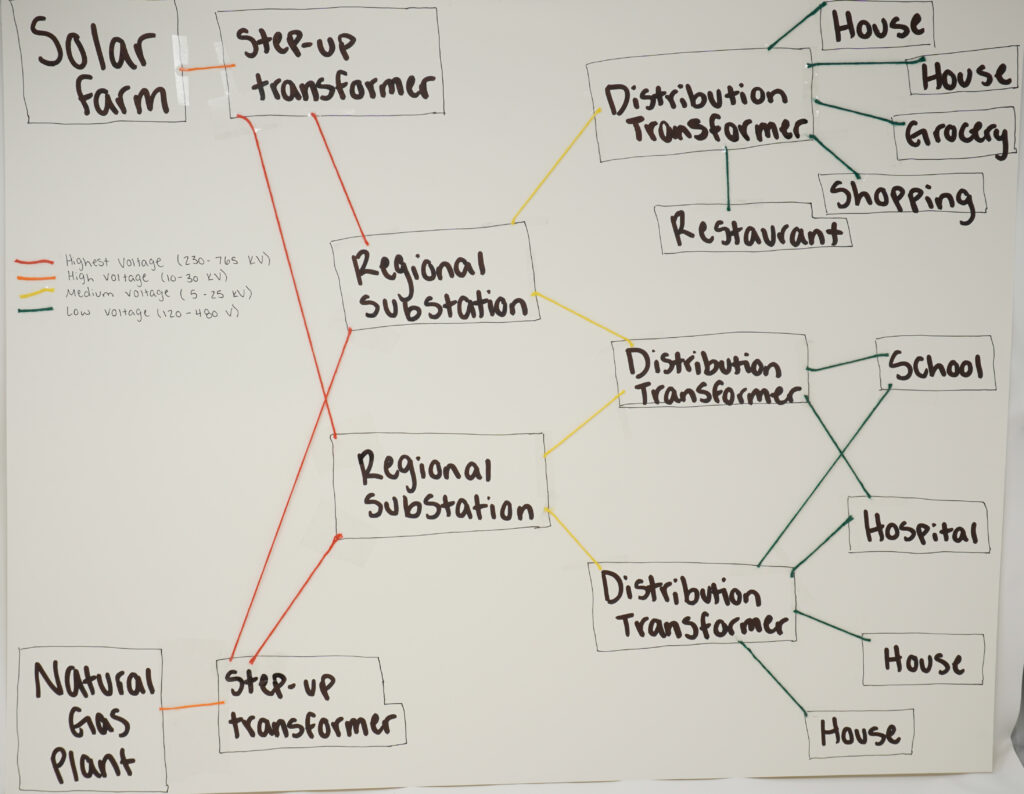
- Using the correct yarn colors, students create transmission and distribution pathways, from the power plant to the end receivers (house, school, commercial building).
- Students add a key to the yarn colors, title their electric grid, and ensure all components are visible and labeled.
- Reflection
- Display finished designs around the room. Conduct an optional gallery walk for students to give each other feedback.
- Direct students to complete the reflection questions in the Student Handout.
Assessment Rubric
(also included in Student Handout)
| Criteria | Excellent | Proficient | Developing |
|---|---|---|---|
| Grid Components | All required components included, clearly labeled, and accurately represented. | All required components included, mostly labeled and accurately represented. | Missing or unclear components or labels. |
| Voltage Representation | Yarn colors used correctly throughout with accurate voltage transitions. | Mostly correct yarn usage throughout with minor errors. | Several inaccuracies with voltage transitions or color use. |
| Organization & Design | The layout is neat, logical, and easy to follow. | The layout is mostly neat, logical, and clear. | The layout is difficult to follow or incomplete. |
| Reflection & Reasoning | Choices are explained clearly and demonstrate strong understanding of main concepts. | Choices are explained clearly and demonstrate understanding of main concepts, with minor gaps. | Explanations show partial or limited understanding of main concepts. |
Student Example
Exit Ticket
Instructions: Access the Exit Ticket and have students reflect on and answer the prompt.