

Bell Ringer
Instructions: Select one of the Bell Ringers for students to reflect on and answer.
Vocabulary
Instructions: Go over important terms and their definitions before watching the Science of Energy Storage video. The student vocabulary list can be found in the Student Guide and Science of Energy Storage – Starter Pack.
| Word | Definition | Example |
|---|---|---|
| Electrons | noun; tiny particles with a negative charge that move through atoms and create electricity | “Electricity is the flow of electrons . . .” |
| Commercial | adjective; related to buying, selling, or using something for business purposes | “Today’s batteries are too expensive and low-powered to work at a huge commercial scale.” |
| Generator | noun; a machine that converts mechanical energy into electrical energy | “We could have [electricity] whether the generators are going or not.” |
| Fleet | noun; a group of similar machines, vehicles or facilities managed and operated together | “Today we have a whole fleet of power plants that we ramp up and turn off to follow electricity demand.” |
| Baseload Power | noun phrase; the minimum amount of electricity that is always needed on the grid | “Keeping plants running continuously like we do with baseload power is efficient and cheaper.” |
| Power Plant | noun; a facility that produces electricity for homes, businesses, or industries | “With affordable energy storage, we can generate power whenever and however it’s cheapest, and then use storage, not power plants, to follow demand.” |
| Flywheel | noun; a heavy, rotating device that stores energy and helps keep machines running smoothly | “The same can be done with compressed air, flywheels, or advanced capacitors.” |
| Capacitor | noun; a device that stores and releases electrical energy in a circuit | “The same can be done with compressed air, flywheels, or advanced capacitors.” |
| Utility-Scale | adjective; large enough to supply electricity to a grid, not just individual homes or buildings | But, if we could invent affordable, utility-scale storage, it would completely change the way we make, and use, electricity.” |
Quiz
Instructions: Review key concepts after watching the Science of Energy Storage video. The Student Guide and Science of Energy Storage – Starter Pack contain the quiz.
Answer Key: Q1:A Q2:C Q3:C Q4:B
Reading and Extended Reading
Instructions: Provide students with the Science of Energy Storage – Reading or Extended Reading infosheet for an in-depth exploration of the topic.
Reading Answer Key:
- Because wind and solar do not produce electricity all the time, storage helps save extra energy for later use.
- Lithium-ion battery.
- It pumps water uphill when electricity is available and lets it flow back down through turbines to generate electricity when needed.
- Molten salt storage.
- Electric charge.
- Lead dioxide and metallic lead.
- Sodium is more common and less expensive than lithium.
- Water is split into hydrogen and oxygen using electricity.
- It is expensive and not very efficient yet.
- Compressed air energy storage.
- In places with hills or mountains and access to water.
- They do not overheat easily and use safe, low-cost materials.
- Zinc batteries or flow batteries might work well because they are safe and designed for stationary use.
- It allows solar energy to be stored as heat and used even after the sun goes down.
- Because different systems work better in different places, for different needs, and over different time periods.
Extended Reading Answer Key:
- Lithium-ion battery
- Electricity is used to pump water to an upper reservoir. When energy is needed, the water flows back down through turbines to generate electricity.
- Because these sources do not produce energy all the time, storage is needed to save energy when it is available and use it later when demand is higher.
- Molten salt thermal energy storage
- Flow batteries can be scaled easily and have long lifespans because the energy is stored in external liquid tanks, separate from the power components.
- It is expensive, less efficient, and the technology is still being developed for large-scale use.
- Pumped storage hydropower
- Supercapacitors charge and discharge much faster than lithium-ion batteries.
- Sodium-ion batteries and zinc batteries
- They are inexpensive, reliable, and good for short-term backup power.
- Molten salt storage
- Mechanical systems use motion or position (like water or air), while electrochemical systems use chemical reactions in batteries.
- Flow batteries or zinc batteries might be practical due to safety and long-duration storage, especially if reliable infrastructure is not present.
- They are less flammable and may be safer to use in certain conditions.
- Supercapacitors, because they can charge and discharge very rapidly.
Computation
Instructions: Provide students with the Science of Energy Storage – Computation activity for math integration and practice.
Key Terms
- LCOS (Levelized Cost of Storage): The average cost to store 1 kilowatt-hour (kWh) of electricity.
- % LCOS Change: How much cheaper (or more expensive) the technology becomes after innovation.
- Innovation Portfolio Cost: The cost (in millions of dollars) to develop the improvements.
- Implementation Duration: How many years it takes to put innovation into practice.
Table of Technologies
| Technology | LCOS ($/kWh) after innovation | % LCOS Change from baseline | Innovation Portfolio Cost ($M) | Implementation Duration (Years) |
|---|---|---|---|---|
| Flow Batteries (FBs) | $0.055 | -66% | 325 | 10 |
| Lead-acid Batteries (PbAs) | $0.086 | -77% | 176 | 7 |
| Lithium-ion Batteries (LIBs) | $0.070 | -51% | 1,063 | 10.5 |
| Sodium-Ion Batteries (NaIBs) | $0.255 | -54% | 244 | 11 |
| EDLC Supercapacitors | $0.337 | -24% | 86 | 5.5 |
| Zinc (Zn) Batteries | $0.082 | -45% | 155 | 6 |
| Hydrogen Storage (above ground) | $0.160 | -33% | 491 | 9.5 |
| Hydrogen Storage (below ground) | $0.115 | -12% | 400 | 9.5 |
| Compressed Air Energy Storage | $0.026 | -60% | 745 | 7.5 |
| Pumped Storage Hydropower | $0.022 | -85% | 570 | 8 |
| Molten Salt Thermal Energy Storage | $0.112 | -17% | 759 | 7 |
Source: DOE
Answer Key: Q1: Pumped Storage Hydropower ($0.022/kWh) and Compressed Air Energy Storage ($0.026/kWh)
Q2: Pumped Storage Hydropower (85% reduction) and Lead Acid Batteries (77% reduction)
Q3: EDLC Supercapacitators (5.5 years) and Zinc Batteries (6 years)
Q4: LCOS = $0.082/kWh; Calculation: 500,000 × 0.082 = $41,000
Q5: Zinc duration = 6 years, Sodium-ion = 11 years; Calculation: 11 – 6 = 5 years
Q6: LIBs cost = $1,063M, PbAs = $176M; Calculation: 1,063 – 176 = $887 million
Q7: LCOS = $0.086/kWh; Calculation: 1,000,000 × 0.086 = $86,000
Q8: Final = Original × (1 – 0.51); 0.070 = Original × 0.49; Original = 0.070 / 0.49 = $0.143/kWh
Q9: Final = Original × 0.76; 0.337 = Original × 0.76; Original = 0.337 / 0.76 = $0.443/kWh
Q10: LIBs = $0.070, Zinc = $0.082, Sodium-ion = $0.255 Answer: LIBs < Zinc < Sodium-ion
Data Set
Instructions: Provide students with the Science of Energy Storage – Data Set for data literacy and analysis practice.
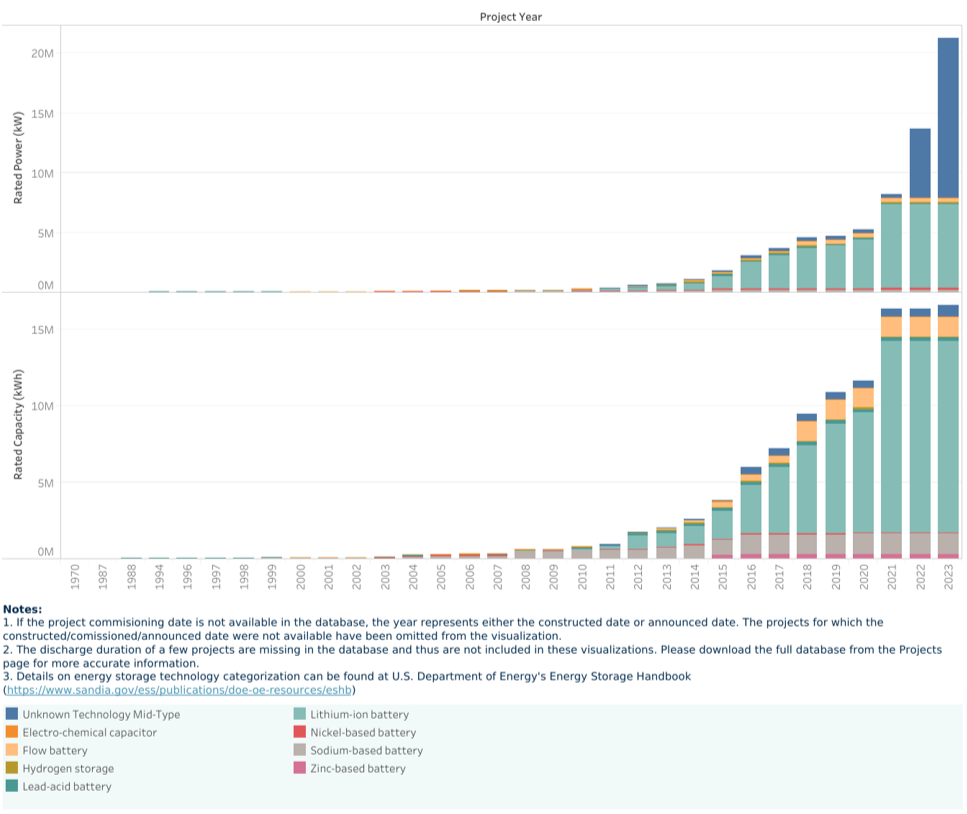
Cumulative Sum of Energy Storage Installations by Year
Source: DOE
The graph above displays the rated power (top graph) and rated capacity (bottom graph) of several different energy storage methods.
Rated power refers to the instantaneous rate at which energy can be transferred in or out of the storage system. This indicates the system’s ability to handle peak loads and provide quick bursts of energy. A system with a high power rating can quickly discharge to meet a sudden increase in demand or provide power during a grid outage.
Rated capacity is the total amount of energy the system can store and release before needing to be recharged or replenished. This value determines how long the system can sustain its power output before needing to be recharged. A system with a high energy capacity can provide power for an extended period, such as several hours, before requiring a recharge.
In essence, power capacity is about the speed of energy delivery, while energy capacity is about the duration of delivery. When choosing an energy storage system, it’s crucial to consider both the power and capacity ratings to ensure it meets the specific energy needs of the application.
Answer Key: Question 1: Answers will vary. (Example: Before 2010, the growth in energy installations was slow, and after around 2015, there was much faster growth. This rapid increase could be due to falling battery costs, improved technology, and growing demand for storage to support renewable energy like solar and wind. Government incentives and climate priorities might also have helped.)
Question 2: Answers will vary. (Example: Some storage projects may not have detailed technology available – especially older projects, international entries, or ones from private companies that didn’t report specifics. This makes it harder to know which storage types are most commonly used or growing fastest. It limits our ability to understand trends by technology and makes it harder to plan for future needs.)
Question 3: Answers will vary. (Example: The increase in energy storage installations likely reflects the growing need to store energy from solar and wind so it can be used when the sun isn’t shining or the wind isn’t blowing. Storage helps balance the energy supply and demand, making wind and solar energy more reliable. The rising trend suggests that energy storage is becoming a key part of electricity systems with variable generation.
Question 4: Answers will vary. (Example: Challenges might include shortages of materials like lithium or cobalt used in batteries, which can drive up costs. There may also be issues with safely recycling or disposing of used batteries. On the grid side, adding lots of storage capacity requires updates in infrastructure, and smart control systems to manage it effectively.)
Question 5: Answers will vary. (Example: Different technologies are good for different tasks. For example, lithium-ion batteries are great for short-term energy use, while pumped hydro can store large amounts for longer periods. If we relied on only one type, we might run into problems with cost, material shortages, or technical limitations. A diverse mix makes the system more flexible, resilient, and able to meet different kinds of energy needs.)
Exploring Energy Storage Efficiency Lab
Instructions: Use the Exploring Energy Storage Efficiency Lab – Student Handout and the following Teacher Guide to conduct the lab activity.
Introduction
This lab simulation introduces students to real-world energy storage methods—batteries, supercapacitors, and pumped hydro—and guides them through designing an experiment to evaluate energy storage efficiency using real-world-style data. Students will not perform a physical lab. Instead, they will practice experimental design and analyze hypothetical data to draw conclusions about performance and application. This blends data literacy, systems thinking, and scientific inquiry.
Student Objectives
Students will be able to
- Describe and compare different energy storage methods.
- Calculate and compare energy storage efficiencies using provided data.
- Design a simulated experiment with clear hypotheses and controls.
- Analyze trends, variation, and trade-offs in energy storage.
- Evaluate implications of storage efficiency in the context of hydropower, solar, and wind energy systems.
Materials
- Student Handout
- Energy Storage Reading or Extended Reading (provides students with background information on Li-ion batteries, supercapacitors, and pumped hydro energy storage methods).
- Research tools (such as online access)
- Calculator (optional)
Procedure
- Introduce the challenge with a discussion on energy storage. Example opening questions include “Why is energy storage important for energy sources such as wind and solar?” and “What does ‘efficiency’ mean in the context of energy storage efficiency?”
- Review background information on three energy storage systems: Li-ion batteries, supercapacitors, and pumped hydro. Note their function, uses, and efficiency characteristics.
- Have students work through the Student Handout (individually or in groups of 2 or 3) to choose a storage method and use the design template to plan a hypothetical test of its efficiency.
- Students will most likely need some time to further research their chosen energy storage method before they write their design plan.
- Working further in the Student Handout, students will analyze a provided data table and calculate trial efficiencies and averages.
- At the end of the Student Handout are reflection questions that students will complete, discussing which systems are most efficient or most consistent, and relate their findings to real-world applications and limitations.
Answer Key
The Student Guide contains the Exploring Energy Storage Efficiency Lab – Student questions.
Answers will vary greatly based on the energy storage method students choose and the way they want to write the experiment procedure. Below are sample answers for the lab.
Step 1: Supercapacitor; I am choosing to investigate the supercapacitor because it charges and discharges energy very quickly, and I’m interested to learn more about the efficiency of such a powerful system.
Step 2: I think the supercapacitor will have very high efficiency (about 85-90%) because it stores energy electrostatically rather than chemically.
Step 3: Independent variable: supercapacitor; Dependent variable: energy output (kJ); Controls: input energy, room temperature, measurement equipment
Step 4: (1) Connect a supercapacitor to a regulated DC power supply. Set the power to a safe and appropriate voltage level that matches the rated voltage of the supercapacitator. (2) Attach a digital multimeter in series with the supercapacitor to measure total input energy once it is fully charged. (3) Connect the fully charged supercapacitor to a low-voltage light bulb. (4) Use the multimeter to measure the total energy output until the supercapacitor is discharged. (5) Record the values for input energy and output energy. Repeat the experiment at least three times. (6) Analyze variables and consistency by checking that input energy stays the same each time and output conditions are consistent; (7) Calculate the efficiency of each trial, and then calculate the average efficiency.
Step 5:
| Storage Method | Trial | Energy Input (kJ) | Energy Output (kJ) | Efficiency (%) |
|---|---|---|---|---|
| Supercapacitor | 1 | 1000 | 850 | 85 |
| Supercapacitor | 2 | 1000 | 870 | 87 |
| Supercapacitor | 3 | 1000 | 840 | 84 |
Step 6:
(1) The average efficiency is 85.3%.
(2) My results proved my hypothesis. I expected around 85-90% efficiency, confirming that the supercapacitor loses very little energy during storage and use.
(3) Looking at all of the data provided, the Li-ion battery had the highest average efficiency at 89.3%. This might be because chemical storage can return more energy slowly and steadily, reducing losses in some cases.
(4) Extreme temperatures; poor manufacturing quality; fast charging or overcharging; aging over time.
(5) Cost of the system; speed of energy release; size and weight; environmental impact and recyclability; safety under stress or failure; life cycle (how many times it can be charged)
(6) Supercapacitors are great for backup power systems, elevators, and flash cameras – anything that needs fast energy bursts and lots of recharge cycles.
(7) Since wind and solar produce energy intermittently, we must store excess energy when it’s available and use it later. High-efficiency systems make sure we don’t waste too much of that energy.
(8) I think hybrid systems that combine batteries and supercapacitors will be important. Batteries provide long-term energy and supercapacitors can handle sudden demands. Together, they can balance the needs of modern grids.
Exit Ticket
Instructions: Access the Exit Ticket and have students reflect on and answer the prompt.