

Introduction
In this St. Patrick’s Day–themed engineering challenge, students help a leprechaun retrieve a lost pot of gold by designing and building a wind-powered lift that raises a small load 11 inches using energy from a fan.
Students explore how wind energy is converted into rotational motion and how that motion can be used to perform mechanical work. The activity emphasizes the Engineering Design Process and highlights the relationship between blade pitch, torque, rotational speed, friction, and mechanical advantage. Students will test multiple prototypes, collect and analyze quantitative data, and refine their designs to improve performance.
Student Objectives
Students will be able to
- Apply the Engineering Design Process to solve a constrained problem.
- Design and construct a wind-powered lifting system.
- Describe how blade pitch, surface area, and blade number affect torque and speed.
- Identify and reduce sources of friction in a mechanical system.
- Conduct controlled testing and collect reliable data.
- Analyze performance data and propose design improvements.
Engineering Design Process Alignment
This activity follows a structured Engineering Design Process:
Ask: Define the problem and constraints.
Imagine: Brainstorm possible solutions.
Plan: Sketch and justify a design.
Create: Build a prototype.
Test: Conduct controlled trials and collect data.
Improve: Analyze results and redesign.
Materials
Per Group
- Student Handout
- Cardboard paper towel tube (to create an 11-inch-tall tower)
- Strong tape
- Green cardstock or cereal box cardboard (blades)
- Plastic straw or wooden dowel (axle)
- Optional: Cardboard scraps (for creativity/reinforcement)
- Optional: Markers or crayons for students to decorate the pieces
- Scissors
- Protractor
- Ruler
- 12 inches of string
- 1 small paper or plastic medicine cup
- 1 penny
For Testing
- Desk fan or box fan (fixed setting for all teams)
- Stopwatch
- Measuring tape or ruler
St. Patrick’s Challenge Scenario
Students are introduced to the problem through a design scenario involving a leprechaun whose “pot of gold” has fallen into a canyon. Teams must engineer a wind-powered lifting system to retrieve it.
The narrative provides engagement, but the engineering goal should be clearly stated:
Design a wind-powered turbine that lifts a 1-penny load 11 inches using only energy from the fan, within the given constraints.
Design Constraints
To ensure fair testing:
- Fan speed must remain constant for all teams (highest setting recommended for a desk fan).
- Distance from fan to turbine must remain constant (recommend 6 inches for desk fan).
- The tower must be at least 11 inches tall.
- The load must remain exactly 1 penny in the medicine cup.
- Only provided materials may be used.
- Students may not touch the turbine during testing.
Procedure
Steps 1-3: Define the Problem and Plan (Ask-Imagine-Plan)
- Divide students into groups of 2 or 3.
- Introduce the challenge scenario (also included in Student Handout).
- Facilitate a brief discussion on wind energy conversion and blade design variables.
- Students brainstorm and sketch a labeled design, including:
- Blade number
- Blade pitch angle (measured)
- Blade shape and size
- Predicted strengths and weaknesses
- Encourage students to justify their design decisions before building.
Step 4: Build Prototype (Create)
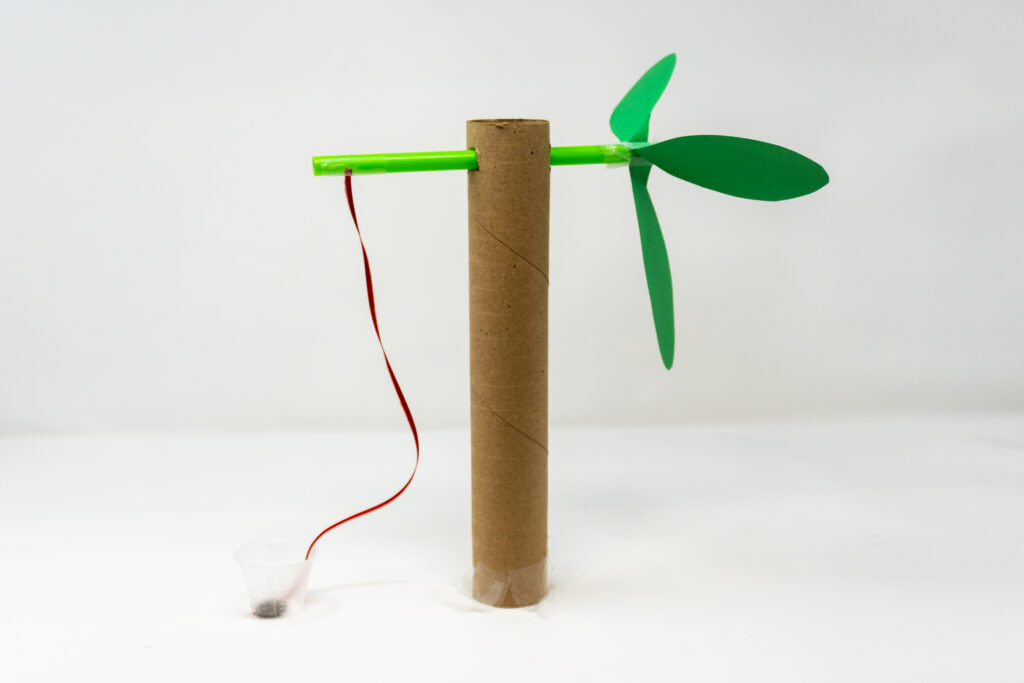
- Student teams will:
- Construct a vertical tower (11 inches).
- Install an axle that rotates freely.
- Attach blades at a measured pitch angle.
- Attach string to the axle and connect the medicine cup with one penny.
- Ensure string wraps smoothly around the axle.
- Monitor for axle alignment issues, excess friction points, blade imbalance, and structural instability.
Step 5: Testing and Data Collection (Test)
Testing should follow a consistent protocol:
- Place the turbine at the designated distance from the fan.
- Turn the fan on to the predetermined setting.
- Start timing when blades begin rotating.
- Stop timing when the cup reaches full height (or consider the trial completed if the cup stalls for more than 10 seconds).
- Conduct three trials per design.
- Students record the lift time, blade pitch angle, blade number, and observations.
Steps 6-7: Redesign and Retest (Improve)
- Based on data from testing, teams propose and sketch an improved design before rebuilding.
- Students test and collect data using their improved design.
- Students reflect on the process by answering the reflection questions.
Key Engineering Concepts to Emphasize
- Energy Transformations: Wind energy (kinetic energy) to rotational motion (mechanical energy).
- Higher blade pitch generally increases torque but reduces speed.
- More blades increase torque but may reduce rotational speed.
- Friction reduces efficiency.
- Failure provides data for improvement.
Optional Extensions
- Increase load to 3, 5, or 10 pennies and redesign.
- Calculate Work using (W = m x g x h)
- m = mass of pennies (in kg)
- g = 9.8m/s2
- h = 0.2794m (11 inches converted to meters)
- Calculate power using Power = Work / Time
- Introduce axle diameter variations to explore mechanical advantage.
- Compare performance across data sets.
Assessment Options (sections included in the Student Handout)
- Design sketch and justifications
- Data table accuracy
- Reflection on improvements