

Introduction
How can engineers build giant wind turbines in the middle of the ocean where the water is too deep to attach them directly to the seafloor? When ocean depths are over 60 meters, traditional fixed seafloor foundations become more difficult and expensive to use.
Offshore wind turbines are built in the ocean to capture strong, steady winds that can generate large amounts of electricity. Winds over the ocean are often faster and more consistent than winds on land, and offshore wind farms can produce energy near coastal cities where many people use electricity. In shallow water, wind turbines can be attached directly to the ocean floor. But in deeper water, engineers must design floating platforms that can support the turbine while staying upright in strong wind and waves.
The image below shows examples of floating offshore wind systems. These structures float on the surface of the ocean and are anchored to the seafloor using cables and mooring systems. Engineers must carefully design these systems so the turbines do not tip over, drift away, or sink while still allowing the blades to spin and generate electricity.
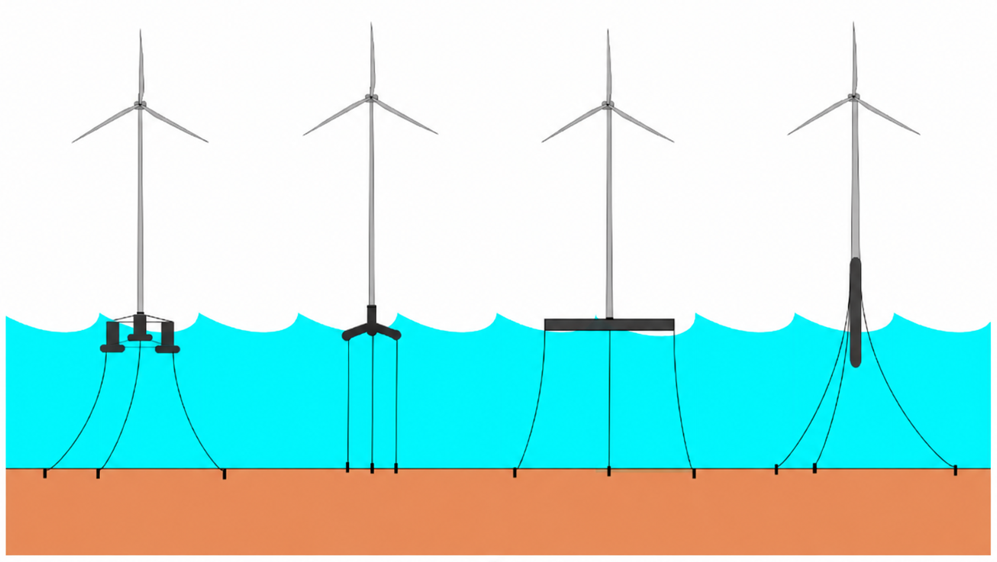
Image Citation: Damiani, R.; Song, H.; Kim, M.S. ‘Dynamics of Offshore Wind Turbine Foundation: A Critical Review and Future Directions.’ Journal of Marine Science and Engineering, vol. 9, no. 6, 2021, p. 589. Licensed under CC by 4.0.
Engineers must design offshore wind systems that:
– Float while supporting heavy equipment.
– Remain upright and balanced.
– Stay anchored in place.
– Allow the turbine blades to spin efficiently in the wind.
– Withstand wind, waves, and ocean movement.
In this challenge, you will act as an offshore wind engineer by designing, testing, and improving your own floating wind turbine platform!
Challenge: Float the Wind Turbine!
Your Mission: Design and build a floating platform that can hold a model wind turbine and stay upright in water without drifting, even when there are waves!
Design Requirements: Your design must:
- Float for the duration of testing.
- Hold the turbine upright.
- Allow the turbine blades to spin.
- Stay in place without drifting.
- Remain stable and recover from waves.
- Be at least 1 foot tall.
- Plan Your Design
Before building:- Brainstorm design ideas with your teammates.
- On a blank sheet of paper, sketch your team design.
- Label parts of your design with the materials you plan to use.
- Show your teacher your plan and get approval.
- Build Your Design
- Collect the building materials you will need.
- Build your floating wind turbine platform!
- Test Your Design
Conduct the following four tests and record your results in the data table provided.- Float Test
- Place the structure in the water.
- Time 10 seconds.
- Observe whether it floats steadily.
- Drift Test
- Use a fan to simulate wind.
- Set the fan at the designated distance and speed as directed by your teacher.
- Time 10 seconds.
- Observe whether the platform stays in place or drifts.
- Wind Test
- Adjust the fan’s angle so that it hits the turbine blades at the right spot.
- Set the fan at the designated distance and speed as directed by your teacher.
- Time 10 seconds.
- Observe whether the turbine spins continuously.
- Wave Test
- Teacher: Create small waves by gently sloshing the water or tapping the container.
- Time 10 seconds.
- Observe whether the platform tilts and recovers.
- Float Test
Round 1: Data Table
| Test | What to Observe | Result (circle one) | Evidence/Observations |
|---|---|---|---|
| Float Test | Did the structure float for 10 seconds? | Pass Needs Improvement | |
| Drift Test | Did the platform stay in place for 10 seconds without drifting*? | Pass Needs Improvement | |
| Wind Test | Did the turbine spin continuously for 10 seconds while staying upright? | Pass Needs Improvement | |
| Wave Test | During 10 seconds of waves, did the structure remain stable or recover after tilting? | Pass Needs Improvement |
- Improve Your Design
After testing, discuss your results with your team. Answer the following questions before rebuilding.
- What problems did your design have?
- What changes could improve stability or performance?
- Which materials or design features worked best?
- Round 2 Testing Data
Round 2: Data Table
| Test | What to Observe | Result (circle one) | Evidence/Observations |
|---|---|---|---|
| Float Test | Did the structure float for 10 seconds? | Pass Needs Improvement | |
| Drift Test | Did the platform stay in place for 10 seconds without drifting*? | Pass Needs Improvement | |
| Wind Test | Did the turbine spin continuously for 10 seconds while staying upright? | Pass Needs Improvement | |
| Wave Test | During 10 seconds of waves, did the structure remain stable or recover after tilting? | Pass Needs Improvement |
- Reflection
- Which design features helped your platform stay balanced or stable? Explain why they worked.
- Describe one major problem your team encountered during testing. What caused the problem?
- How did your redesign improve the performance of your platform? Use evidence from your testing results.
- If you could build a third version, what additional improvements would you make and why?
- How is this activity similar to the challenges real offshore wind engineers face?
- Which design features helped your platform stay balanced or stable? Explain why they worked.