

If you look at Earth from space, you’ll see a mysterious white spot on the west side of South America, in Bolivia. It’s so big that it looks like a flaw in the satellite photo. But it’s actually the world’s largest deposit of lithium, which has eroded from the Andes Mountains to form an enormous salt flat.
Lithium is a very special element. It’s the lightest metal, with an atomic number of 3. Only hydrogen and helium are lighter, and they’re gases. It’s also highly reactive, because its third electron, circling alone in an outer orbit, is eager to bond with other elements. These two qualities, light weight and reactivity, make it perfect for rechargeable batteries.
In fact, the lithium-ion battery has changed the world. It has allowed portable computers and mobile phones to become increasingly lighter and smaller, fundamentally altering the way we work, communicate, and access information.
Continued advances in lithium batteries are expected to make electric cars cheaper and lighter, with the ability to drive longer on a single charge. They may also lead to widespread power-grid batteries. These could provide better, more portable storage of electricity to stabilize the output of renewable energies, when the wind’s not blowing or the sun’s not shining.
This has made lithium a highly valuable commodity and could turn the Bolivian salt flat, once a remote tourist destination, into a powerful economic resource for the world.
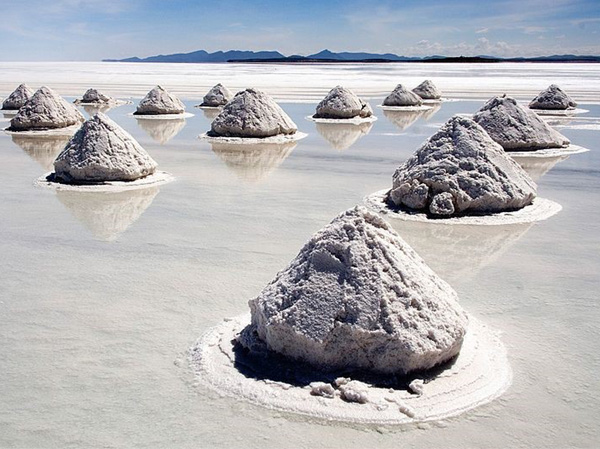
Piles of lithium-rich salts at the Salar de Uyuni in Bolivia.
Credit: Luca Galuzzi (Lucag), edit by Trialsanderrors via Wikimedia Commons (CC BY-SA 2.5 [http://creativecommons.org/licenses/by-sa/2.5]).
Background
Synopsis: Lithium-ion batteries have transformed the way people share and access information, and with the emergence of electric cars, lithium could challenge petroleum as the dominant portable-energy source of the future, as well as complementing renewable power grids for 24-hr reliability. Although it has a very reactive nature, lithium appears to calm mental disorders and provide beneficial health outcomes, as well.
With its very small size and extreme reactivity, lithium is a special element.
- Lithium is a soft, silver-white metal with the atomic number 3; only hydrogen and helium have less mass, and they are gases.
- Lithium was one of the first elements to be synthesized 13.7 million years ago in the Big Bang, along with hydrogen, helium, and beryllium. But because of its relative nuclear instability, lithium is less common in the solar system than are many other chemical elements.
Lithium ore is produced from prehistoric brine deposits that evaporated repeatedly to concentrate lithium eroded from nearby mountains and hydrothermal deposits into huge salt flats over more than 30,000 yr of geologic time.
- The largest of these deposits are found in the Atacama Desert of Bolivia and Chile.
- Lithium is also produced from minerals found in igneous pegmatites.
Lithium belongs to the alkali metal group of chemical elements, which are never found in their pure form in nature.
- These elements are very reactive because they all have a single energetic electron orbiting in their outermost shell that is eager to react with other atoms.
- Lithium metal is so reactive that it is typically stored in mineral oil.
- When combined with water, it reacts violently as it evolves hydrogen gas.
- Lithium is flammable.
- Lithium powder burns crimson red and is the key ingredient in red fireworks.
- Even lithium’s nucleus verges on instability, with very low binding energies—in the 1950’s, one of its isotopes was used in thermonuclear-weapon research.
Despite its reactivity, the curative powers of lithium were well known by Greek, Roman, and Native American peoples to calm the inflammation of gout as well as mania.
- By the late nineteenth century, Lithia Springs, Georgia, was a famous health destination visited by Mark Twain and Presidents Grover Cleveland, William Howard Taft, William McKinley, and Theodore Roosevelt.
- The soft drink 7 Up used to contain lithium citrate.
- Lithium is regularly prescribed for bipolar disorder, although how it works is a bit of a mystery. One theory is that our nervous systems rely on flows of positively charged ions of sodium and potassium, and lithium ions may buffer swings in these flows that are believed to cause bipolar disorder. Another theory suggests that lithium might protect or enhance the growth of neurons. Overdosing can be toxic or lethal.
- Lithium is found in groundwater in concentrations thousands of times smaller than medical dosages. Since the 1970’s, research from around the globe shows that a higher concentration of lithium in groundwater correlates with decreased incidence of suicide, homicide, and rape and coincides with “beneficial clinical, behavioral, legal and medical outcomes.”
In the past, lithium was also used to alloy with aluminum, as a base for automotive lubricating grease, and in the production of glass and ceramics.
But since the 1990’s, the market for lithium has grown dramatically. With the advent of electric cars and portable electronics like cell phones and laptops, rechargeable batteries needed to get smaller and lighter. And that is where lithium has a distinctive edge.
- Lithium is energy dense; its very low atomic mass enables lithium-ion batteries to have high charge-to-weight and power-to-weight ratios.
- The portability of these batteries was transformational for personal electronics, fundamentally changing the way people share and access information.
- Batteries are pretty simple: they need a source of electrons that flow as electrical current to where they are needed. Rechargeable batteries need to work in both directions, discharging and then recharging.
- Lithium engages in chemical reactions to give up its third solo electron in its orbital to power your devices; it then runs those reactions in reverse, taking the electron back when you plug the devices in to recharge them.
- Approximately 0.4 g of lithium are contained in a smartphone battery, 7 g in a laptop battery, 75 g in an electric-scooter battery, and 2,300 g in a plug-in hybrid vehicle battery.
- Although most lithium-ion batteries have built-in thermal-overload protection, internal shorts from manufacturing defect or physical damage can cause side reactions that can disable a battery or, worse, lead to a risk of catastrophic discharge called spontaneous thermal runaway.
Future advances in battery design will continue to transform our lives away from dependence on fossil fuels.
- Lighter, longer-range electric-car batteries will evolve through advanced design.
- Larger grid-scale batteries will be developed to complement renewable solar- and wind-energy technologies, with utilities charging the batteries at times of low demand and tapping into them to provide short bursts of electricity at peak times.
References
Lithium | Wikipedia
Consumer’s Guide to Minerals, 2013: American Geosciences Institute, 228 p.
An increasingly precious metal | Economist
Lithium Dreams | New Yorker
Lithium: A metal that floats on oil and powers our phones | BBC
What Price Lithium, the Metal of the Future? | Fortune
Should We All Take a Bit of Lithium? | New York Times
I Don’t Believe in God, but I Believe in Lithium | New York Times
Contributors
Juli Hennings
Harry Lynch