
Quiz & Cloze Notes
The Student Guide and Introduction to Electricity – Starter Pack contain the quiz and cloze notes.
Answer Key: Q1:A Q2:D Q3:D Q4:B
Cloze Notes Answer Key: electricity, electrons, nucleus, positively-charged, negatively-charged, magnets, ampere
Data Set
The Student Guide contains the Introduction to Electricity – Data Set.
Answer Key: Question 1: Canada – Hydro; China – Coal; France – Nuclear; United Kingdom – Wind; United States – Gas
Question 2: Answers will vary. (Example: Each country’s natural resources, economy, geography, and technology affect which energy sources work best for them.)
Question 3: Canada produces the most electricity per person. Answers will vary. (Example: If they produce more than they use, they could sell the extra electricity to other countries, or store it for emergencies.)
Question 4: France and the United States generate electricity from “Other renewables.” Answers will vary. (Example: The other countries may not have the right environment, such as volcanic activity or strong tides, or they may not have the technology or economic resources to implement use of these energy sources.)
Question 5: Answers will vary.
Play-Doh Circuits Hands-On
The Student Guide contains the Play-Doh Circuits Hands-On – Student questions.
Part 1: Testing a Parallel Circuit Answer Key
1.3A. positive, anode
1.3B. negative, cathode
1.7A. Yes.
1.7B. Answers will vary. Example: I think the second diode will not light up if placed in the play-doh incorrectly, but the first diode will stay on.
1.7C. Answers will vary. Example: The second diode will not light up because the positive current will not be connected to the positive lead of the diode (the anode), and the negative current will not be connected to the cathode.
1.8A. Only one.
1.8B. The one that was flipped.
1.9A. Yes.
1.10A. Only one.
1.10B. The one that was flipped.
1.10C. A. Stay on.
Part 2: Testing Series Circuit Answer Key
2.3A. Answers will vary. Example: I think that the second diode will not light up if placed in the play-doh incorrectly, and the first diode will also go out.
2.3B. Answers will vary. Example: When inserted incorrectly, the second diode will break the connection of the electric current, causing the first diode to also go out.
2.3C. Both.
2.3D. Neither.
2.5A. Yes.
2.5B. B. It got weaker.
2.6A. All the lights
2.6B. Neither.
2.6C. B. will go out
2.6D. A. It gets weaker.
2.6E. Answers will vary. Example: In a parallel circuit, each diode has its own path for the electric current to flow. When one diode is flipped, the current for that diode is blocked, but the others stay on because the current is still flowing. In a series circuit, the current is flowing in one line through each diode. If one diode is flipped, the electric current for the whole circuit is blocked, so all the diodes go out.
Part 3: Testing Conductors & Insulators Answer Key
Make a prediction. Student answers will vary.
Correct Response: Penny (Conductor); Plastic Straw (Insulator); Wood (Insulator); Paper Clip (Conductor)
3.2A. Yes.
3.2B. Conductors.
3.2C. Answers will vary. Example: When the diode leads connected to the pennies, the diode lit up, showing that the electric current flowed through the pennies.
3.3A. No.
3.3B. Insulator.
3.3C. Answers will vary. Example: When the diode leads connected to the plastic, the diode did not light up, showing that the plastic blocked the electric current from flowing.
3.4A. No.
3.4B. Insulators.
3.4C. Answers will vary. Example: When the diode leads connected to the wood, the diode did not light up, showing that the wood blocked the electric current from flowing.
3.5A. Yes.
3.5B. Conductor.
3.5C. Answers will vary. Example: When the diode leads connected to the paperclips, the diode lit up, showing that the electric current flowed through the paperclips.
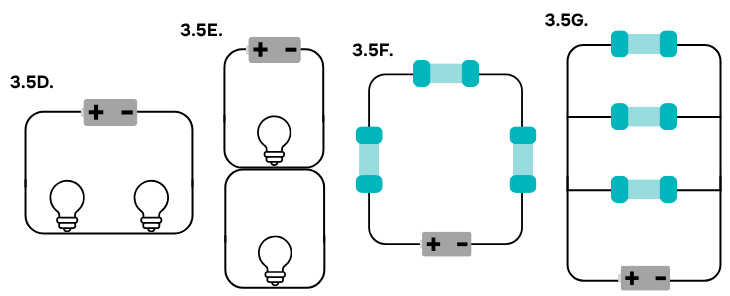
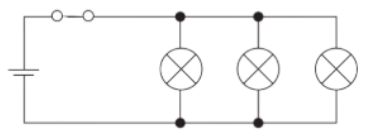
3.5D. Series 3.5E. Parallel 3.5F. Series 3.5G. Parallel
Part 4: Ohm’s Law – Math Activity Answer Key
4.1
V = I x R
2A x 5Ω = 10V
4.2
R = V / I
12V / 3A = 4Ω
4.3
Answer: I = V / R
10V / 20Ω = 0.5A
4.4
R = V / I
15V / 0.5A = 30Ω
4.5
20Ω + 30Ω = 50Ω (total resistance)
4.6
I = V / R (total)
10Ω = 30Ω = 40Ω
20V / 40Ω = 0.5A
4.7
P = V2 / R
202 = 400V
400V / 5Ω = 80W
4.8
P = V2 / R
122 = 144 V
144V / 4Ω = 36W
Part 5: Introduction to Circuit Diagrams Answer Key
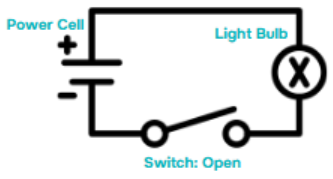
5.2 Answers will vary
Example: The light bulb is currently “off.” The electric circuit is open, blocking the current from flowing through.
5.3
Example (closed switch)
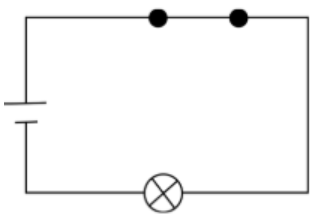
5.4
Example
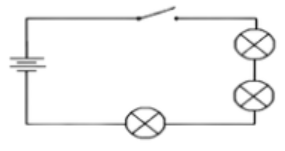
5.5
Example