

Bell Ringer
Instructions: Select one of the Bell Ringers for students to reflect on and answer.
Vocabulary
Instructions: Go over important terms and their definitions before watching the Introduction to Oil video. Student vocabulary list can be found in the Student Guide and Introduction to Oil – Starter Pack.
| Word | Definition | Example |
|---|---|---|
| Dependent | adjective; needing something or someone in order to survive | “. . . many feel we’re too dependent on [oil].” |
| Commerce | noun; buying and selling things, especially between places or countries | “. . . but the global flow of commerce as well . . . often a long journey powered by oil.” |
| Transportation Fuel | noun phrase; a type of energy source used to power things that move, like cars and buses | “. . . oil is a fantastic transportation fuel.” |
| Compact | adjective; small and tightly packed | “[Oil] packs a huge amount of energy into a compact, lightweight liquid form.” |
| Versatile | adjective; being able to do many different things well or being useful in many ways | “. . . [oil] is an incredibly versatile chemical feedstock.” |
| Chemical Feedstock | noun phrase; a material used to make chemicals and other products | “. . . [oil] is an incredibly versatile chemical feedstock.” |
| Political Capital | noun phrase; the trust, support and influence a leader or government has, which they can use to get things done or make decisions | “The world’s largest oil-consuming countries spend . . . huge political capital trying to stabilize oil regions each year.” |
| Stabilize | verb; to make something steady or less likely to change suddenly | “The world’s largest oil-consuming countries spend billions of dollars and huge political capital trying to stabilize oil regions each year.” |
| Smog | noun; dirty air that looks like fog, usually caused by pollution | “Smog, local air pollution, and CO2 emissions come from the tailpipe.” |
| Tailpipe | noun; the pipe at the back of a vehicle where smoke and gases come out after the fuel is burned | “Smog, local air pollution, and CO2 emissions come from the tailpipe.” |
| Excessive | adjective; too much of something or more than what is needed | “This gives oil an excessive influence on the global economy.” |
| Economy | noun; the way money, jobs, and businesses are organized – how people earn, spend and trade money and goods | “This gives oil an excessive influence on the global economy.” |
| Recession | noun; a time when the economy slows down, and there are fewer jobs, less spending, and businesses may struggle | “High oil prices are often followed by recession.” |
| Cripple | verb; to seriously hurt or stop something from working properly | “A shock to the global supply of oil . . . can cripple the world economy.” |
| Stock Portfolio | noun phrase; a collection of different investments, like shares of companies, that a person owns to help their money grow | “The solution, just like in a stock portfolio, is to diversify into other transportation fuels.” |
| Diversify | verb; to add different kinds of things so that you’re not dependent on just one | “The solution, just like in a stock portfolio, is to diversify into other transportation fuels.” |
| Alternatives | noun; other choices or options you can use instead of the main one | “As oil prices rise in the future, alternatives will become more competitive . . .” |
| Competitive | adjective; being good enough to win or succeed against others | “As oil prices rise in the future, alternatives will become more competitive . . .” |
| Prosperity | noun; having success, wealth, and a good standard of living | “. . . oil is a miracle fuel that built the prosperity of the 20th century.” |
Quiz & Cloze Notes
Instructions: Review key concepts after watching the Introduction to Oil video. The Student Guide and Introduction to Oil – Starter Pack contain the quiz and cloze notes.
Quiz Answer Key: Q1:C Q2:C Q3:D Q4:A
Cloze Notes Answer Key: oil; transportation fuel; commerce; use; pollution; risk; diversify
Data Set
Instructions: Provide students with the Introduction to Oil – Data Set for data literacy and analysis practice.
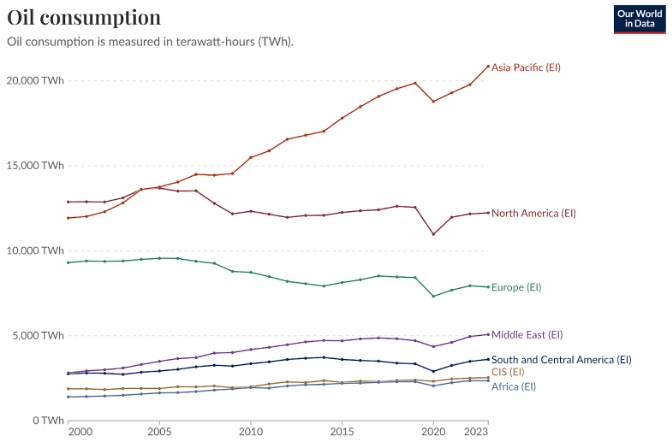
Data Table
| Region | 2023 Oil Consumption (Terawatt-Hour**) |
|---|---|
| Asia-Pacific | 20,861.53 |
| North America | 12,235.45 |
| Europe | 7,870.29 |
| Middle East | 5,079.12 |
| South and Central America | 3,614.03 |
| CIS* | 2,544.61 |
| Africa | 2,358.97 |
*Commonwealth of Independent States (CIS): a group of 10 countries (like Russia and Kazakhstan) that used to be part of the Soviet Union.
**Terawatt-Hour (TWh): The amount of electricity you would use if you kept 1 trillion (1,000,000,000,000) watts of power running for one hour.
Answer Key: Question 1: Asia-Pacific, North America; Question 2: 2005 (answers may vary slightly); Question 3: (Answers may vary) Example: Lack of accessibility; developing nations; limited infrastructure; high rural population; cost/expense.
Question 4: (Answers will vary) Example: Many developed and growing economies; urbanization and industrial growth; developed infrastructure. Question 5: Answers will vary.
Hands-On – Transportation Trade-Offs
Instructions: Use the Transportation Trade-Offs – Student Handout and the following Teacher Guide to conduct the lab activity.
Introduction
Students act as shipping managers making decisions about how to transport goods across a fictional country. Each transport method has different costs, speeds, and environmental impacts. The goal is to balance budget, delivery time, and sustainability.
Materials
- Student Handout
- Calculators
Student Objectives
- Identify and compare different transportation methods based on cost, speed, and environmental impact.
- Make decisions about transport routes by weighing trade-offs among time, budget, and oil use.
- Track and analyze data related to transportation choices, including total cost, days in transit, and oil consumption.
- Evaluate outcomes against defined constraints (e.g., budget limits, delivery deadlines, sustainability goals).
Procedure
1. Introduction: Present the scenario and distribute the Student Handout. Explain the goals of the activity along with the constraints. It may be helpful to sketch a “map” of the cities on the board, highlighting the starting point, distances between cities, and available transportation options.
Have students work in groups of 2-4.
2. Model: Guide students through the completion of the Route Planner for one possible route. Below is an example for a possible route from City A to City B.
| From – To | Transport Mode | Distance (miles) | Cost ($) | Time (days) | Oil/Fuel Use (assigned value) |
| City A to City B | Ship | 300 miles | ($150)/(100 miles = x/(200 miles) x = $300 | (200 miles)/(1 day) = (300 miles)/(x days) x = 1.5 days | Low (2) |
3. Monitor: Circulate about the room as groups work on planning routes and making decisions for the best transportation options for delivery of the goods. Once all routes have been planned, have students calculate the total cost, days and Oil/Fuel Use (add numeric values).
4. Optional: Include some twists throughout the simulation such as:
- Fuel shortage causes an increase in prices.
- Weather causes delays in the time to travel between cities.
- A strike makes a particular transportation method unavailable.
Conclusion:
Reflection and Analysis: Guide student discussion, evaluating their results with the Reflection Questions and optional High School Extension Questions.
Answer Key
The Student Guide contains the Transportation Trade-Offs Hands-On – Student questions.
Reflection Questions Answer Key
- Student answers will vary. Trade-offs include making decisions of less time for more cost, less environmental impact (fuel use) for longer time, etc.
- Student answers will vary but may include concepts related to type of transport, cost to transport goods, and environmental impact of goods.
- Oil is popular because it can fuel many different types of transportation from gasoline, diesel, or airplane fuel. It also has a high energy density.
- Relying on oil could be a problem if there is an oil shortage for various reasons, causing the price to increase. Burning oil-based fuels also emits carbon dioxide and particulate matter, which impact the environment.
- People could reduce dependence on oil by purchasing goods that are made closer to where they live, choosing more fuel-efficient modes of transportation, planning routes of travel to minimize miles traveled, use public transportation, etc.
Extension Reflection Questions Answer Key
- When oil prices rise, transportation and shipping costs increase, which can affect trade and consumer prices. In the simulation, a price spike may have led students to choose more fuel-efficient or shorter routes to stay within budget.
- High oil prices or shortages could slow down trade and limit access to goods. Systems can prepare by investing in alternative fuels, electric transport, and more efficient infrastructure to reduce oil dependency.
- A sustainable plan would minimize fuel use and emissions while staying economically viable. Quality answers should mention efficiency, low environmental impact, and adaptability as key factors.
- Political instability or trade restrictions in oil-rich regions can disrupt supply and raise prices. This affects global shipping and encourages countries to diversify energy sources or rethink trade routes.
Exit Ticket
Instructions: Access the Exit Ticket and have students reflect on and answer the prompt.