

The most abundant element, making up an incredible 75 percent of the known mass of the universe, is hydrogen. It also might be the energy fuel of the future.
For more than 4 billion years, hydrogen has fueled our sun, a nuclear fusion reactor that fuses hydrogen into helium to light up our solar system. Hydrogen has also fueled our rockets. It’s very lightweight, a huge advantage for space travel.
Under extreme pressure, or at extremely low temperatures, it becomes liquid. Without a spark and an oxidizer, liquid hydrogen is stable. So rockets also carry liquid oxygen and an ignition source. Once lit, hydrogen packs a serious punch, burning at more than 5,000 degrees Fahrenheit.
Hydrogen may one day power our earthbound transportation, too. In most fuel cells, hydrogen is forced through a membrane. It splits off an electron as electricity, which can run an electric motor to propel a vehicle. To fill the tank of a fuel-cell car, hydrogen has to be highly compressed—but in that state, it contains three times the energy, pound for pound, as gasoline. And when processed through a fuel cell, the only emissions are water vapor.
On Earth, hydrogen doesn’t often exist in a pure gas form. But it can be separated from water by electric current. Whether used in cars, rockets, or even fusion reactors, this essential element could, and probably should, play an ever-more-important role in powering the world.
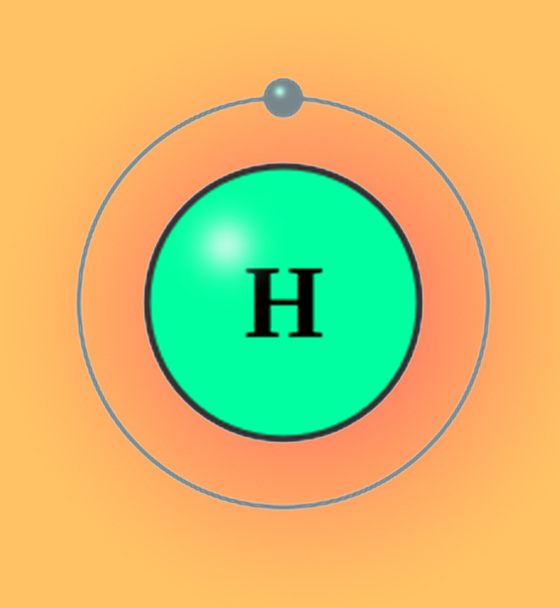
Electron shell diagram for hydrogen, the first element in the periodic table of elements.
Credit: Pumbaa (original work by Greg Robson) (CC BY-SA 2.0 uk [https://creativecommons.org/licenses/by-sa/2.0/uk/deed.en])
Background
Synopsis: Hydrogen is the most abundant element in the universe; it formed in the first few moments after the Big Bang. It is the simplest element on the periodic table and lighter than air. It forms water and is essential for all life on Earth, right down to your DNA. It also powers the sun and stars—as well as the rockets we use to explore space.
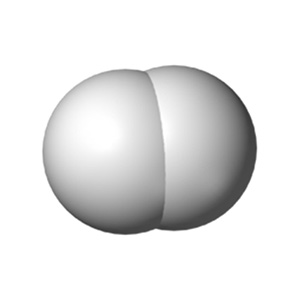
Dihydrogen molecule, H2.
Credit: Benjah/bmm27 (public domain), via Wikimedia Commons
- Hydrogen, which was discovered by accident, is essential for life.
- In 1671, scientist Robert Boyle noticed that a gas was produced as a byproduct of iron and acid reactions.
- In 1766, Henry Cavendish formally distinguished it as a separate element.
- In 1783, Antoine Lavoisier named the element hydrogen, derived from the Greek hydro and genes, meaning “water forming.”
- Two hydrogen ions attach themselves to oxygen to form the amazing polar molecule we know as water.
- Hydrogen ions occur in all of the nitrogen bases that make up our DNA and RNA.
- Hydrogen is so light that Earth’s gravity can’t hold it but so reactive that it rarely exists in its pure form, instead bonding with other particles that keep it earthbound.
- Hydrogen, with an atomic number of 1, is the first element on the periodic table.
- Because of its unique properties, it is not considered part of any of the characteristics groups that make up the periodic table; it stands on its own.
- Hydrogen is the simplest of all elements, but it has three isotopes—the only isotopes of any element that have been given their own specific names.
- Protium represents 99.9885 percent of all hydrogen on Earth. It is the only element that does not have a neutron, with just a proton and an electron.
- Deuterium, or heavy hydrogen, is a stable isotope that has one neutron, one proton, and one electron. It takes part in fusion reactions, forming helium (two neutrons, two protons, and two electrons).
- Tritium is an unstable, or radioactive, isotope with two neutrons, one proton, and one electron that is also used in fusion reactors.
- Hydrogen is a colorless, odorless, tasteless, nontoxic gas, so human senses can’t detect it.
- It can be liquefied at very high pressures or very cold temperatures. Its boiling point is -423.2 °F (-252.87 °C) and its melting point is -434.7 °F (-259.34 °C).
- With only one electron in its orbital, hydrogen readily bonds with itself or other ions to fill its outer shell.

The 804-ft German zeppelin Hindenburg burned as the hydrogen that filled it was exposed to the ignition source. Credit: Gus Pasquarella (public domain), via Wikimedia Commons
- Hydrogen is the lightest of all chemical elements and can’t be retained by Earth’s gravity—making it attractive for aerial balloonists for more than 150 years.
- Most of the molecules hydrogen forms are heavy enough to be earthbound, but when it bonds with itself to make hydrogen gas—represented as H2—the dihydrogen molecule is lighter than air.
- The first manned gas balloon flight, using hydrogen gas, was launched in Paris in December 1783.
- A gas balloon could lift a load higher than a similarly sized hot-air balloon, so they were popular through the 1800s, even used to observe troop movements in the Civil War at tethered vantage points high in the sky.
- The use of hydrogen to fill balloons and rigid frame airships, like zeppelins, ended after the German aircraft LZ 129 Hindenburg was engulfed in flames on May 6, 1937, as it tried to dock in Lakehurst, New Jersey, killing 36 people. Dozens of scientific and conspiracy theories exist about the cause of this fateful fire.
- Although initially designed for use with inflammable helium, the Hindenburg was inflated with flammable H2 because of the 1927 Helium Control Act by the U.S. government, which sought to regulate the scarce and expensive helium.
- Today, H2 is used in most weather balloons.

The space shuttle Atlantis was propelled by liquid hydrogen and liquid oxygen fuels. Credit: Scott Andrews, Canon (public domain), via Wikimedia Commons
- Hydrogen is the fuel that powers the sun and stars.
- An unbelievable 75 percent of the mass of the known universe is hydrogen.
- Our sun is a nuclear reactor powered by hydrogen as it fuses to form helium. Of its atoms, 91 percent (70 percent of its mass) are hydrogen and 8 percent (28 percent of its mass) are helium, ratios that change over time as nuclear fusion proceeds.
- The sun has been converting hydrogen to helium for 4.5 billion years.
- Other elements that make up the rest of the sun include oxygen, carbon, nitrogen, silicon, magnesium, neon, iron, and sulfur.
- Gas giants like Jupiter are mostly composed of hydrogen; their interiors have enough pressure to create liquid hydrogen, and possibly solid or metallic hydrogen.
- As a lightweight, high-energy density fuel, hydrogen is perfect for powering spacecraft away from Earth’s gravitational pull toward space.
- To carry their payloads into space, rockets need fuel that is extremely lightweight, with an energy density high enough to defeat gravity. The fuel also needs to remain stable until ignition.
- Hydrogen is extremely light and won’t ignite unless an ignition source and oxidizer like air are present. Once it ignites, though, it really packs a punch, burning at 5500 °F (3038 °C).
- Liquid hydrogen is the perfect fuel for space exploration but, like liquid oxygen, it must be protected from any heat sources—a major challenge for space agencies.
- To carry their payloads into space, rockets need fuel that is extremely lightweight, with an energy density high enough to defeat gravity. The fuel also needs to remain stable until ignition.
- Hydrogen is a promising source of clean fuel when used in fuel cells because it carries reactive energy without any carbon, thus reducing emissions to just water vapor and warm air.
- Hydrogen fuel cells are devices that convert the chemical energy of hydrogen into electricity through reactions with oxygen.
- A gallon of gasoline weighs about three times as much as a kilogram (2.2 lb) of hydrogen gas, but they both produce about the same amount of energy.
- Hydrogen has to be compressed to about 10,000 psi to fit into fuel-cell electric vehicles (FCEV). Compression stations can fill FCEV tanks in about 5 minutes, but building the network of stations necessary to support drivers is a challenge.
- Internal combustion engines can also run on hydrogen, but they are less efficient and produce additional tailpipe emissions.
References
Hydrogen | Wikipedia
Hindenburg Disaster | Wikipedia
What Is the Sun Made Of? | Space.com
Rocket Propellant | Wikipedia
Hydrogen | DOE Alternative Fuels Data Center
Contributors
Juli Hennings
Harry Lynch