

The Chernobyl nuclear power plant, in Ukraine, was designed and operated so badly, it was practically destined for disaster.
First, the Soviet plant design was fatally flawed. It didn’t include a containment vessel, the massive concrete structure that encloses other nuclear reactors. Adding one, of course, would have been very expensive. But, it would have contained the accident.
It occurred when unqualified engineers ran the reactor at very low power during a test – which made the reaction unstable. To keep the test running, they pulled nearly all the safety control rods from the core. This caused the reaction to spiral out of control. The engineers panicked and dropped all the rods back in, which displaced coolant water and caused the reactor to overheat. The coolant water then boiled to steam with such force that it blew the thousand-ton lid off the reactor.
In the explosion, a hundred tons of nuclear fuel were scattered across the site, or vaporized into the air as the reactor caught fire. Firemen rushed in to put out the blaze. Two workers were killed on site. More than a hundred others died or became seriously ill from radiation poisoning. Nearby towns were evacuated and have been left abandoned since, as more than a hundred thousand people were displaced.
But, what was a disaster for the region’s human population would turn out to be a boon for its wildlife. Something we’ll discuss on another EarthDate. I’m Scott Tinker.
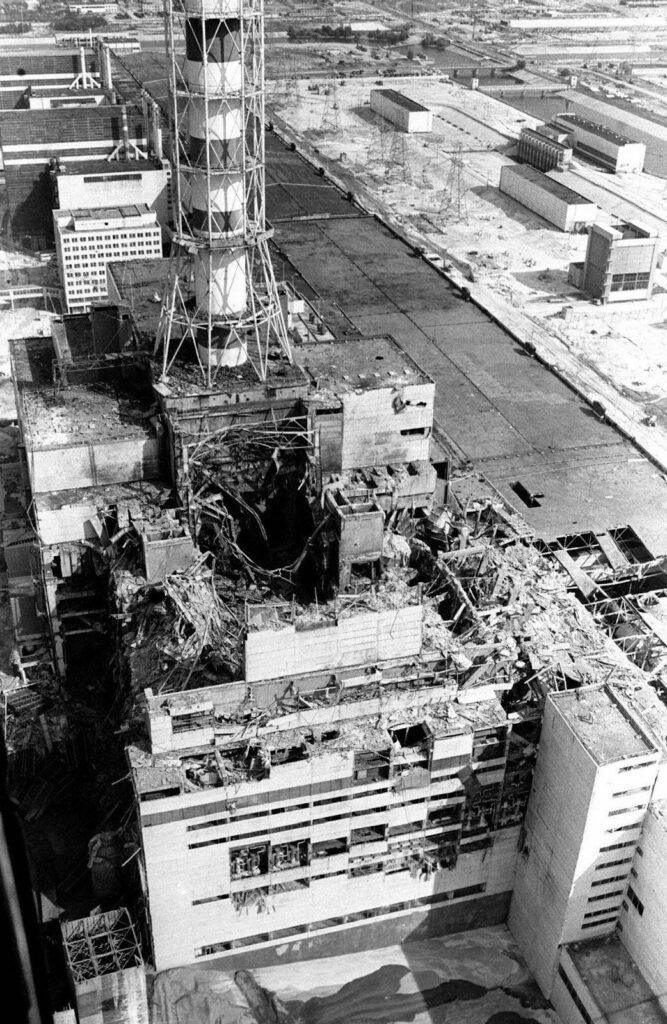
Reactor 4 at Chernobyl, where a flawed design and human error combined into one of history’s worst nuclear disasters.
Credit: By IAEA Imagebank – 02790015, CC BY-SA 2.0, https://commons.wikimedia.org/w/index.php?curid=63251598
Background:
Synopsis: In April 1986, a flawed reactor design and a failed safety test caused the explosion of Chernobyl’s Reactor Four, releasing widespread radiation and forcing mass evacuations. The disaster exposed how human decisions and unstable technology can combine into catastrophe, reshaping nuclear safety worldwide and leaving behind an exclusion zone with consequences that were only beginning to unfold.
A Day of Disaster
- In the early morning of April 26, 1986, a nuclear reactor in northern Ukraine exploded, releasing massive amounts of radiation into the environment.
- The accident occurred at the Chernobyl Nuclear Power Plant, about 80 miles (129 km) north of Kyiv, and quickly became the worst nuclear disaster in history.
- Radioactive particles spread across Ukraine, Belarus, Russia, and much of Europe, leaving behind a zone of contamination that is still hazardous today.
- Entire towns and villages were evacuated, forests and farmland were abandoned, and hundreds of thousands of people were displaced.
- Though the tragedy caused great suffering, the decades that followed have revealed another story about how nature responded and adapted to life in a radioactive landscape.
The Explosion
- The story of Chernobyl’s recovery begins with the disaster that scarred the land and its people.
- On April 25, 1986, operators at Chernobyl’s Reactor Four began a safety test to see if the plant’s turbines could power the reactor’s cooling pumps for a short time after a shutdown.
- Operators were electrical engineers, not reactor physicists, and key safety systems were intentionally disabled to complete the experiment.
- The Chernobyl reactors used a Soviet RBMK design based on uranium-fueled, water-cooled, and graphite-moderated systems.
- Physicist Hans Bethe described the RBMK as “fundamentally faulty, having a built-in instability.”
- In this design, if coolant water boiled into steam, the reactor became more reactive instead of shutting down.
- The reactors also lacked the thick containment buildings that surround Western nuclear plants.
- Later analysis showed that if Chernobyl had a containment dome, radiation would likely not have escaped.
- During the test, the reactor was run at dangerously low power, a condition known to make the RBMK unstable.
- To keep the reactor operating, operators withdrew all but six of the 211 control rods, far below the 30-rod safety minimum.
- On April 25, 1986, operators at Chernobyl’s Reactor Four began a safety test to see if the plant’s turbines could power the reactor’s cooling pumps for a short time after a shutdown.
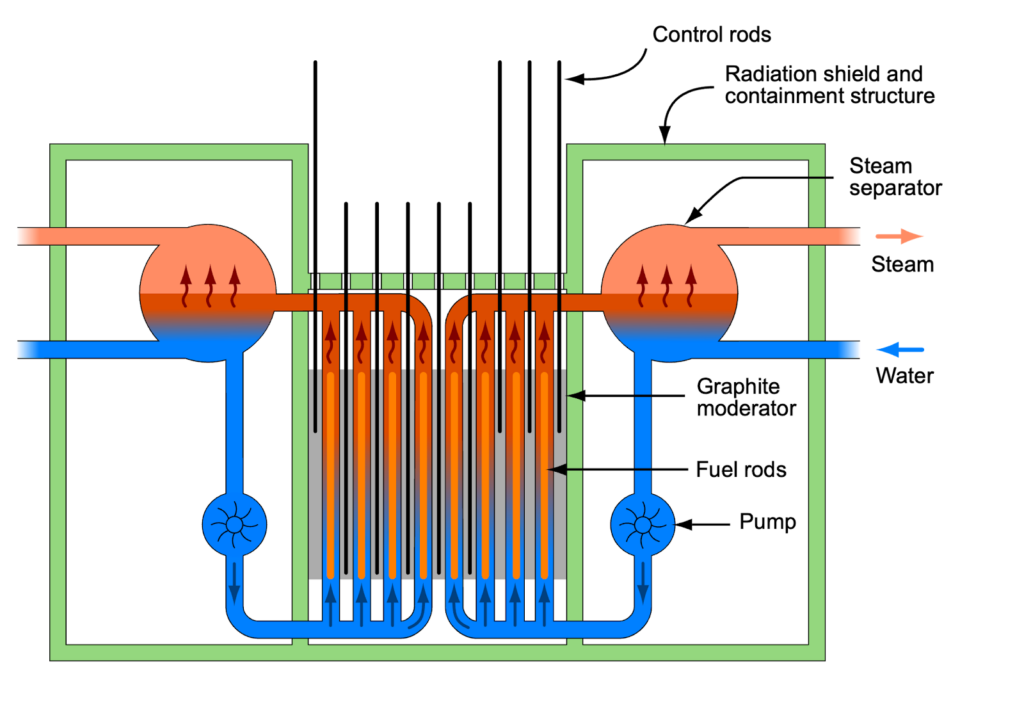
Diagram of the RBMK nuclear reactor design used at Chernobyl, showing graphite moderation, water cooling, and vertical control rods. In this configuration, boiling water could increase reactivity, a built-in instability that contributed to the 1986 accident.
Credit: By Fireice~commonswiki, Sakurambo, Emoscopes – Own work based on: Magnox reactor schematic.svg, CC BY-SA 3.0, https://commons.wikimedia.org/w/index.php?curid=3579057
- At 1:23 A.M., the turbine was shut down, reducing power to the water pumps.
- With less coolant, water turned to steam, making it a weaker absorber of neutrons.
- This allowed the chain reaction to accelerate rapidly.
- The operators tried to shut down the reactor by pressing the emergency shutdown button, which drove the control rods back into the core.
- But the rods had graphite tips. As they entered, the graphite displaced water and briefly increased reactivity.
- Instead of reducing power, the control rods triggered a surge.
- Within seconds, two explosions tore through the reactors.
- The blasts were chemical, driven by steam and hydrogen, not a nuclear detonation.
- The reactor’s 1000-ton cover was blown off, fuel and graphite were ejected into the air, and fires broke out across the site.
- About 50 tons of nuclear fuel vaporized and were released into the atmosphere, and another 70 tons were blasted across the grounds and rooftops.
- In all, the radioactive release was estimated to be many times greater than Hiroshima’s bomb, and far more contaminating to the environment.
- Sand was dropped on the area to stop the fire while boron was released to absorb neutrons and prevent additional nuclear reactions.
- A temporary concrete structure, called a sarcophagus, was put into place a few weeks later to limit further release of radioactive material.
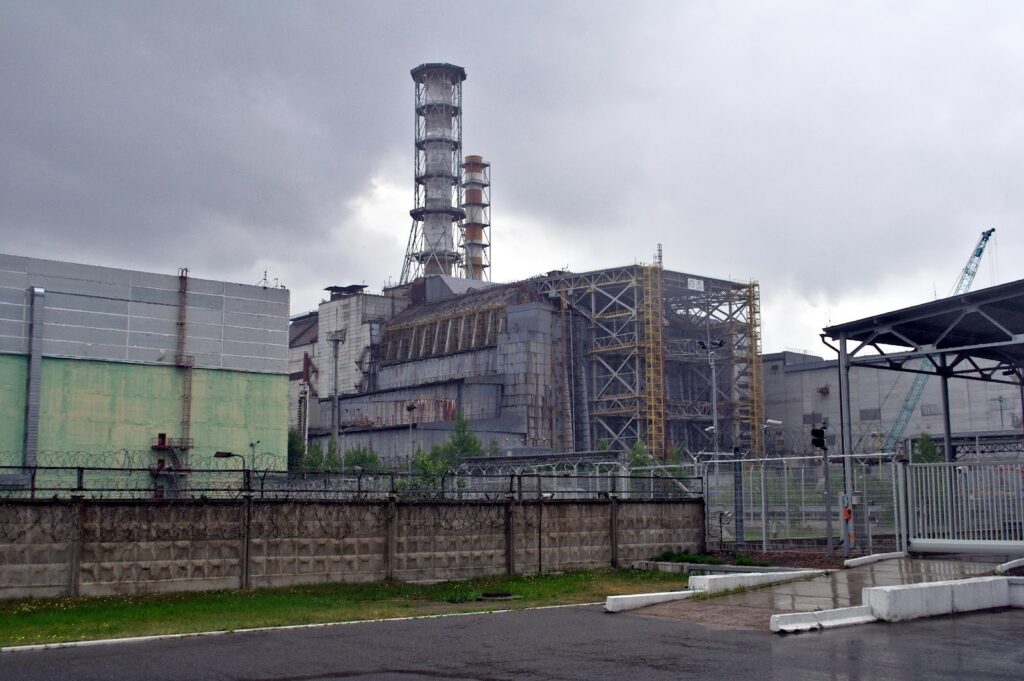
This photo shows Reactor 4 at the Chernobyl Nuclear Power Plant, which lacked the thick concrete containment structures common in Western reactor designs. The metal-clad construction left the reactor vulnerable, allowing radioactive material from the 1986 explosion to escape directly into the environment.
Credit: By Paweł ‘pbm’ Szubert (talk) – Own work, CC BY-SA 3.0, https://commons.wikimedia.org/w/index.php?curid=27270396
The Impact
- The effects of the disaster were immediate and widespread.
- Two plant workers died immediately in the explosions at Reactor Four from non-radiation causes.
- In the following days and weeks, 28 firefighters and plant employees died from acute radiation exposure.
- Many had rushed to the scene without protective gear, unaware of the radiation they faced.
- More than 100 others were hospitalized with serious radiation sickness, and many suffered long-term health effects.
- Radioactive iodine spread widely, contaminating milk and food supplies.
- Thousands of thyroid cancer cases have since been linked to exposure, especially in children.
- Treatment has proven successful in ninety-nine percent of these children.
- In total, hundreds of thousands of people were evacuated or resettled, and millions across Europe were exposed to elevated radiation.
- While the human cost was tragic, the disaster also left a lasting environmental scar on the land.
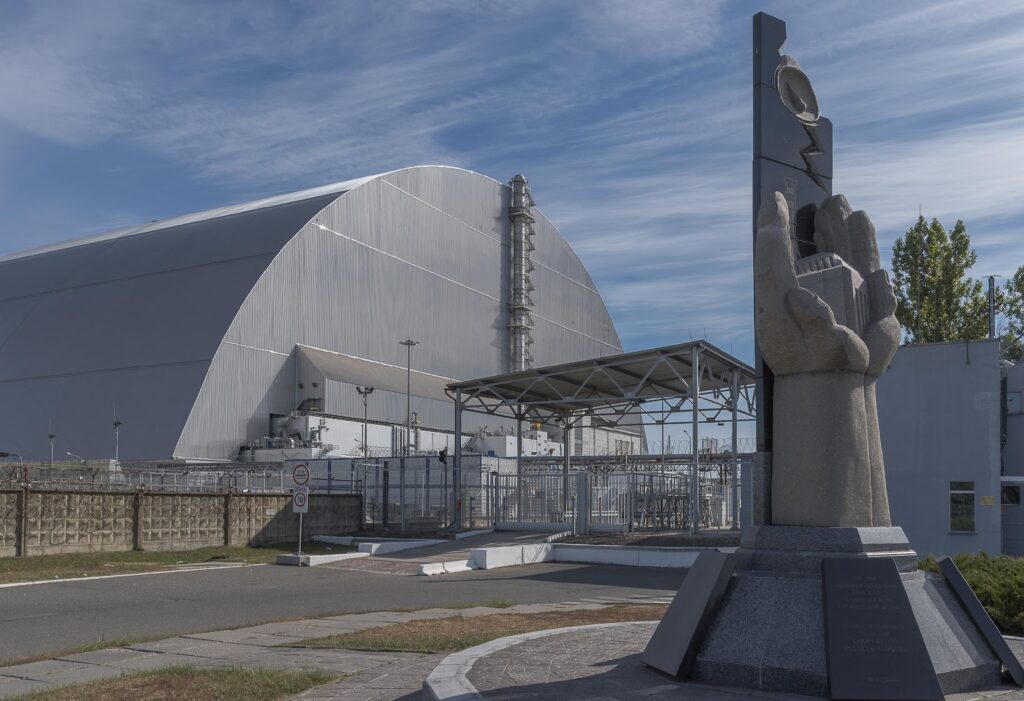
Completed in 2016, the New Safe Confinement structure now covers Chernobyl’s Reactor 4, sealing in the remains of the 1986 accident. In the foreground stands the Monument to the Liquidators, honoring the workers and responders who risked their lives to contain the disaster. Credit: By Mattias Hill – Own work, CC BY-SA 4.0, https://commons.wikimedia.org/w/index.php?curid=116165591
Nuclear Fallout
- The explosion and fallout devastated nearby forests, fields, and rivers.
- A stand of pine trees closest to the reactor absorbed lethal doses of radiation and turned reddish-brown, becoming known as the “Red Forest.”
- Entire towns and villages within 30 kilometers (18.6 miles) of the plant were emptied almost overnight.
- The city of Pripyat, once home to 50,000 people, was evacuated the day after the explosion and has remained abandoned ever since.
- The Soviet government established the Chernobyl Exclusion Zone, a 30-kilometer (18.6-mile) radius around the plant, to restrict human habitation.
- The region, once a fertile part of Ukraine’s grain belt, was suddenly transformed into one of the most radioactive landscapes on Earth.
A Disaster That Changed the World
- Chernobyl became a global turning point for nuclear energy and safety.
- The accident exposed how design flaws, inadequate training, and secrecy can combine to overwhelm even advanced technology.
- In its aftermath, nuclear regulators around the world strengthened safety standards, requiring containment structures, redundant cooling systems, and clearer chains of responsibility.
- The disaster also reshaped international cooperation, as scientists and governments began sharing radiation data and emergency response protocols more openly.
- Chernobyl remains the defining example of how human decisions, not just technology, determine risk.
- The explosion left a scar on the land and displaced generations of families.
- It also created an exclusion zone that would become an unexpected and long-term experiment, one whose ecological consequences were only beginning to unfold.
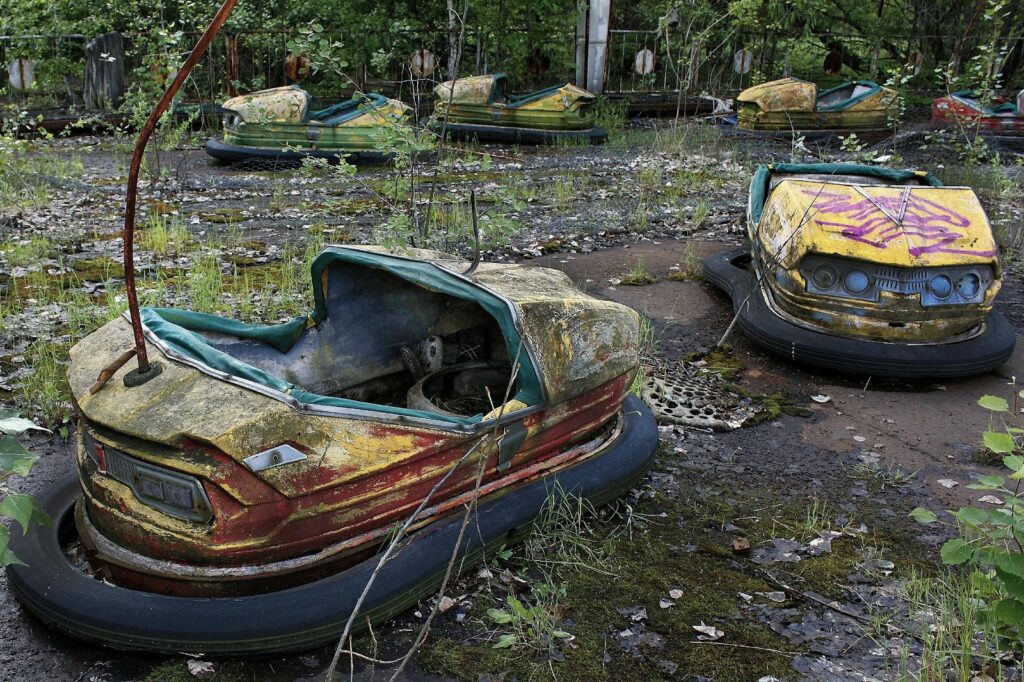
A decaying amusement park ride in Pripyat, the city evacuated after the 1986 Chernobyl disaster. Once built for residents who never returned, the abandoned park has become a symbol of sudden displacement and long-term evacuation. Credit: By Shanomag – Own work, CC BY-SA 4.0, https://commons.wikimedia.org/w/index.php?curid=40467624
References:
Nuclear Reaction: Why Do Americans Fear Nuclear Power? | Frontline, PBS.org
Backgrounder on Chernobyl Nuclear Power Plant Accident | U.S. Nuclear Regulatory Commission
Chernobyl Accident 1986 | World Nuclear Association
Contributors:
Lynn Kistler
Harry Lynch