

Bell Ringer
Instructions: Select one of the Bell Ringers for students to reflect on and answer.
Vocabulary
Instructions: Go over important terms and their definitions before watching the Introduction to Geothermal video. Student vocabulary list can be found in the Student Guide and Introduction to Geothermal – Starter Pack.
| Word | Definition | Example |
|---|---|---|
| Geothermal | adjective: related to the heat that comes from inside the Earth | “Geothermal energy, the heat of the Earth, can be found beneath our feet everywhere.” |
| Extracting | verb: taking something out from a source | “But extracting enough of it at an affordable price is the challenge.” |
| Affordable | adjective: not too expensive | “But extracting enough of it at an affordable price is the challenge.” |
| Turbine | noun: a machine that spins when water, air or steam flows through it to generate electricity | “We use that heat . . . to turn a steam turbine to make electricity.” |
| Flexible | adjective: able to change or be used in different ways | “Like hydropower, geothermal is flexible.” |
| Base-load power | noun phrase: the minimum amount of electricity a city or country needs continuously | “[Geothermal energy] can be always on base-load power.” |
| Ramp up | verb phrase: to increase or to make something go faster or stronger | “Or it can be ramped up quickly to follow demand.” |
| Fracturing | verb: to break something into pieces | “We’re experimenting with drilling new wells, fracturing the rocks, and circulating water.” |
| Circulating | verb: moving around in a loop or system | “We’re experimenting with drilling new wells, fracturing the rocks, and circulating water” |
| Applications | noun: ways something can be used | “[Geothermal energy’s] applications are broad . . .” |
| Cost-prohibitive | adjective: so expensive or difficult that it stops people from using it | “[Geothermal energy is] still cost-prohibitive.” |
Quiz & Cloze Notes
Instructions: Review key concepts after watching the Introduction to Geothermal video. The Student Guide and Introduction to Geothermal – Starter Pack contain the quiz and cloze notes.
Quiz Answer Key: Q1:D Q2:D Q3:B Q4:C
Cloze Notes Answer Key: Geothermal; heat; buildings; electricity; flexible; surface; expensive
Data Set
Instructions: Provide students with the Introduction to Geothermal – Data Set for data literacy and analysis practice.
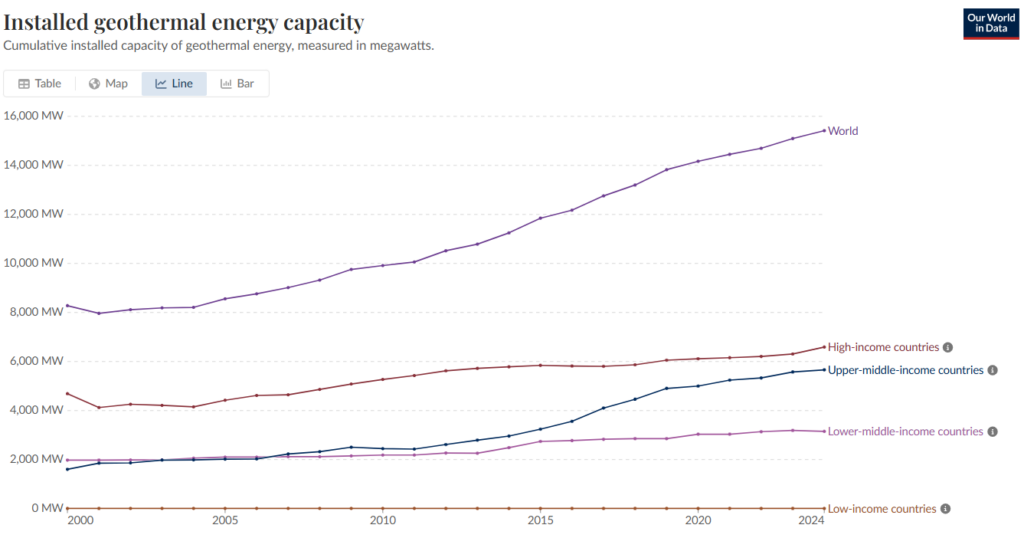
Source: Our World In Data
Data Table
| Region | 2000 (MW) | 2024 (MW) |
|---|---|---|
| High-income countries | 4,687.91 | 6,586.55 |
| Low-income countries | 7.30 | 7.30 |
| Lower-middle income countries | 1,974.70 | 3,146.97 |
| Upper-middle income countries | 1,598.79 | 5,656.29 |
| World | 8,272.70 | 15,411.61 |
Answer Key:
Question 1: Globally, geothermal energy capacity has increased significantly between 2000 and 2024, showing a strong upward trend in the use of geothermal energy worldwide. However, this trend is not the same across all economic regions. For example, low-income countries have shown no growth at all in this time period.
Question 2: Increase = 15,411.61 MW – 8,272.70 MW = 7,138.91 MW
Percent increase = (7,138.91 / 15,411.61) x 100 = 46.32% percent increase
Question 3: Upper-middle-income countries have contributed the most to the increase. Between 2000 and 2024, their capacity increased by 4,057.5 MW. This is the largest increase among all income categories.
Question 4: Answers will vary. (Example: Low-income countries may face financial, technical and infrastructure barriers that make it difficult to develop geothermal energy projects.)
Question 5: Answers will vary.
Heat Transfer Lab
Instructions: Use the Heat Transfer Lab – Student Handout and the following Teacher Guide to conduct the lab activity.
Introduction
Cities, as well as individual homes, can use geothermal energy to heat and cool buildings efficiently, lowering electricity use and pollution. This hands-on activity simulates how underground soil maintains a relatively constant temperature and can exchange heat with water. Students will observe thermal energy transfer using simple materials and visualize how geothermal systems work.
Student Objectives
Students will be able to
- Describe how geothermal energy involves heat transfer between underground soil and fluids.
- Observe and compare how temperature changes in different soil conditions.
- Explain the basic principle of geothermal heating and cooling.
- Reflect on how natural energy sources can support sustainable city design.
Materials (per group)
- Student Handout
- 2 clear containers filled with soil (one chilled overnight, one at room temperature)
- 2 resealable small plastic bags
- 2 liquid crystal thermal temperature strips
- 2 measuring cups or beakers
- 1 cup of warm water (~40-45°C)
- Warm tap water if available or heated with a kettle
- 2 pipette droppers (or other tool to drip water slowly)
- Timer or stopwatch
- Graph paper or online graphing tool
Procedure:
- Give each student or student group a copy of the Student Handout
- Divide the students into groups and provide them with the materials to start the experiment.
- Once students have completed the experiment, have them graph their results and answer the reflection questions to analyze their observational data and draw conclusions.
Big Ideas
The temperature strip in the chilled soil should show a bigger temperature change as it pulls heat from the water. The temperature strip in the room temperature soil should show less change, demonstrating less cooling.
This shows that underground soil can absorb heat or stay cooler than the air above. It acts like a sponge for thermal energy. Because soil underground stays at a steady temperature, it can either pull heat away when it’s hot or give off heat when it’s cold—like a natural heater or cooler.
Answer Key
The Student Guide contains the Heat Transfer Lab – Student questions.
Reflection Question Sample Responses
Question 1: Answers will vary depending on student data.
Example:
Chilled Soil: Starting temperature = 40°C, Final temperature = 30°C after 5 minutes
(30 − 40) ÷ 5 = −2.0°C/min
Room-Temperature Soil: Starting temperature = 40°C, Final temperature = 35°C after 5 minutes
(35 − 40) ÷ 5 = −1.0°C/min
Note: Students should correctly substitute their measured values, perform the calculation, and include units (°C/min). A more negative value indicates a faster decrease in temperature.
Question 2: (Sample Student Response: The chilled soil container had the greater average rate of temperature change (a steeper downward slope on the graph). This indicates that thermal energy moved more quickly from the warm water into the cooler soil. Because the chilled soil had a larger temperature difference from the warm water, thermal energy was transferred at a faster rate.)
Question 3: Answers will vary. (Sample Student Response: In this experiment, the soil transferred thermal energy to or from the warm water. Similarly, geothermal systems circulate water through underground pipes, where the ground’s relatively constant temperature can warm the water in winter or cool it in summer. Because the ground helps provide heating and cooling, buildings use less electricity to maintain comfortable indoor temperatures.)
Exit Ticket
Instructions: Access the Exit Ticket and have students reflect on and answer the prompt.