
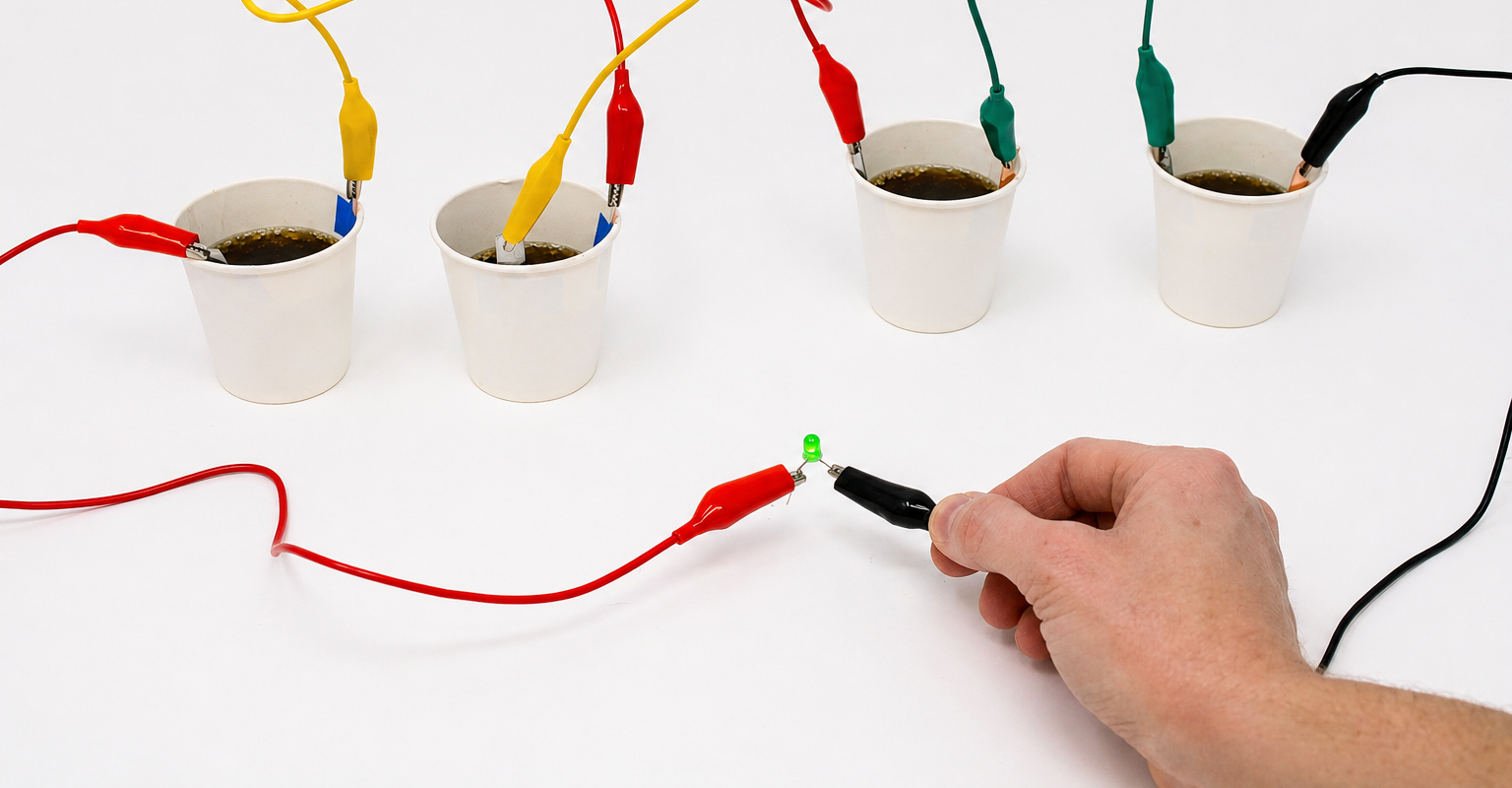
Power Up! Exploring Electrolytes Lab

Summary

Power Up! Exploring Electrolytes Lab

The Power Up! Exploring Electrolytes Lab is a hands-on electrochemistry investigation where students build simple voltaic cells and test how different electrolyte solutions affect battery performance. Each student group constructs an electrochemical cell using zinc and copper electrodes, measures voltage with a multimeter, and tests whether their cell can power an LED diode. Groups then connect multiple cells in series to explore how voltage builds across a battery system, reinforcing key concepts in circuits, oxidation-reduction reactions, and energy transfer.

Students investigate one assigned electrolyte, such as vinegar, salt water, a sports drink, or cola, and contribute their data to a shared class dataset. By comparing class-wide results, students determine which electrolytes allow charge to move most effectively and how the chemistry of the electrodes sets the voltage of each cell. This build-a-battery activity gives students a concrete way to understand how everyday batteries work, similar in concept to a lemon battery experiment but with a controlled investigation focused on electrolyte effectiveness.

The lab supports skills such as data analysis, controlled experimentation, systems thinking, and quantitative reasoning. Students practice formulating hypotheses, recording multiple trials, calculating averages, and drawing conclusions from class data. The activity is designed for middle school and high school physical science, chemistry, and environmental science classrooms, and it supports NGSS standards including HS-PS3-3 on designing energy conversion devices and MS-PS1-2 on analyzing chemical reactions.

Teachers can use the lab as a standalone investigation on batteries and electrochemistry or as part of a broader unit on electricity, energy storage, or energy systems. An optional Biology Extension connects the lab to electrolytes in the human body, supporting cross-disciplinary learning between physical and life sciences. The lab also doubles as an engineering design opportunity, since students can extend the activity by modifying variables to optimize battery performance.

Extend the Lesson: Use the Teacher Guide for facilitation support and the Student Guide for classroom-ready procedures and data tables. Pair this lab with the Play-Doh Circuits Lab to build a foundational understanding of series and parallel circuits before students construct their electrochemical cells. After the lab, connect students to the Introduction to Energy Storage lesson to explore how battery chemistry scales up to power phones, electric vehicles, and the electric grid.

Activities
Lab - Teacher Guide

Includes a clear introduction to the lab, student objectives, a full materials list with electrolyte options, and step-by-step procedures for setup, demonstration, and student work.

Lab - Student Guide

Walks students through a complete hands-on investigation of how batteries work.

Extension

Connects battery chemistry to the role of electrolytes in the human body.

Downloadables
Electricity
Access Answer Key!