

Includes objectives, materials, procedures, troubleshooting tips, and extensions.
Holiday Lights: Play-Doh Circuits
Summary
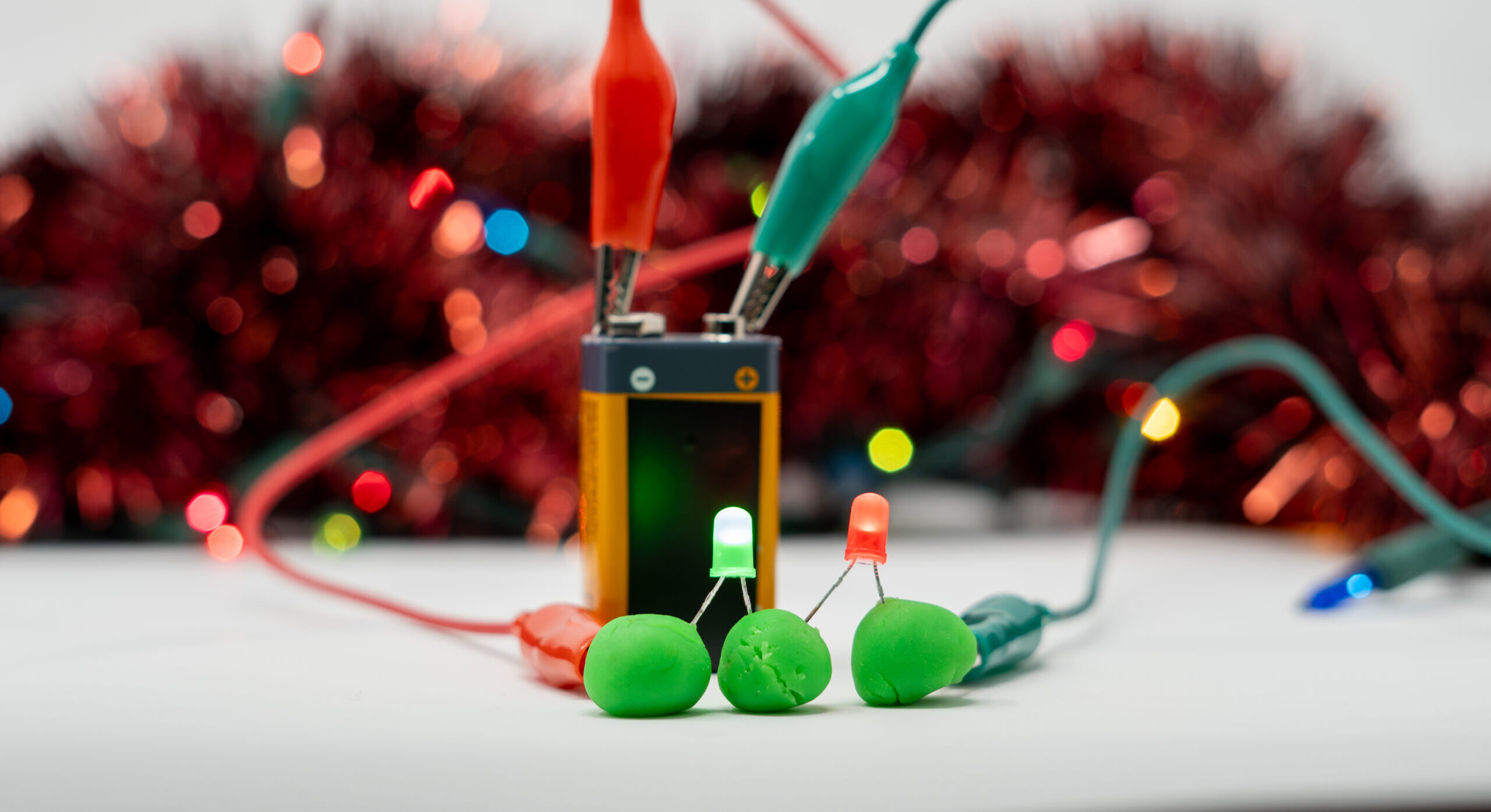
Teach circuits with a seasonal hook that students already care about. Holiday Lights Play-Doh Circuits helps students understand how series and parallel circuits work by building “mini holiday light strands” using Play-Doh, LED diodes, alligator clips, and a 9-volt battery. Students investigate LED polarity, construct and test series circuits (older-style light strands), then construct and test parallel circuits (modern LED strands). Along the way, they observe how electricity flows differently in each circuit type and explain why one burned-out bulb can shut down an entire strand in series but not in parallel.
The lesson begins with a quick exploration of anode and cathode and how polarity affects whether an LED lights. Students then build a simple closed circuit and expand it into a series circuit with multiple LEDs. They make predictions, test what happens when one LED is removed, and reflect on why breaking one connection interrupts current in a single-path circuit. Next, students transition to a parallel circuit, add more LEDs, and test reliability by removing one LED while others remain lit. A short reading section then introduces voltage distribution and current distribution, helping students connect what they observed to core physical science concepts.
This activity works well for upper elementary through middle school physical science and can also support high school review. It is especially useful when you want a highly engaging lab that reinforces NGSS-aligned practices like predicting, testing, explaining patterns, and communicating results. The lesson also includes optional extensions such as testing a real strand of holiday lights or diagnosing a pre-built circuit with an intentional wiring error.
Activities
Student Guide
A handout to guide students through building and testing real circuits with simple materials.
Answer Key
Includes expected sketch labels for LED polarity and battery terminals, sample hypotheses, and clear explanation-based answers.
Downloadables