

Case Study: Puerto Rico’s Electric Grid and the Rise of Community Microgrids
In September 2017, Hurricane Maria devastated Puerto Rico’s electric system, destroying an already fragile grid and plunging the entire island into darkness. With transmission towers toppled and distribution lines shredded, nearly all 3.4 million residents lost power. Many urban areas waited months for restoration, while some rural communities endured outages lasting close to a year, making it the longest blackout in U.S. history. The storm exposed long-standing vulnerabilities: decades-old infrastructure, dependence on imported oil and natural gas, and chronic financial strain at the Puerto Rico Electric Power Authority (PREPA). Rebuilding efforts stretched for years, and even subsequent storms, like Hurricane Fiona in 2022, caused island-wide failures, underscoring continuing weaknesses in the centralized grid.
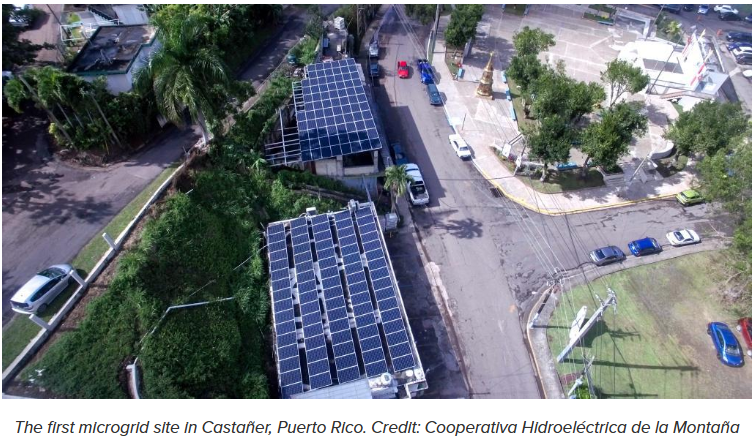
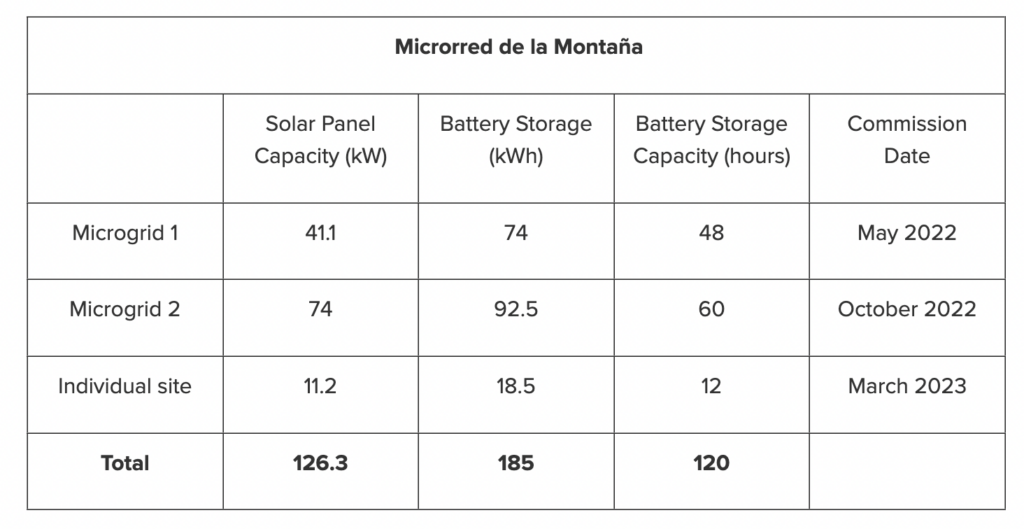
Amid these challenges, local organizations and cooperatives began turning to alternative community microgrids as a way to strengthen energy security. In mountainous, rural regions where grid repair was slowest, microgrids offered residents a source of dependable electricity when the main grid proved unreliable. One example is the Microrred de la Montaña initiative, a cooperative project serving towns such as Adjuntas, Jayuya, Lares, and the community of Castañer. With support from nonprofits and technical partners, the project installed clusters of rooftop solar panels paired with battery storage in key community centers and businesses. The first phase, commissioned in 2022, deployed systems totaling over 40 kW of solar capacity with nearly 75 kWh of battery storage across several sites.
These installations allowed essential services like medical facilities, pharmacies, food stores, and communication hubs to continue operating during grid outages. For residents who had once waited months for electricity, the ability to refrigerate medicine, charge devices, or power lights and fans represented a dramatic improvement in resilience and quality of life. Similar projects across the island, from rural cooperatives to school-based microgrids, have emerged as part of a broader effort to build a cleaner and more dependable energy future for Puerto Rico.
While the island works toward modernizing its central grid, community microgrids have become a symbol of local empowerment: systems built not only to provide electricity, but to offer stability and security in places where outages have been a persistent reality for years.
Data Table:
Conclusion Questions:
- Based on the table, how many average U.S. homes (using 30 kWh/day) could each microgrid power for one day using only battery storage?
- Compare the total solar panel capacity of all microgrids (126.3 kW) to the capacity of a typical U.S. power plant (often 500,000 kW or more). What does this suggest about the scale of microgrids versus main grids?
- What might be the benefits and limitations of relying on microgrids for rural or disaster-prone communities, based on the case study and data?
- If you had to live for 9 months without electricity, what impact would that have on your quality of life? Think of everything in your world that uses electricity.
References:
“Microgrids in Puerto Rico Keep Rural Communities Connected.” Environmental and Energy Study Institute, 11 Feb. 2020, https://www.eesi.org/articles/view/microgrids-in-puerto-rico-keep-rural-communities-connected.
“New Co-op Plans to Increase Energy Security and Resilience in Puerto Rico.” Environmental and Energy Study Institute, 21 Feb. 2023, https://www.eesi.org/articles/view/new-co-op-plans-to-increase-energy-security-and-resilience-in-puerto-rico.
Roberts, David. “Puerto Rico’s Blackout, and the Solar and Storage Solution.” Vox, 13 June 2018, https://www.vox.com/energy-and-environment/2018/6/13/17413828/puerto-rico-blackout-power-grid-hurricane-maria.
Option A: Research Project
Project Prompt:
Choose two or three of the locations listed below.
- Nepal (mountainous, rural)
- Bangladesh (flood-prone, rural)
- Texas, USA (rural counties, prone to severe weather)
- Philippines (typhoon-prone islands)
- Haiti (earthquake and hurricane-prone)
- Kenya (rural, off-grid communities)
- Indonesia (rural islands, earthquake/volcano risk)
- Alaska, USA (remote, harsh climate)
For each location you selected, you will investigate how the community currently receives electricity and what challenges or opportunities exist. Your goal is to understand both the present energy system and how it could be improved to become more sustainable and resilient.
Note: There will be significant variation between cities, towns, and rural areas within each location. For this project, base your answers on what most people or most of the country/region rely on, rather than focusing on unusual or highly localized exceptions.
For each fact, record the source of information (website and/or article title, author or organization, and date accessed).
| State/Country | Current Delivery (Grid/Microgrid) For each location, determine which system(s) most people rely on today; provide metrics | Source(s) |
|---|---|---|
| | ||
| State/Country | Reliability Find real reliability information where possible, such as average outages per year, average hours of electricity per day, known problems, and seasonal disruptions. | Source(s) |
|---|---|---|
| State/Country | Average Cost Look for cost per kilowatt-hour ($/kWh) if available. If not, describe the cost of alternatives, typical household electricity bills, and differences between rural and urban costs. | Source(s) |
|---|---|---|
| State/Country | Resilience Investigate how quickly electricity returns after events like hurricanes, floods, earthquakes, snowstorms, volcanic activity, or any main grid outages. | Source(s) |
|---|---|---|
| State/Country | Propose an Improvement Plan Propose a realistic plan for improving electricity access in the region that addresses sustainability and resilience, and fits the geography and challenges of the location. Include specific ideas with metrics. | Source(s) |
|---|---|---|
Assessment Rubric
| Criteria | Proficient |
|---|---|
| Research Accuracy and Content Understanding | Accurately explains the current energy delivery system for each location; demonstrates strong understanding of grid/microgrid concepts and regional challenges |
| Evidence Use: Data, Sources, and Geographic Reasoning | Uses multiple credible sources; includes specific data (cost, outages, resilience metrics); clearly connects geographic factors (e.g., mountains, islands, climate) to energy access. |
| Improvement Plan Quality | Proposes realistic, well-reasoned improvements tied clearly to research and geography; addresses sustainability and resilience. |
Option B: Debate Activity
Should Your Community Invest in Expanding the Main Grid or Develop More Microgrids?
Objective:
You will analyze and evaluate the pros and cons of expanding the main electric grid versus developing microgrids. You will collaborate, construct arguments, and engage in an organized debate.
Debate Preparation
Are you a Main Grid Advocate or a Microgrid Advocate? ____________________________________________________
Using reputable sources, complete the research on each of these features. Keep track of your sources and add them to the sources list chart. Highlight at least one advantage and one limitation of your system.
| Grid Feature | ______________________________________Research______________________________________ | Source(s) |
|---|---|---|
| Scale: How big the electrical system is and how many customers or buildings it serves. | | |
| Reliability: How consistently the grid can supply electricity without interruptions. | ||
| Cost: The expenses required to build, operate, and maintain the grid. | ||
| Infrastructure: The physical equipment that makes the grid work, such as generation sources, power lines, and control systems. | ||
| Vulnerability: How easily the grid can be disrupted by weather, failures, cyberattacks, or other risks. |
Debate Structure
Prepare each of the following sections of the debate. Prepare to share your evidence and reasoning with the other advocates on your “side” and determine who will present each section in the actual debate.
| Debate Section | _________________________Your Preparation_________________________ |
| Opening Statement (2 minutes per side) Introduce your position and give an overview of your main arguments. This is your chance to clearly state what your team supports and why. | |
| 3-4 Main Arguments with Evidence (1-2 minutes per argument) Present your strongest reasons for your position, supported by facts, data, and examples. Be sure to address economic, environmental, social, and technological factors as needed. Consider: – What are the costs and benefits (economic, environmental, social) of this approach? – How do geography, weather, and disaster risk affect the type of grid? – What are the technological and maintenance advantages and challenges? – How might this approach impact local jobs and community resilience? | |
| Counter Arguments (2-3 minutes) What points do you anticipate the other side raising in response to your argument? Draft responses by pointing out possible weaknesses or alternative interpretations. This shows that you understand the opposing view and can defend your position. | |
| Closing Statement (1-2 minutes) Summarize your key points and restate why your position is the stronger choice. End with a clear, persuasive final message to the audience or judges. |
Post-Debate Reflection
- How did the debate change or strengthen your understanding of the benefits and limitations of both microgrids and the main electric grid? Use at least one example from the debate to support your response.
- If your community had to choose between expanding the main grid or investing in microgrids, which option would you recommend and why? Consider factors such as reliability, cost, environmental impact, and resilience to extreme weather.
Assessment Rubric
| Criteria | Advanced |
| Individual Assessment | |
| Research Quality | Research on all five features is thorough, accurate, and supported by multiple reputable sources; includes specific data, examples, and clear explanations linking grid type to real-world conditions |
| Debate Preparation | Prepares a clear opening idea, strong draft arguments with evidence, thoughtful potential counterarguments, and a focused closing point; materials show deep understanding and readiness for collaboration. |
| Post-Debate Reflection | Reflection is thoughtful, insightful, and connects learning to evidence, debate experience, and personal reasoning; clearly recommends a solution with justification. |
| Group Assessment | |
| Debate Presentation | Debate components are well-organized, clear, and persuasive; opening and closing are strong; arguments include relevant evidence; group transitions smoothly between speakers |
| Collaboration and Team Coordination | Group collaborates effectively; members share responsibilities; incorporates ideas from all students; shows strong teamwork during presentation |