

Bell Ringer
Instructions: Select one of the Bell Ringers for students to reflect on and answer.
Vocabulary
Instructions: Go over important terms and their definitions before watching the Science of Solar video. Student vocabulary list can be found in the Student Guide and Science of Solar – Starter Pack.
| Word | Definition | Example |
|---|---|---|
| Nuclear Fusion Reactor | noun: a device that produces energy by fusing (joining) light atoms, like hydrogen, into heavier atoms, like helium | “. . . we don’t have a working nuclear fusion reactor.” |
| Watt | noun: a unit of power equal to one joule per second, used to measure electrical power | “This square meter will receive over a thousand watts of sunlight today.” |
| Solar Array | noun: a group of connected solar panels that generate electricity from sunlight | “Our solar array . . . can turn about 15% of that sunlight into electricity.” |
| Silicon | noun: a chemical element (Si), commonly used as a semiconductor in solar panels and electronics | “A solar panel is essentially two layers of silicon . . .” |
| Positively-Charged | adjective phrase: having fewer electrons than protons, resulting in a net positive electrical charge | “One layer is positively-charged and one is negatively charged, like the batteries we made earlier.” |
| Negtively-Charged | adjective phrase: having more electrons than protons, resulting in a net negative electrical charge | “One layer is positively charged and one is negatively-charged, like the batteries we made earlier.” |
| Electron | noun: a subatomic particle with a negative charge; main carrier of electricity | “[The] Sun strikes the layers, [and] excites electrons between them . . .” |
| Wavelength | noun: the distance between one wave peak and the next in a series of waves, like in light or sound | “You remember the light comes in different wavelengths along the spectrum from infrared to ultraviolet.” |
| Spectrum | noun: the range of different wavelengths of light, from infrared (long) to ultraviolet (short) | “You remember the light comes in different wavelengths along the spectrum from infrared to ultraviolet.” |
| Efficient | adjective: doing something well without wasting time, energy or resources | “We can make panels nearly three times as efficient at capturing energy by adding more layers…” |
| Affordable | adjective: inexpensive; reasonably priced | “If we could figure out more affordable storage to smooth out this curve and more affordable panels…” |
| Intermittent | adjective: occurring at irregular intervals; not continuous or steady | “[Clouds and night] make solar’s output intermittent which can be a challenge to handle in an electricity system.” |
| Generator | noun: a machine that converts mechanical energy into electrical energy | “They concentrate it with mirrors, [and] heat water to make steam which turns a generator . . .” |
Quiz
Instructions: Review key concepts after watching the Science of Solar video. The Student Guide and Science of Solar – Starter Pack contain the quiz.
Answer Key: Q1:B Q2:A Q3:C Q4:C
Reading and Extended Reading
Instructions: Provide students with the Science of Solar – Reading or Extended Reading info sheet for an in-depth exploration of the topic.
Reading Answer Key
- Solar energy is energy that comes from the Sun.
- Photovoltaic cells convert sunlight into electricity.
- Solar panels capture sunlight and convert it into electricity using photovoltaic cells.
- Active systems use mechanical devices like solar panels to capture sunlight, while passive systems use building design and materials to naturally capture and store solar energy.
- Silicon is most commonly used in solar cells.
- Sunlight excites the electrons in the solar cell material, causing them to move, creating an electric current.
- Solar energy itself does not produce carbon dioxide or other harmful gases, unlike hydrocarbons but there is an environmental impact from the mining, processing, and transportation of the rare earth materials needed for the solar panels.
- The main disadvantage is that solar energy is intermittent, meaning it is not available at night or on cloudy days.
- Solar energy can be stored using batteries or other energy storage systems.
- Good solar orientation helps capture sunlight to naturally heat the building, especially in winter.
- Thermal mass refers to materials like concrete or brick that absorb sunlight during the day and release it slowly at night, keeping the building warm.
- Storing solar energy is difficult because it requires special batteries or storage systems, which can be expensive and have limited capacity.
- Solar energy provides an alternative to burning hydrocarbons for electricity, helping to reduce reliance on non-renewable sources.
- Solar panels can save money on electricity bills over time, making it a worthwhile long-term investment.
- Solar energy is sustainable because it comes from the Sun, which will continue to shine for billions of years, and it does not harm the environment by releasing emissions
Extended Reading Answer Key
- Solar energy is energy derived from the Sun.
- Photovoltaic cells convert sunlight directly into electricity.
- Solar orientation refers to positioning a building to maximize sunlight exposure, especially through south-facing windows.
- Thermal mass stores and slowly releases heat, helping maintain stable indoor temperatures.
- The p-n junction creates an electric field that drives the flow of electrons, generating electricity when sunlight hits the solar cell.
- Doping introduces impurities to silicon, creating p-type and n-type layers that allow electrons to flow and generate electricity.
- Active systems use mechanical devices like solar panels to convert solar energy, while passive systems rely on building design and materials to naturally capture and store solar energy.
- The primary environmental benefit is that solar power generates electricity without emitting carbon dioxide or other greenhouse gases.
- One challenge is the intermittency of solar energy, as it is only available when the Sun is shining.
- Energy storage is important because solar power is intermittent, and storage ensures electricity is available when the Sun isn’t shining.
- Lithium-ion batteries store excess solar energy during the day for use at night or on cloudy days.
- Pumped hydro storage uses excess solar energy to pump water to a higher elevation, which can later be released to generate electricity.
- Solar energy is considered sustainable because the Sun provides an almost unlimited supply of energy, unlike finite hydrocarbons.
- Economic advantages include low operational costs after installation, job creation in the solar industry, and reduced reliance on imported hydrocarbons .
- Disadvantages include the high initial installation costs and the need for energy storage solutions due to intermittency.
- Answers will vary, but a possible strong response might include reducing the cost of solar panel production or improving energy storage technologies.
- Solar energy could reduce the demand for hydrocarbons, decrease energy prices, and shift global energy markets toward more sustainable sources.
- Rooftop solar panels would reduce land use and habitat disruption while still capturing sunlight efficiently, helping minimize environmental impacts.
- Manufacturing solar panels requires raw materials and energy, but once installed, solar panels produce no emissions. In contrast, burning hydrocarbons for electricity emits greenhouse gases and contributes to environmental degradation.
- One solution is using energy storage systems like batteries or pumped hydro storage to store excess energy for use when sunlight is not available.
Computation: Solar Calculations
Instructions: Provide students with the Science of Solar – Computation activity for math integration and practice.
Answer Key:
Q1: (5000 watt/generator) x (1 panel/200 watt) = (5,000 panel/200 generators) = 25 panels/1 generator
Q2: A) Daily output per panel = 300 W × 5 h = 1,500 Wh = 1.5 kWh
Annual output = 1.5 kWh × 365 = 547.5 kWh
B) Number of panels = 900,000 kWh ÷ 547.5 kWh ≈ 1,645 panels
C) Improved output = 547.5 kWh × .20 = 109.5 kWh 547.5 kWh + 109.5 kWh = 657 kWh
Panels needed = 900,000 kWh ÷ 657 kWh/panel ≈ 1,370 panels
Panels saved = 1,645 panels – 1,370 panels = 275 panels
Q3: A) Daily output per home = 6 kW × 4 h = 24 kWh
Annual output per home = 24 kWh × 365 = 8,760 kWh
Total annual output for 1,250 homes = 8,760 kWh × 1,250 homes = 10,950,000 kWh
B) Total CO₂ avoided = 10,950,000 kWh × 0.5 kg/kWh = 5,475,000 kg
Convert to metric tons: 5,475,000 kg ÷ 1,000 = 5,475 metric tons CO₂ avoided annually
Data Set
Instructions: Provide students with the Science of Solar – Data Set for data literacy and analysis practice.
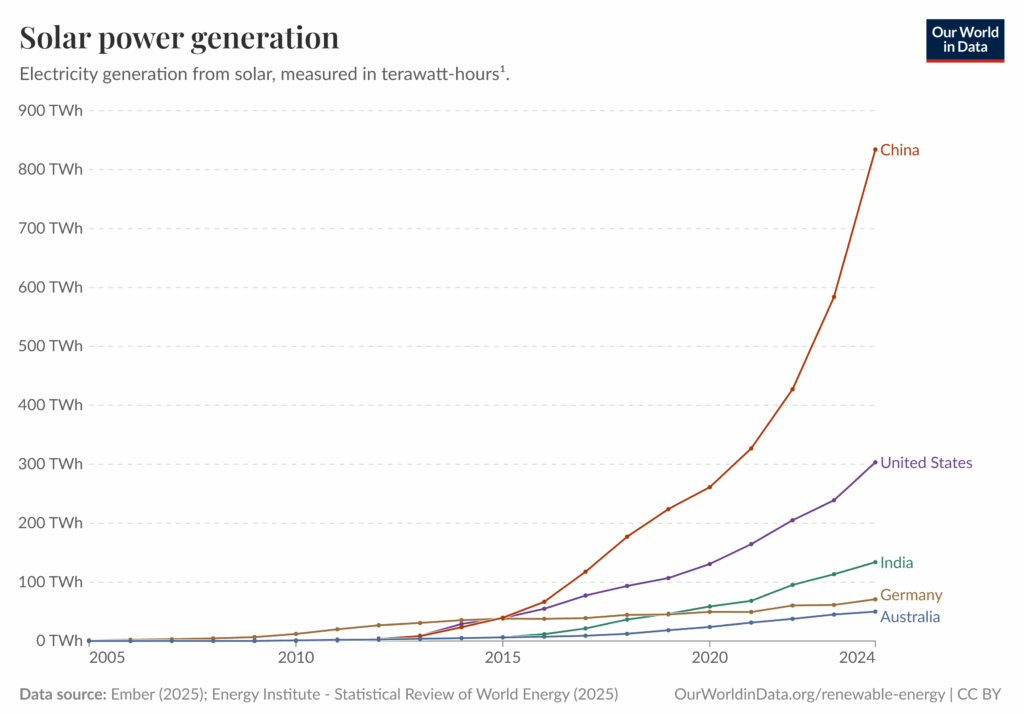
Data Table
| Country | Solar Production (TWh, 2024) |
|---|---|
| Australia | 49.84 |
| China | 834.10 |
| Germany | 70.99 |
| India | 133.81 |
| United States | 303.17 |
Answer Key: Question 1: Total = 49.84 + 834.10 + 70.99 + 133.81 + 303.17 = 1391.91
China’s share = 834.10 ÷ 1391.91 ≈ 60%
Question 2: Answers will vary. (Example: Australia may have less developed solar infrastructure or lower energy demand due to its smaller population, while Germany has made significant investments and policies supporting solar energy, leading to higher production relative to its size.)
Question 3: Answers will vary. (Example: China’s far higher solar production suggests greater government investment, stronger policy incentives, or higher national energy demand compared to Australia.)
Question 4: Answers will vary. Question 5: Answers will vary.
Solar Panel Energy Lab
Instructions: Use the Solar Panel Energy Lab – Student Handout and the following Teacher Guide to conduct the lab activity.
Introduction
How does the angle of a solar panel affect solar energy output? In this lab, students will conduct an investigation and use real-world instruments and tools to find out the answer to this question. They will learn how to accurately collect data, make conclusions based on careful analysis, and present their findings.
Student Objectives
Students will be able to
- Investigate how changing the angle of a solar panel affects its electricity output.
- Analyze data from repeated trials to draw conclusions about optimal panel placement.
- Connect findings to real-world solar panel installation and energy design.
Materials
- Student Handout
- Small solar panel or solar garden lights*
- Multimeter (to measure voltage and/or current)
- Duct or electric tape (to connect probes to wire ends)
- Protractor or adjustable stand (for precise angles)
- Lamp (with a consistent, bright bulb), a grow light, or bright sunlight
- Ruler/tape (to keep distance from light source constant)
- Graph paper or digital graphing tool
*Instructions for Using Solar Garden Lights
- Turn Off the Light: Make sure the solar light is switched off and dry before opening it.
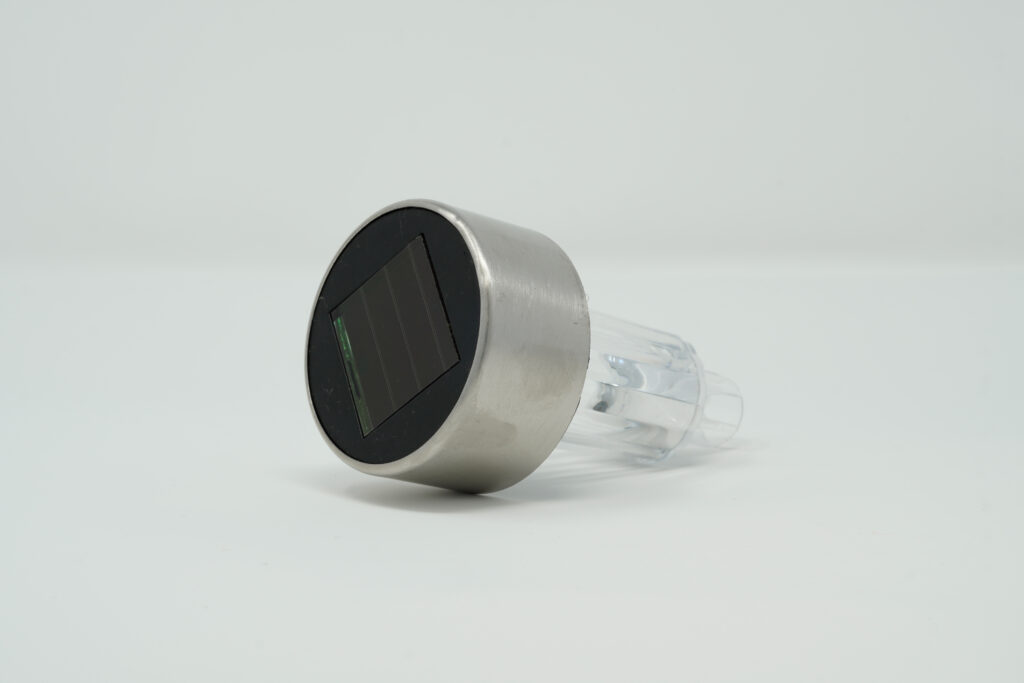
- Open the Solar Light: Look for screws or clips on the casing. Carefully open it to expose the small solar panel and its wires.
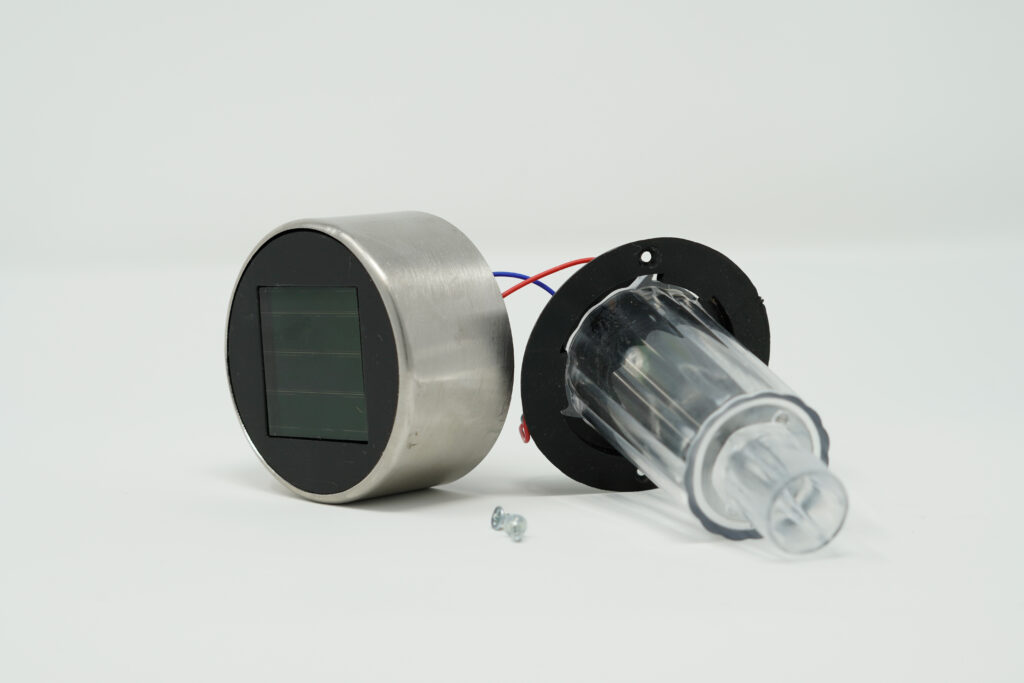
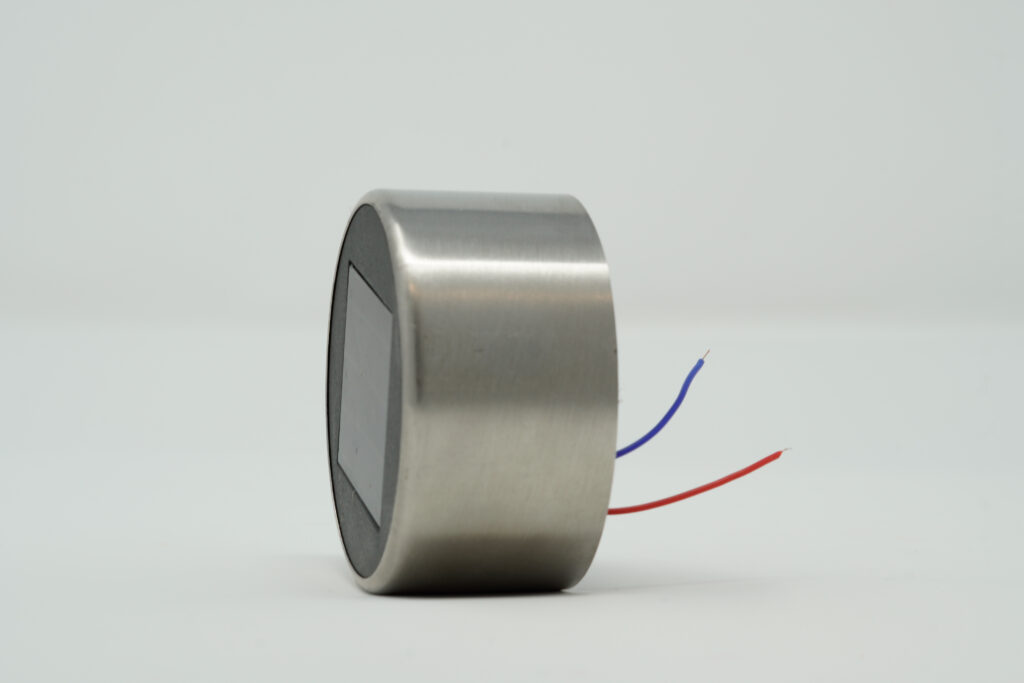
- Locate the Wires: Find the two thin wires running from the solar panel to the battery or circuit board.
- Disconnect the Wires: Remove the battery and carefully disconnect the two wires from the battery terminals.
- Expose the Wire Ends: If needed, strip about 1 cm of insulation from each wire using wire strippers or scissors. Be gentle to avoid breaking the wires.
Procedure:
- Divide the students into groups and provide each group with the Student Handout.
- Students will discuss the lab question “How does the angle of a solar panel affect how much electricity it produces?” and identify the independent, dependent and controlled variables.
- Students will discuss with their group and write their own hypothesis (If, Then Statement).
- Students will follow the instructions on the Student Handout to conduct the experiment, including multiple trials.
- Students will graph their results using graphing paper or an online digital tool (based on teacher preference or student choice).
- Finally, they will answer analysis questions and summarize the conclusion of their investigation.
Notes on Sunlight and Panel Angles (Sunlight vs. Lamp Experiments)
- When students conduct the experiment using a lamp, 0° represents maximum perpendicular light exposure—essentially the “ideal” alignment of panel and light source.
- In sunlight, however, 0° just means the panel is lying flat. The actual solar angle will depend on geographic location, time of day, and season. Therefore, students will likely see higher voltages at angles closer to the current solar altitude.
Discussion Prompt: Ask students why the best angle changes in sunlight but not with a fixed lamp. This helps reinforce real-world applications of solar tracking and seasonal solar energy collection.
Tip for Outdoor Setup: Recommend that students take note of the time and location during the experiment and optionally look up the current solar elevation angle using an app or website. This helps them connect their measured “best angle” with the sun’s actual position in the sky.
Teacher Tips
- Have students share and compare their data to discuss variability and sources of error.
- Reinforce the importance of multiple trials and averaging for scientific reliability.
- Discuss how this lab models engineering design – optimizing a system based on evidence.
Assessment Rubric
| Criteria | 3 – Excellent | 2 – Satisfactory | 1 – Needs Improvement |
|---|---|---|---|
| Completed data table | All data recorded clearly | Most data recorded | Missing/unclear data |
| Graph is accurate and labeled | All points/labels correct | Minor errors | Major errors/missing graph |
| Analysis questions | Thoughtful, complete answers | Some details missing | Answers incomplete |
| Safety and teamwork | Followed all instructions | Minor reminders needed | Did not follow instructions |
Answer Key
Lab Question: A. angle of the solar panel B. electricity C. light intensity, type of solar panel, distance from the light source
Hypothesis: Answers will vary. (Example: If the solar panel is angled to face the light source directly, then it will produce the most electricity.)
Analysis Questions: Answers will vary.
Optional Extension Activities
1. Light Source Comparison
Repeat the experiment using different types of lamps (LED, incandescent, fluorescent) or try under both sunlight and artificial light. Record and compare your results.
2. Seasonal Effects
Research how the optimal angle for solar panels changes with seasons in your location. How would this affect your experiment and real-world installations?
3. Cost Analysis
Estimate the cost savings for a homeowner if they increase panel output by 20% due to better angle placement. Use research to find local electricity rates.
4. Shading Investigation
Test how partial shading (covering part of the panel) impacts voltage/current at the best angle. What does this imply for panel placement on rooftops?
5. Real-World Design Proposal
Design a solar panel setup for a specific building (your school, home, etc.), justifying your angle choice based on data and research.
Exit Ticket
Instructions: Access the Exit Ticket and have students reflect on and answer the prompt.