

Instructions: Read the “Solar-Powered Bake-Off” story and answer the reflection questions below.
One hot and sunny afternoon, Mia and Jake decided to have a backyard baking challenge. The goal? To make the best chocolate chip cookies—using only the Sun’s energy!
Mia chose the passive solar method. She placed her cookie dough on a dark-colored tray inside a closed, clear plastic-covered box. As the sunlight passed through the plastic, it heated up the inside, just like a greenhouse. The trapped heat slowly baked her cookies over time.
Jake wanted a faster approach. He built a solar oven with reflective mirrors to direct more sunlight onto his baking tray. Then, he added a small solar-powered fan that circulated the warm air, distributing the heat more evenly. His setup used active solar energy since it involved extra equipment and devices to move and control the heat.
After a few hours, both had warm, gooey cookies! Mia’s passive solar method took longer but worked naturally with the Sun’s heat. Jake’s active solar method baked his cookies more quickly by using extra components to enhance the heating process. That’s the key difference! Passive solar energy collects and stores heat naturally, while active solar energy uses mechanical or electrical systems to enhance or distribute the heat.
Reflection Questions
- What were the key differences between Mia’s and Jake’s solar cooking methods?
- Why did Mia’s passive solar method take longer to bake the cookies?
- How did Jake’s active solar method speed up the baking process?
- If you were to bake cookies using only solar energy, which method would you choose and why?
Investigation Instructions: Passive vs. Active Solar Models
Objective
Explore the difference between active and passive solar energy by designing and testing two different solar-heating models.
Write a Hypothesis:
Predict which model will result in the greatest temperature change.
Materials
- Shoebox or other cardboard container
- Black construction paper
- Clear plastic wrap or sheet protector
- Tape
- Small black cup or aluminum can
- Room temperature water
- Plastic or paper straw
- Probe thermometer
- Direct sunlight or a heat lamp
- Stopwatch or timer
- Flinn Scientific Kit (optional): Solar Ovens Kit
Procedure
Part 1: Passive Solar Energy Experiment
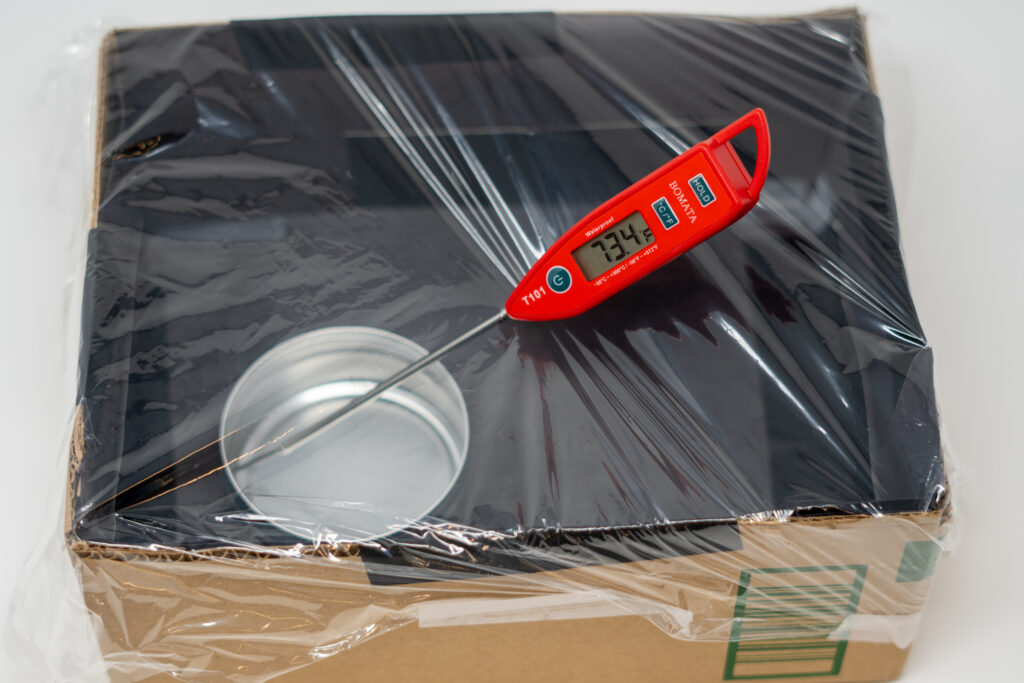
- Line the inside of one shoebox with black construction paper.
- Fill a black cup or aluminum can with water.
- Cover the top of the box with clear plastic wrap, securing it with tape to create a greenhouse effect.
- Use the probe thermometer to poke a hole through the plastic wrap. Position the probe inside the water cup and the display unit where it can be easily read.
- Put the box in direct sunlight or under a heat lamp.
- On the Passive Solar Data Table, record the starting temperature of the water.
- Check and record the water temperature every 1 minute for 20 minutes.
Part 2: Active Solar Energy Experiment
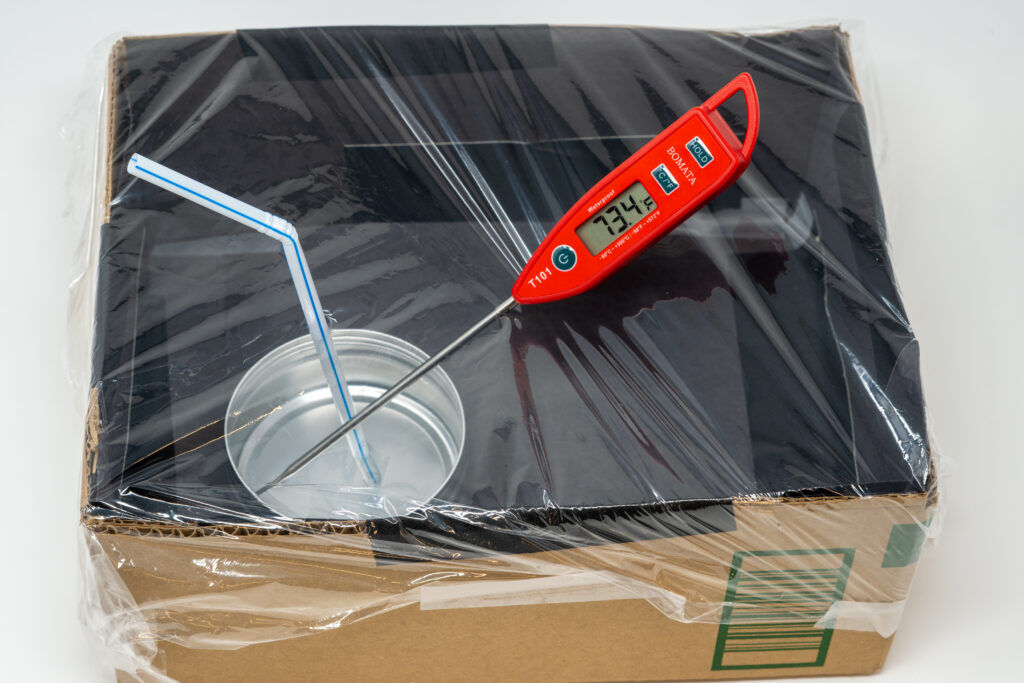
- Follow the same instructions from Part 1: Steps 1-4
- Make another small hole in the plastic so that you can insert a straw into the cup.
- Set the model in direct sunlight or under a heat lamp.
- On the Active Solar Data Table, record the starting temperature of the water.
- Every 1 minute, lightly blow air into the straw, making the water bubble, simulating active circulation, and record the temperature every 1 minute for 20 minutes.
Data Tables
Passive Solar Data Table
Starting Temperature: ____________
| Time | Temp | Time | Temp | Time | Temp | Time | Temp |
|---|---|---|---|---|---|---|---|
| 1 min. | 6 min. | 11 min. | 16 min. | ||||
| 2 min. | 7 min. | 12 min. | 17 min. | ||||
| 3 min. | 8 min. | 13 min. | 18 min. | ||||
| 4 min. | 9 min. | 14 min. | 19 min. | ||||
| 5 min. | 10 min. | 15 min. | 20 min. |
Temperature Difference After 20 Minutes: ____________
Active Solar Data Table
Starting Temperature: ____________
| Time | Temp | Time | Temp | Time | Temp | Time | Temp |
|---|---|---|---|---|---|---|---|
| 1 min. | 6 min. | 11 min. | 16 min. | ||||
| 2 min. | 7 min. | 12 min. | 17 min. | ||||
| 3 min. | 8 min. | 13 min. | 18 min. | ||||
| 4 min. | 9 min. | 14 min. | 19 min. | ||||
| 5 min. | 10 min. | 15 min. | 20 min. |
Temperature Difference After 20 Minutes: _________
Conclusion
- Which experiment resulted in the greatest temperature difference?
- Did the experiment prove or disprove your hypothesis? Explain why.