

Bell Ringer
Instructions: Select one of the Bell Ringers for students to reflect on and answer.
Vocabulary
Instructions: Go over important terms and their definitions before watching the Introduction to Solar video. Student vocabulary list can be found in the Student Guide and Introduction to Solar – Starter Pack.
| Word | Definition | Example |
|---|---|---|
| Generate | verb; to produce or create something, especially power or electricity | “To generate electricity, solar panels just need sunlight.” |
| Standardized | adjective; made the same in form or quality, so that things work the same way everywhere | “The technology is common and manufacturing is standardized.” |
| Modular | adjective; made of separate parts or modules that can be combined or rearranged. | “The panels are lightweight, easy to install, and modular, meaning solar systems can be very small …” |
| Scaled | verb; changed in size to make things bigger or smaller, depending on what’s needed | “ . . . or they can be scaled reasonably quickly for large projects . . .” |
| Emissions | noun; pollutants or gases released into the air, often by vehicles or power plants | “. . . all while producing zero emissions at the generation source.” |
| Displace | verb; to force something or someone to move from its usual or original place | “Large solar plants cover enormous areas of land that displace wildlife . . .” |
| Inefficient | adjective; not working in the best way – it wastes energy, time or resources | “The panels themselves are inefficient at making electricity . . .” |
| Landfills | noun; places where trash and waste are buried under the ground | “They wear out, and need to be disposed of in landfills.” |
| Intermittent | adjective; starting and stopping – not happening all the time | “This means solar needs an electricity source to backup its intermittent output.” |
| Grid | noun; a system of wires and power lines that brings electricity to homes and buildings | “This [backup] can be a battery system or a grid connection . . .” |
| On Demand | adjective phrase; available whenever it is needed, without delay | “This [backup] can be . . . on demand generation like natural gas or hydro . . .” |
Quiz & Cloze Notes
Instructions: Review key concepts after watching the Introduction to Solar video. The Student Guide and Introduction to Solar – Starter Pack contains the quiz and cloze notes.
Quiz Answer Key: Q1:A Q2:A Q3:D Q4:B
Cloze Notes Answer Key: generate, sun, emissions, inefficient, intermittent, backup, landfills
Data Set
Instructions: Provide students with the Introduction to Solar – Data Set for data literacy and analysis practice.
Share of Renewable Electricity Generation by Technology, 2000 – 2030
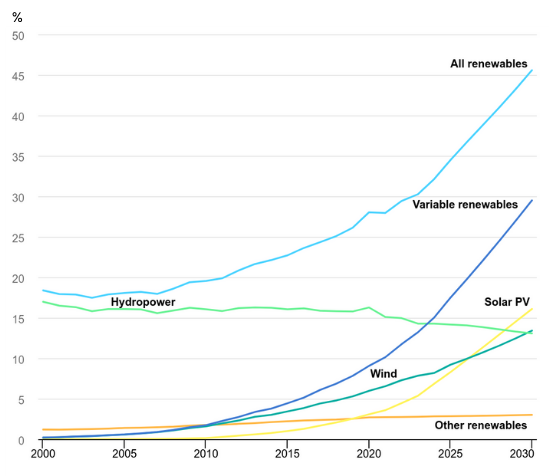
Source: IEA (2024), IEA, Paris https://www.iea.org/data-and-statistics/charts/share-of-renewable-electricity-generation-by-technology-2000-2030, License: CC BY 4.0
Answer Key: Question 1: A Question 2: C Question 3: C Question 4: Answers will vary (Example: As technology improves, solar panels are getting better at making electricity, which makes them more useful.) Question 5: Answers will vary.
Active and Passive Solar Lab
Instructions: Use the Active and Passive Solar Lab – Student Handout and the following Teacher Guide to conduct the lab activity.
Introduction
Students will explore the differences between passive and active solar energy and conduct experiments demonstrating how thermal energy from the Sun can be efficiently harnessed and transferred. By studying thermal transfer, students will learn how passive solar design can help meet energy needs and improve energy efficiency.
Student Objectives
- Explore the difference between passive and active solar energy.
- Test and collect data on two different solar-heating models.
- Discuss real-world building and design cost-benefits.
Materials
For Solar Experiments: (for each group of 3-4 students)
- Shoebox or other cardboard container
- Black construction paper
- Clear plastic wrap or sheet protector
- Tape
- Small black cup or aluminum can
- Room temperature water
- Straw
- Probe thermometer
- Direct sunlight or a heat lamp
- Stopwatch or timer
Procedure
Step 1: Introduction
Provide students with the Reading Activity and Investigation Instructions handout and have them work in pairs to read the “A Solar-Powered Bake-Off” story then answer the reflection questions. Have students share their answers and ask questions in a class discussion on passive vs. active solar energy. Alternatively, the teacher could read the story to the class and conduct a whole-class discussion on the reflection questions.
Step 2: Experiments
Divide the class into groups of 2-3 and have students follow the instructions on the lab sheet to conduct the passive vs. active solar energy experiments.
Step 3: Class Discussion
After completing the experiments and drawing conclusions, engage students in a class discussion, making real-world connections with the following discussion questions and features table:
- How are passive and active solar energy used to heat and cool real buildings?
- What are the cost-benefits of each?
- How could passive solar designs help in sustainable architecture?
- Where would each method be more effective (e.g. hot vs. cold climates)?
Passive and Active Solar Energy Features Table
| Feature | Passive Solar Energy | Active Solar Energy |
|---|---|---|
| Mechanical energy needed? | No | Yes |
| Energy collected? | Absorbed and stored | Uses mechanical devices to transfer energy |
| Example | Greenhouses, sunrooms | Solar water heaters, solar panels |
| Cost? | Cheaper (few materials) | More expensive (equipment required) |
| Maintenance? | Low (once built) | Higher (requires upkeep) |
Step 4: Extension Ideas
Have students modify the designs to improve heat absorption, and/or test with different materials (foil lining, different colors, etc.)
Reflection Questions Answer Key:
Question 1: (Example response): Mia used a passive solar method, letting the Sun’s heat naturally warm up her cookies inside a plastic-covered box. Jake used an active solar method, which included extra tools (mirrors and a fan) to make the cookies bake faster.
Question 2: (Example response): Mia’s method took longer because it didn’t use any devices to speed up the heating. The Sun’s energy had to slowly heat up the inside of her box, and the heat stayed mostly in one place.
Question 3: (Example response): Jake used reflective mirrors to focus even more sunlight on his cookies and a solar-powered fan to blow the warm air around. This made the oven warm up faster and spread the heat evenly.
Question 4: Answers will vary.
Hypothesis Example
(Example response): I think the active solar model will result in the greatest temperature change because the straw will help move the air like a fan and spread the heat more evenly inside the box.
Conclusion Answer Key
Question 1: (Example response): The active solar method had the biggest temperature change. The water in the cup heated up more in the active setup than in the passive one.
Question 2: Answers will vary.
Exit Ticket
Instructions: Access the Exit Ticket and have students reflect on and answer the prompt.