

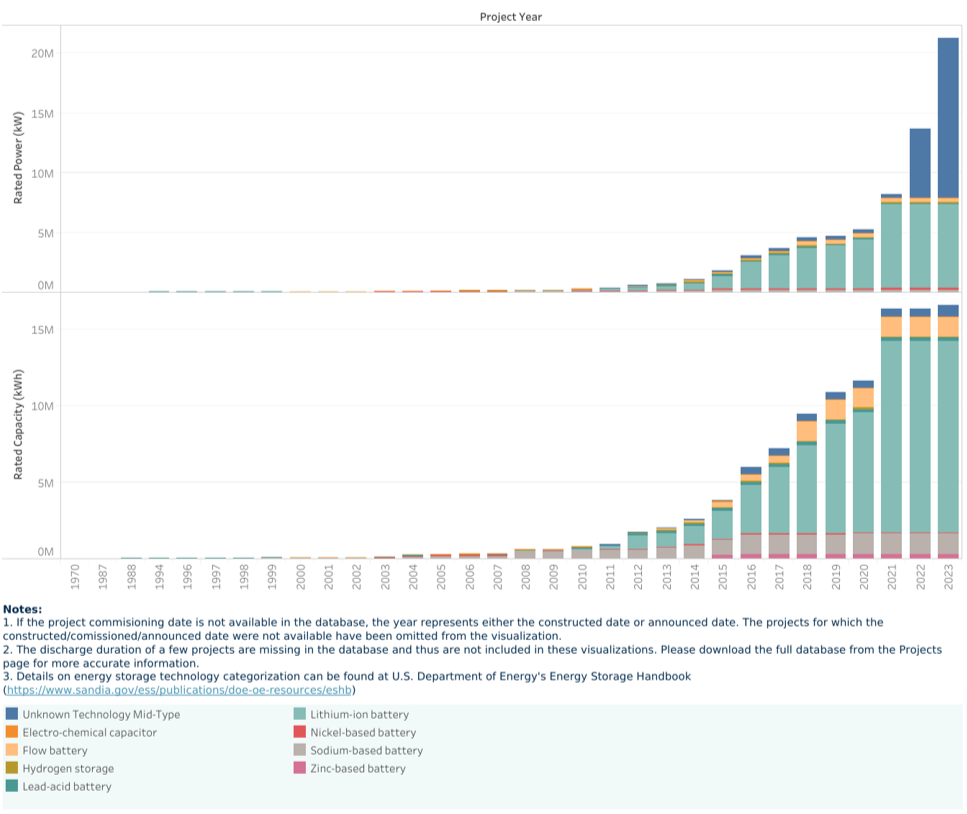
Cumulative Sum of Energy Storage Installations by Year
Source: DOE
The graph above displays the rated power (top graph) and rated capacity (bottom graph) of several different energy storage methods.
Rated power refers to the instantaneous rate at which energy can be transferred in or out of the storage system. This indicates the system’s ability to handle peak loads and provide quick bursts of energy. A system with a high power rating can quickly discharge to meet a sudden increase in demand or provide power during a grid outage.
Rated capacity is the total amount of energy the system can store and release before needing to be recharged or replenished. This value determines how long the system can sustain its power output before needing to be recharged. A system with a high energy capacity can provide power for an extended period, such as several hours, before requiring a recharge.
In essence, power capacity is about the speed of energy delivery, while energy capacity is about the duration of delivery. When choosing an energy storage system, it’s crucial to consider both the power and capacity ratings to ensure it meets the specific energy needs of the application.
Instructions: Study the graph and definitions above to answer the questions.
Question 1
How does the pace of energy storage installations change over time in the graph? Identify a period when growth was slow, and one when it was fast. What might explain those differences?
Question 2
The graph includes storage projects labeled as “unknown technology mid-type.” Why might some projects not have their technology type listed? How does that affect what we can learn from the data?
Question 3
Energy storage helps solve problems with solar and wind energy, which don’t always produce electricity when it’s needed. Based on the growth in storage installations, what might this suggest about the role of storage in supporting hydropower, solar, and wind energy?
Question 4
If the trend in the graph continues, what challenges might come with rapidly increasing energy storage capacity? Think about things like materials, costs, or grid integration.
Question 5
As more energy storage is installed, why might it be important to have different types (like batteries, pumped hydro, or thermal)? What could happen if we relied on just one type of storage technology?