

Bell Ringer
Instructions: Select one of the Bell Ringers for students to reflect on and answer.
Vocabulary
Instructions: Go over important terms and their definitions before watching the Introduction to Energy Choices video. Student vocabulary list can be found in the Student Guide and Introduction to Energy Choices – Starter Pack.
| Word | Definition | Example |
|---|---|---|
| Attribute | noun; a quality, feature or characteristic that belongs to someone or something | “[Energy choices are] based on four attributes: affordable, available, reliable, and sustainable.” |
| Reliable | adjective; able to be trusted to work well or do what is expected | “ . . . we have to back [wind and solar] up with a more reliable, on-demand source.” |
| Sustainable | adjective; not harmful to the planet and able to last a long time | “And energy that is not affordable is ultimately not sustainable.” |
| Open market | noun phrase; a system where goods and services are traded freely with few restrictions | “It’s hard for an expensive resource to compete in the open market with a cheap one.” |
| Externality | noun; a hidden cost or side-effect of something that affects others | “Paying for these so-called externalities would raise their cost and bring competing sources closer together.” |
| Market disadvantage | noun phrase; a condition where a product or company has fewer benefits compared to others | “But if some countries do this and others don’t, it creates a market disadvantage.” |
| Subsidy | noun; money given by a government to help lower the cost of a product or service | “Subsidies help bring down the cost of expensive new technologies, but we can’t afford to subsidize them forever.” |
| Commodity | noun; a raw material or basic product that can be bought and sold | “[Oil’s highly developed transportation network] has made a regional resource into a global commodity.” |
| Consistent | adjective; always acting or behaving in the same way – staying steady over time | “Can we rely on a consistent supply?” |
| Disrupt | verb; to cause something to stop working in the usual way | “With oil, hurricanes and war have sometimes disrupted that global trade.” |
| Intermittently | adverb; starting and stopping – not working continuously | “Wind and solar produce electricity intermittently.” |
| Criteria | noun; standards or rules used to make a decision or judgment | “The energies that best meet these four criteria will be the energies that we choose to use in the future.” |
Quiz & Cloze Notes
Instructions: Review key concepts after watching the Introduction to Energy Choices video. The Student Guide and Introduction to Energy Choices – Starter Pack contain the quiz and cloze notes.
Quiz Answer Key: Q1:A Q2:C Q3:D Q4:B
Cloze Notes Answer Key: any order [affordability, availability, reliability, sustainability], price, transportation, intermittent, environmental
Data Set
Instructions: Provide students with the Introduction to Energy Choices – Data Set for data literacy and analysis practice.
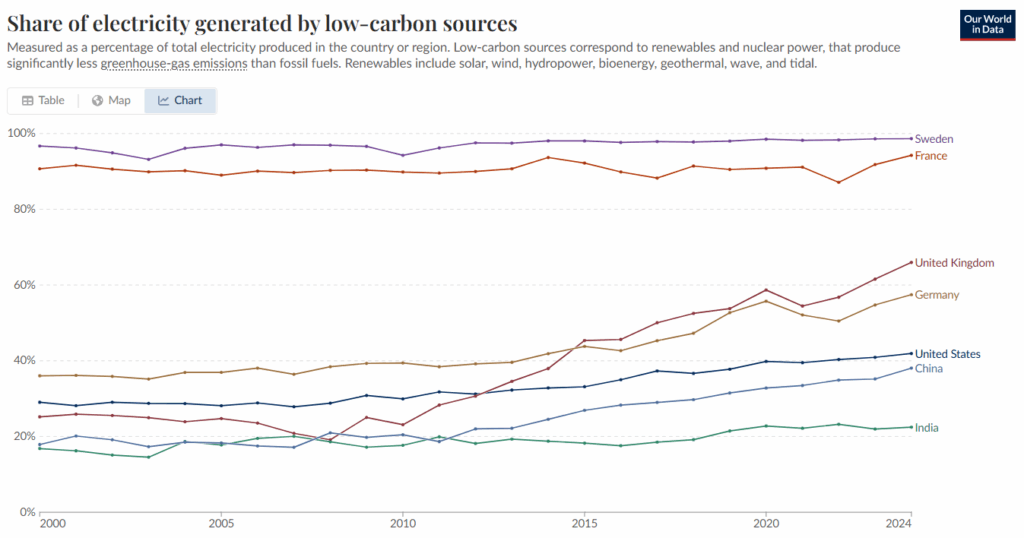
Answer Key: Question 1: Answers will vary. (Example: Both Sweden and France’s share of low carbon electricity has stayed steadily over 90% from 2000 to 2024. Sweden and France’s trend lines stayed steady and flat, while the other countries started with lower percentages and increased more over time.)
Question 2: The United Kingdom had the biggest increase, more than doubling its low carbon electricity from 2000 to 2024. (65.99 – 25.19 = 40.8% increase).
Question 3: The United States had a little more low carbon electricity in 2024 (41.92 – 38.06 = 3.86% more). From 2000 to 2024 China increased its low carbon electricity by 20.19%, while the United States increased by 12.86%.
Question 4: Answers will vary. (Example: I think that Germany and the UK started investing more into low carbon energy sources after 2010 because new technology made it cheaper and easier to use. Maybe they also passed laws to reduce pollution or reduce coal usage.)
Question 5: Answers will vary.
Power Card Priorities Hands-On
Instructions: Use the Power Card Priorities – Student Handout and the following Teacher Guide to conduct the lab activity.
Introduction
In this activity, students will explore how different energy sources are selected and prioritized in the real world by applying four key criteria: affordable, available, reliable, and sustainable. Working in small groups, they will analyze energy cards and make decisions based on these pillars, sparking critical thinking and discussion. This activity encourages evidence-based reasoning and collaboration about energy use and its impact.
Student Objectives
Students will be able to
- Evaluate and categorize different energy sources based on the four energy pillars.
- Justify their energy choices based on evidence and reasoning related to real-world and local energy needs and trade-offs.
- Communicate their group’s 3 top energy choices and explain the reasoning behind their decisions.
Materials
- Student Handout per student
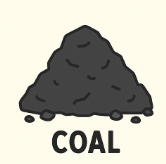
- Deck of Energy Source Cards per student (each student will receive 4 cards of each energy source)
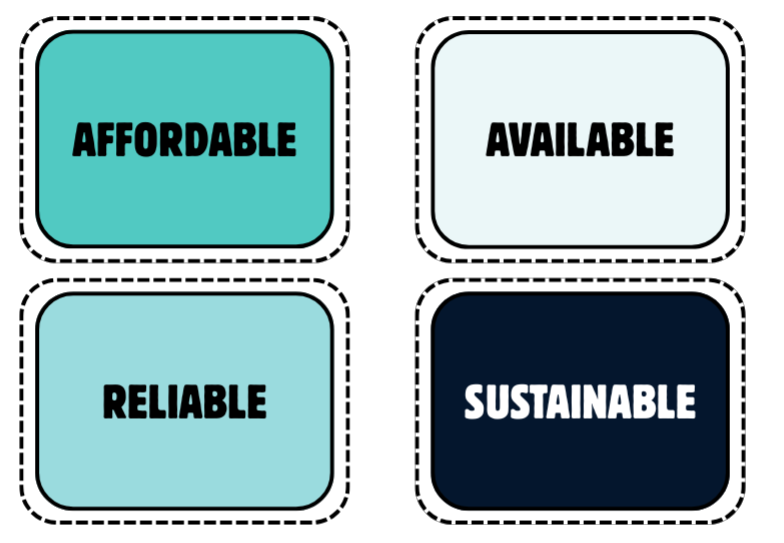
- One set of Pillar Cards per group (Affordable, Available, Reliable, Sustainable)
- Sheet of writing paper (per team) to draft their “Power Proposal.”
Procedure:
- Begin the class with a discussion on the “Four Pillars of Energy Decisions.” (Optional: Show students the video: Introduction to Energy Choices).
- Clearly define the Four Pillars. Students can give examples of things in their everyday lives that match each criteria.
- Affordable: Not costing too much and within most people’s budget.
- Available: Something that can be easily used or accessed when needed.
- Reliable: Able to be trusted to work well or do what is expected.
- Sustainable: Not harmful to the planet and able to last a long time.
- Arrange students into groups of 2-4.
- Have each group arrange the four Pillar Cards at the top of their table.
- Then, starting with one energy resource, students will place a card of that energy source beneath each Pillar they think it matches. For example, if the students started with the energy source “Coal”, their arrangement would look something like this:
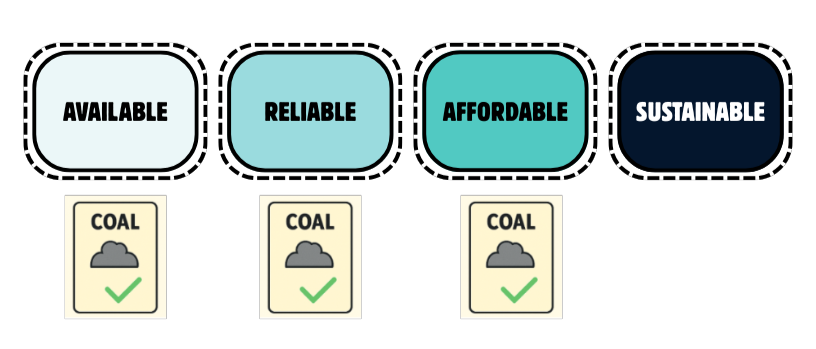
Coal is affordable, available, and reliable. However, it is not sustainable due to its high emissions.
- Students will continue through each energy source, matching Energy Cards to the Pillars. Encourage students to thoroughly discuss each choice. They can also connect the energy source to local conditions. For example, solar would be available if students lived in an area that got a lot of sun throughout the year, but unavailable if they lived in an area that is often cloudy or rainy. In order to place a card beneath a pillar, they need to all agree and be able to explain the reasoning behind their decision.
- Students will also fill out the Energy Source Evaluation Chart on the Student Handout as they make their decisions.
- Once students have completed going through each energy source, they will independently answer the reflection questions, including explaining what would be their top 3 energy sources for their community.
- Each team will then work together to create a “Power Proposal” for their community, and pitch it to the teacher and the rest of the class. The teacher and/or classmates can then vote on the most realistic and thoughtful proposal based on the rubric attached below.
Energy Source Evaluation Chart
Local conditions will change student answers and reasoning will vary. The chart below is to help teachers evaluate student responses and generate discussion.
| Energy Source | Affordable | Available | Reliable | Sustainable |
|---|---|---|---|---|
| Coal | Yes | Yes | Yes | No |
| Oil | Yes | Yes | Yes | No |
| Natural Gas | Yes | Yes | Yes | No |
| Solar | Debatable | Location-dependent | No | Debatable |
| Wind | Yes | Location-dependent | No | Debatable |
| Hydro | Debatable | Location-dependent | Yes | Yes |
| Nuclear | Debatable | Location-dependent | Yes | Debatable |
| Geothermal | Debatable | Location-dependent | Yes | Yes |
Power Proposal Rubric
| Category | Excellent | Needs Improvement |
|---|---|---|
| Use of the Four Pillars | Clearly applies all four pillars to each energy source in proposal decisions | Mentions the four pillars sporadically with little explanation |
| Reasoning and Evidence | Strong reasoning with clear examples and facts | Weak or missing reasoning with unclear examples and few facts |
| Clarity of Proposal | Proposal is well-organized and easy to understand | Hard to follow or unclear |
| Teamwork and Participation | All team members contribute and support the final idea | One or two members dominate, while others are not involved |
Cards to Print
Pillar Cards
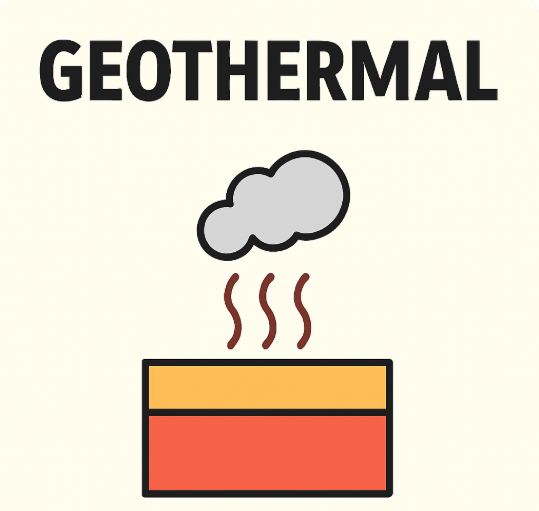
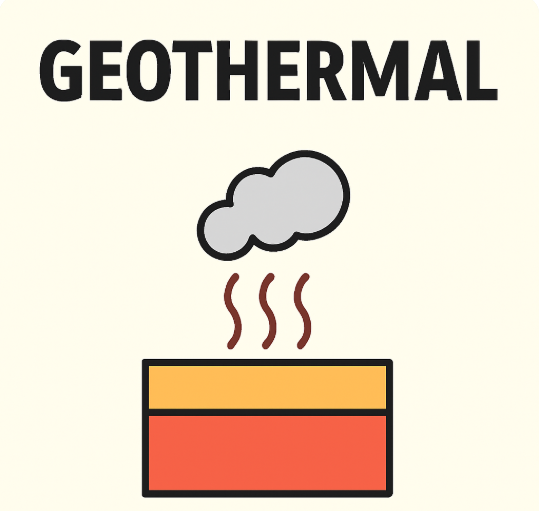
Energy Source Cards
 |  | 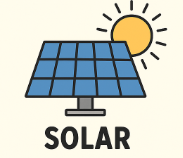 | 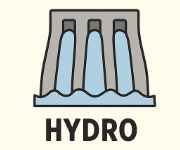 |
 | 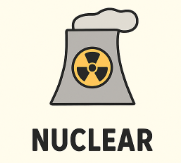 |  |  |
| | | |
| | |  |
Exit Ticket
Instructions: Access the Exit Ticket and have students reflect on and answer the prompt.