

Introduction
As an educator, comprehensively covering all of the major energy sources can sometimes seem intimidating or overwhelming. Why not let students do some of the work and learn about these sources from each other? Teaching during the month of February can be challenging, but Valentine’s Day creates the perfect opportunity for a fun and creative activity! In this activity, students will identify and explain the benefits of various energy sources by creating Valentine’s cards that highlight the benefits of a specific energy source.
Structure
Each student will be assigned one of the following energy sources: oil, coal, natural gas, nuclear, solar, wind, hydro, geothermal, biomass or biofuel. Depending on your class size, students can also work in pairs to research one of the energy sources.
Students will independently design and create a Valentine’s card for their assigned energy source. Each card must include at least three benefits, an illustration, and a catchy slogan to engage their classmates.
See below for Example Valentine’s Card and Grading Rubric for teacher reference.
Step-By-Step Instructions
1. To set the stage for the Valentine’s Cards, begin by showing the Introduction to Energy Choices video followed by a brief, whole-class discussion focused on the “Four Pillars of Energy Choices” outlined in the video. For a more in-depth look into this topic, explore Switch Classroom’s Introduction to Energy Choices full lesson plan.
2. Ask Guiding Questions to connect the activity to the topic, such as “What makes a good Valentine’s Day card?” and “How can we use our cards to creatively share information about energy sources?”
3. Assign each student an energy source and if class size requires it, pair up students to collaborate on one energy source.
4. Provide students time to research their assigned energy source with the goal of making it seem like a “lovable” energy resource.
5. Switch Classroom’s free, full lesson plans can assist students in providing credible and engaging information. For example, the lesson Introduction to Nuclear helps students learn about the mechanisms, advantages and complexities of nuclear power. Or Introduction to Geothermal explores the workings of geothermal energy, both its benefits and drawbacks. Switch Classroom has resources available for all assigned energy sources.
6. Students will design their cards based on their research. Each card must include:
- At least three benefits of the energy source.
- An illustration that represents the energy source.
- A catchy slogan that makes the energy source appealing and engaging.
Next Step: Optional Sharing Extensions
For the next step, have students share and showcase their energy source in a creative and engaging way through one of the following extension activities. The extensions will encourage students to interact, explain and share their energy source’s benefits, and engage in dynamic discussions, making the learning process even more memorable and meaningful.
- Gallery Walk: Set up a “Valentine Gallery” in the classroom. Students can display their cards on desks, walls, or bulletin boards. Each student or pair then walks around the room to view their classmates’ cards.
- Peer Engagement: Provide students with a checklist or worksheet featuring all the energy sources. As they view the cards, they can write down one benefit and the catchy slogan for each energy source.
- Speed Sharing: Arrange desks or tables in a large circle or rows. Students take turns sitting at their station to share the benefits and slogan aloud with classmates who rotate to listen for 1-2 minutes before moving to the next station.
- Energy Valentine Voting: After viewing all the cards, allow students to vote for categories such as “Most Informative,” “Most Creative Illustration,” or “Catchiest Slogan.” This adds a fun, competitive element.
- Digital Sharing: If technology is available, students can record short videos or audio clips presenting their cards. These clips can be shared in a slideshow or on a classroom learning platform for everyone to view.
Example Valentine’s Card
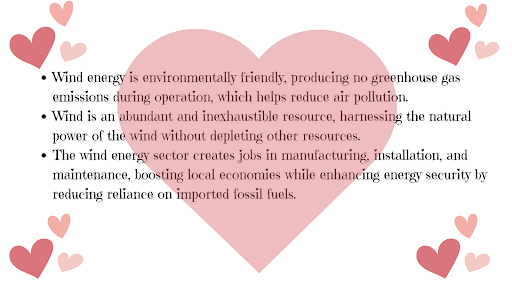
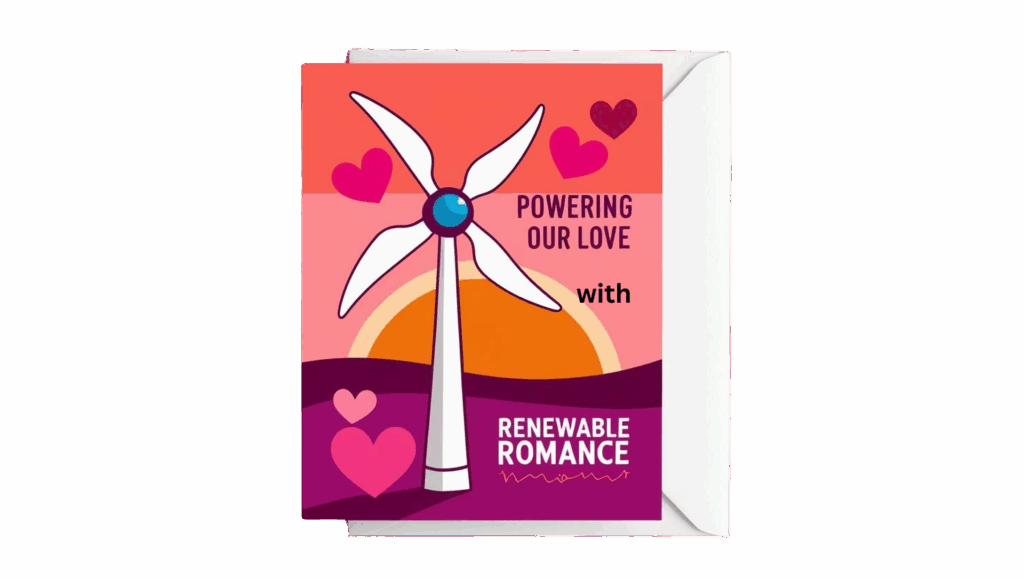
Grading Rubric
| Category | Advanced (Areas exceeding standards) | Criteria (Standards for this task) | Concerns (Areas that need attention) |
| Presentation | The card is well-presented, neat, and free of errors. – There are a few, if any, spelling mistakes. – Apparent care was taken to ensure an engaging picture. – Catchy slogan apparent. | ||
| Content: Benefits | The benefits of the energy source are clearly stated and easy to understand. – Three or more benefits are presented. – Benefits are well-researched. – Benefits go beyond the energy source itself (jobs, savings, etc.) | ||
| Creativity | The card is visually stunning, highly creative, and uses color and images effectively. – Creativity is evident in the making of the card. – Images are cited correctly. |