

Bell Ringer
Instructions: Select one of the Bell Ringers for students to reflect on and answer.
Vocabulary
Instructions: Go over important terms and their definitions before watching the Science of Hydropower video. Student vocabulary list can be found in the Student Guide and Science of Hydropower – Starter Pack.
| Word | Definition | Example |
| Hydropower | noun; power (usually electrical) created from the energy of moving water | “Biomass – burning wood – was our first major energy source, but not too long after came hydropower.” |
| Power plant | noun phrase; a large building or factory where electricity is generated from primary energy, such as coal, gas, water and uranium | “Water ran our first major power plants and it still accounts for three percent of global energy today . . .” |
| Gravitational pull | noun phrase; a force that pulls objects towards each other – everything that has mass pulls on other things with gravity | “ . . . and it does that by tapping into Earth’s gravitational pull.” |
| Counteract | verb; to act against something so that it has less effect or no effect at all | “When I lift this tank, the energy I use to counteract gravity is stored in the water.” |
| Potential Energy | noun; energy stored in an object due to its position or state, such as the energy in water held behind a dam | “When I lift this tank, the energy I use to counteract gravity is stored in the water. It’s called potential energy.” |
| Kinetic Energy | noun; the energy of an object in motion, such as water falling down a waterfall | “. . . the potential energy is turned into kinetic energy as the flowing water turns a turbine.” |
| Turbine | noun; a machine that converts the energy from flowing air or water into mechanical energy, often used for power generation | “. . . the potential energy is turned into kinetic energy as the flowing water turns a turbine.” |
| Pelton Wheel | noun phrase; a type of water turbine that uses fast-moving water to spin its spoon-shaped blades and make energy | “The water turns the Pelton wheel or impeller to which is connected to a generator.” |
| Impeller | noun; a spinning part inside a machine that pushes liquids or air to make them move faster or in a certain direction | “The water turns the Pelton wheel or impeller to which is connected to a generator.” |
| Generator | noun; a machine that works by turning motion into electrical energy | “The water turns the Pelton wheel or impeller to which is connected to a generator.” |
| Reservoir | noun; a large storage area for water, typically behind a dam | “One of the benefits of hydro is that you can store . . . a huge reservoir of water behind a dam.” |
| Emissions | noun; substances, especially gases, released into the atmosphere, usually as byproducts of energy production or burning fuel | “Gravity does the work so the electricity is cheap and the plant burns no fuel, meaning no emissions.” |
| Base Load | noun phrase; the minimum level of demand for electricity that is constantly needed and met by power plants as they produce energy | “The other great benefit of hydro is it can be base load or peak load power. As long as there’s water, it can run all the time.” |
| Demand curve | noun phrase; a line on a graph that shows how much electricity people need at different times of the day | “Or you can stop and start it almost instantly to follow the demand curve.” |
| Displace | verb; forcing populations to move from their original location, often due to large projects like building hydroelectric dams | “Flooding a river valley to make a reservoir means covering towns and displacing people.” |
| Refit | verb; to fix, change or add new parts to something, so that it works better or can be used in a new way | “The rest of the world is refitting old plans with more efficient equipment . . .” |
Quiz
Instructions: Review key concepts after watching the Science of Hydropower video. The Student Guide and Science of Hydropower – Starter Pack contain the quiz.
Answer Key: Q1:C Q2:A Q3:C Q4:C
Reading and Extended Reading
Instructions: Provide students with the Science of Hydropower – Reading or Extended Reading info sheet for an in-depth exploration of the topic.
Reading Answer Key
- Hydropower is energy produced by using the movement of water. It generates electricity by converting the potential energy of water stored at a height into kinetic energy as the water flows down, which turns a turbine connected to a generator.
- Potential energy is the stored energy an object has due to its position, like water at a high elevation in a dam. Kinetic energy is the energy of motion, like water flowing downhill.
- A turbine spins when water flows through it. The spinning motion creates mechanical energy, which is then converted into electricity by a generator.
- The Grand Coulee Dam is an example. It works by storing water in a reservoir created by a dam. When the water is released, it flows through turbines that generate electricity.
- Impoundment systems use a large reservoir created by a dam, while diversion systems use the natural flow of rivers or streams, without the need for a large reservoir.
- A larger reservoir stores more water, providing a more consistent supply of water for electricity generation, especially during times of low water flow.
- Hydropower is renewable because it uses the natural water cycle, which is constantly replenished by rainfall and snowmelt.
- Hydropower provides a steady, renewable source of electricity and helps reduce reliance on fossil fuels. It is also efficient and produces no greenhouse gases.
- Droughts reduce the amount of water available for hydropower generation, leading to less electricity production.
- Tidal power uses the rise and fall of ocean tides to generate electricity. It works by capturing the energy from the tides using turbines placed in tidal streams or on the seabed.
- A country might choose tidal power because it is more predictable than wind or solar power. Tides occur at regular intervals, making tidal power a reliable energy source in coastal areas.
- Large hydropower dams can flood land, displace wildlife and people, disrupt ecosystems, and affect fish migration. They can also impact water quality and biodiversity.
- Fish ladders help fish migrate past dams by providing a way for them to swim around or over the dam, ensuring their populations remain healthy.
- During low rainfall, there is less water available for hydropower generation, which can decrease electricity production and affect the reliability of the power supply.
- Hydropower can provide a steady and renewable source of electricity, reducing dependence on fossil fuels and lowering electricity costs. However, it can also cause problems such as land flooding, ecosystem disruption, and community displacement due to dam construction.
Extended Reading Answer Key
- Hydropower is energy produced by harnessing the power of flowing or falling water. It generates electricity by converting the potential energy of water at higher elevations into kinetic energy as it flows downward, which spins turbines connected to a generator that converts mechanical energy into electrical energy.
- Potential energy is stored energy due to an object’s position (e.g., water held at a height in a reservoir), while kinetic energy is the energy of motion (e.g., water flowing down and turning a turbine).
- Turbines are large wheels with blades that spin when water flows through them. The spinning turbines convert the kinetic energy of the moving water into mechanical energy.
- The Three Gorges Dam in China is the largest hydropower plant in the world, with a capacity of over 22,000 megawatts. It is significant because of its size and ability to generate large amounts of renewable energy, contributing to China’s energy production and reducing reliance on fossil fuels.
- Impoundment hydropower creates a reservoir by damming a river. Diversion hydropower diverts water from a river into a channel or pipeline. Pumped-storage hydropower stores energy by pumping water to an upper reservoir during low demand and releasing it during high demand.
- Water in a reservoir has potential energy due to its elevated position. When the water is released, it flows downward, and the potential energy is converted into kinetic energy, which drives turbines to generate electricity.
- The Grand Ethiopian Renaissance Dam (GERD) is unique as it is set to become Africa’s largest hydropower plant and will enable electricity exports to neighboring countries. It has faced regional tensions over water rights with Egypt and Sudan due to its location on the Blue Nile.
- Tidal power is highly predictable because tides are consistent and can be forecasted. It offers a renewable energy source that does not depend on weather conditions, unlike wind or solar power.
- The more efficient a turbine is, the more kinetic energy it can convert into mechanical energy, leading to greater electricity production from the same amount of water flow.
- Larger reservoirs can store more water, providing a more consistent supply of water for power generation, especially during periods of low water flow.
- Large-scale hydropower projects can flood ecosystems, displace communities, disrupt fish migration, and change local water quality, potentially leading to reduced biodiversity.
- Hydropower provides a renewable, domestic source of electricity, reducing dependence on imported fossil fuels and helping to stabilize energy supplies.
- Hydropower projects can displace communities, disrupt local economies, and affect agriculture. These impacts can be minimized by planning for compensation, environmental restoration, and building infrastructure to support displaced populations.
- Water availability is crucial, as reduced rainfall or droughts can lower water levels, reducing the amount of electricity generated. Hydropower plants rely on a consistent water supply to operate efficiently.
- Hydropower could boost the local economy by providing jobs and revenue from electricity exports. However, it could also have negative environmental impacts such as ecosystem disruption and community displacement, which would require careful management.
- Climate-related changes like droughts can reduce water availability, affecting hydropower plants’ ability to generate electricity. This could lead to power shortages or the need for backup power sources during dry periods.
- Building a large dam offers higher power generation potential but can have significant environmental and social impacts, such as ecosystem disruption and community displacement. Smaller diversion systems have less impact but generate less power and may not be as reliable in meeting energy demands.
- Factors to consider include minimizing ecosystem disruption, ensuring fish migration, reducing water quality impacts, and incorporating environmental restoration plans. The location and design should also consider local communities and water rights.
- Hydropower can provide a stable and reliable power supply, especially when integrated with other renewable sources. Pumped-storage hydropower can store energy during low demand and release it during high demand, helping to balance the grid.
- Fish ladders allow fish to bypass dams and continue their migration to breeding grounds. This helps maintain fish populations and supports biodiversity, reducing the negative environmental impact of hydropower plants.
Computation
Instructions: Provide students with the Science of Hydropower – Computation activity for math integration and practice.
Answer Key: Question 1: 12 million MWh x 0.80 = 9.6 million MWh
Question 2: 15 million MWh x 0.90 = 13.5 million MWh of usable energy
Question 3: Yes. The region’s demand is 12 million MWh per year, and the dam is able to produce 13.5 million MWh per year. 13.5 million MWh – 12 million MWh = 1.5 million MWh excess power
Question 4: 13.5 million MWh x 1000 = 13,500,000,000 kWh
13,500,000,000 kWh / 10,000 = 1,350,000 homes
Question 5: Answers will vary. Student answers should be comprehensive and consider multiple factors including carbon dioxide emissions, cost, displacement of people and disruption of ecosystems, etc.
Data Set
Instructions: Provide students with the Science of Hydropower – Data Set for data literacy and analysis practice.
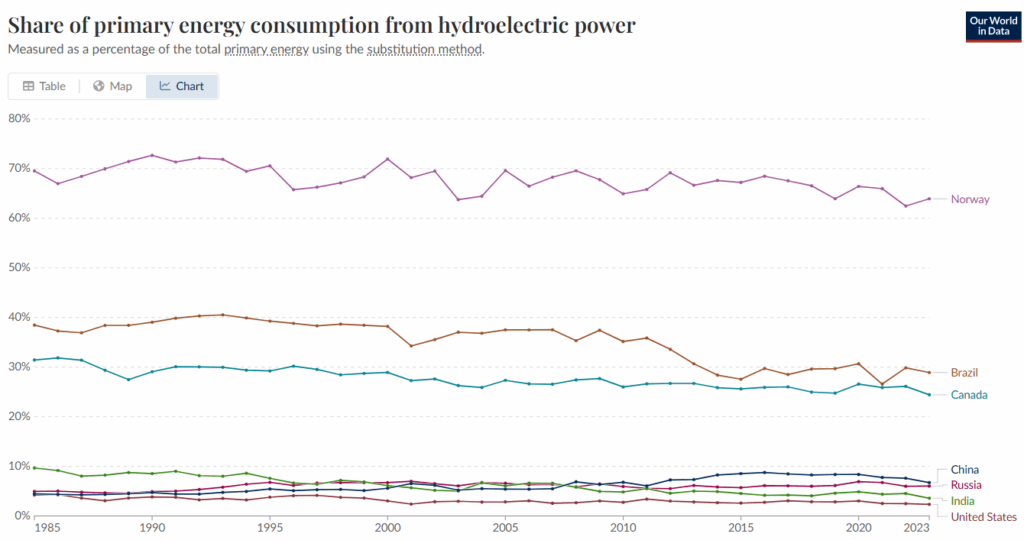
Data Table
| Country | 1985 | 2023 |
| Brazil | 38.5% | 28.9% |
| Canada | 31.4% | 24.4% |
| China | 4.4% | 6.7% |
| India | 9.7% | 3.6% |
| Norway | 69.5% | 63.9% |
| Russia | 4.9% | 6.0% |
| United States | 4.2% | 2.3% |
Answer Key: Question 1: Between 1985 and 2023, China and Russia increased their share of hydroelectric power. China increased 2.3% (6.7 – 4.4) and Russia increased 1.1% (6 – 4.9)
Question 2: No, not necessarily. A decrease in the share of hydroelectric power doesn’t always mean a country is producing less of it. It could mean that the total energy demand has grown and other energy sources (such as fossil fuels or solar, nuclear and wind) have increased even faster. So the hydroelectric output might be the same or even higher, but its percentage of the total energy mix has gone down.
Question 3: Answers will vary. (Example: Positive impacts include (environmental) reduced greenhouse gas production, cleaner air quality, less acid rain and (economic) job creation, lower long-term cost of operation, less damage from flooding. Negative impacts include (environmental) disruption of habitats/ecosystems, increased sedimentation, increased methane production in tropical regions due to the breakdown of organic material and (economic) high initial costs, displacing communities.
Question 4: Answers will vary. (Example: Countries may be focusing on developing and innovating other low-emission energy sources, such as wind and solar. Hydropower has been used for many years and is a stable energy source limited by the geography and availability of moving water.)
Question 5: Answers will vary. (Example: Norway has abundant mountainous terrain and steep rivers, making it ideal for building hydroelectric dams. Norway is also a wealthy nation that adopted hydropower early and has consistently maintained their dam systems. There is strong political commitment to sustainability and energy independence, with policies that support state-owned hydro companies and investment in sustainable energy.)
Water Pressure and Flow Investigation Lab
Introduction
In this lab investigation, students will explore how the height of water affects flow rate and pressure, which are key principles behind how hydroelectric dams generate energy. Using a simple jug-and-tube setup, students will model how gravity and water movement can be harnessed to simulate real-world hydropower systems. Students will practice data collection, analysis, and applied scientific reasoning.
Student Objectives
Students will be able to
- Understand how water height influences flow rate and pressure.
- Measure and calculate the flow rate.
- Collect, record, and analyze experimental data.
- Apply scientific reasoning to real-world hydropower systems, such as dams and turbines.
Materials
- Box cutter (pre-lab for teacher)
(per student group)
- Student Handout
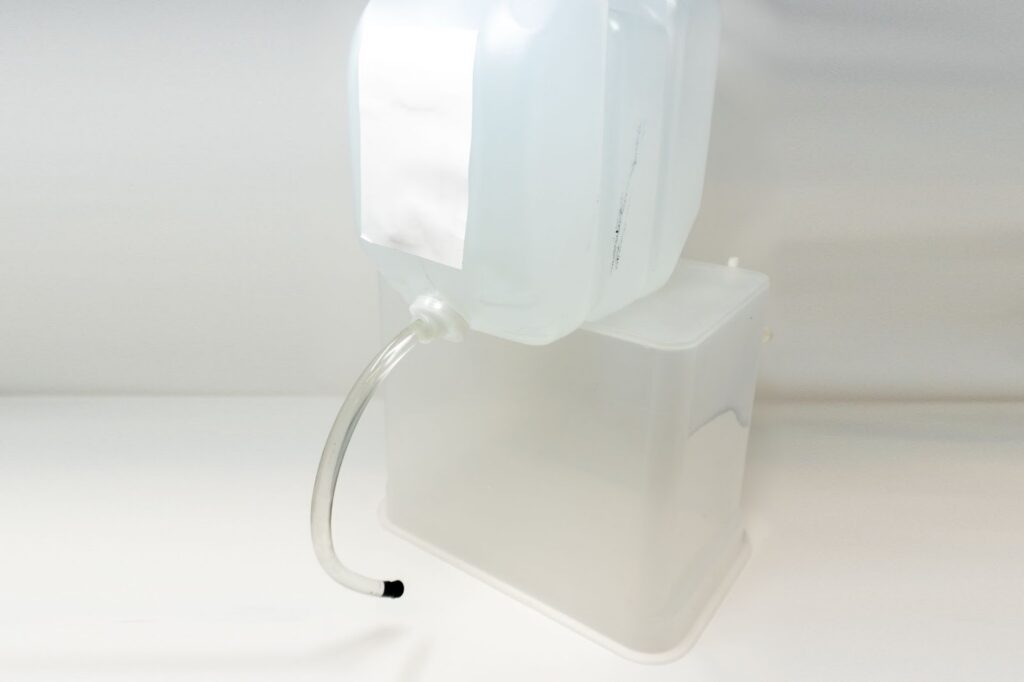
- Water jug with vent
- Example: 2.5 gallon water jug with vent
- Plastic tubing (~1 foot length)
- Example: ½”ID plastic tubing (diameter chosen can vary)
- Rubber stopper (needs to match the diameter of plastic tubing)
Example: 0# tapered rubber stopper - Glue gun
- Large container (to catch water from the jug)
- Large graduated cylinder or beaker (marked with mL/L) to measure water collected
- Stopwatch
- Ruler or measuring tape
- Permanent marker
Teacher Prep
(or supervised student group set-up)
- Using a box cutter, cut off the vent from the water jug.
- Insert the plastic tubing and seal with hot glue.
- Plug the other end of the plastic tubing with a rubber stopper.
- Using the permanent marker, mark the following levels on the jug: ¾ full, ½ full, ¼ full.
- Demonstrate the setup before students begin.
Procedure
- Divide the class into groups of 2-4 students.
- Provide each group with materials and the Student Handout.
- On the Student Handout is an Introduction and Research Question. Begin a class discussion on the goal of the investigation, leading to the formulation of a hypothesis.
- Assign roles before students begin the investigation: Timer, Recorder, Pourer, and Measurer.
- Instruct students to follow the instructions on the Student Handout to conduct the investigation.
- Remind students to use caution with water on floors to prevent slipping, and to clean up spills immediately.
- After completing the investigation, students will create a graph based on their collected data showing the relationship between flow rate and water height, and complete analysis and conclusion questions.
Answer Key
The Student Guide contains the Water Pressure and Flow Lab – Student questions
Analysis and Conclusion Questions
Question 1: (Example Response) As the water height increased, the flow rate also increased. This means that when the container was full, the water flowed out faster than when the container was only ¼ full. There is a clear positive relationship between water height and flow rate.
Question 2: Answers will vary based on the student’s specific hypothesis. (Example: Yes, my results supported my hypothesis. I predicted that the flow rate would increase with water height because more water above the tube means more pressure pushing the water out. The data showed that higher water levels consistently led to higher flow rates, confirming my hypothesis.)
Question 3: (Example Response) This model shows that the higher the water behind a dam, the more pressure it creates, which can spin turbines faster and generate more electricity. Just like in the experiment, gravity pulls the water down, and the more height (or potential energy) that it has, the more kinetic energy it can create when released.
Question 4: (Example Response) Engineers build tall dams to store more water to increase the potential energy of the water. A taller dam means the water can fall a greater distance, which increases the pressure and flow rate. This allows the turbines to spin faster and generate more electricity efficiently.
Question 5: Answers will vary based on the results of student trials. (Example: The results were mostly consistent but there were some small differences between trials. These differences could be caused by small timing errors when starting or stopping the stopwatch, or slight changes in how fast or slow the stopper was removed. Also, small leaks or bubbles in the tubing could affect the flow.
Question 6: Answers will vary. (Example: If the tubing was wider, I think the water would flow out faster because there’s more space for it to move through. If it was longer, the flow rate might slow down because there’s more resistance inside the tube. In real dams, engineers must design pipes and turbines to balance speed and pressure for maximum energy efficiency.)
Exit Ticket
Instructions: Access the Exit Ticket and have students reflect on and answer the prompt.