

Bell Ringer
Instructions: Select one of the Bell Ringers for students to reflect on and answer.
Vocabulary
Instructions: Go over important terms and their definitions before watching the Introduction to Environmental Impacts video. Student vocabulary list can be found in the Student Guide and Introduction to Environmental Impacts – Starter Pack.
| Word | Definition | Example |
|---|---|---|
| Impact | noun; the effect or influence something has on people, places or things | “All energy has environmental impacts, from air to water to solid waste, to land use, and beyond.” |
| Emissions | noun; gas or particles released into the air, especially by cars, factories and power plants | “The most discussed and debated environmental effect today is CO2 emissions.” |
| Fossil Fuels | noun phrase; energy sources like coal, oil, and natural gas formed from ancient plants and animals | “All fossil fuels, when burned, produce [emissions].” |
| Atmosphere | noun; the layer of gases that surrounds Earth and helps protect and support life | “How much, and what effect [reducing CO2 emissions] will have on the atmosphere . . . [is] yet to be seen.” |
| Acid Rain | noun; rain or snow that contains acids formed when pollution mixes with moisture in the air | “Sulfur dioxide causes acid rain.” |
| Erode | verb; to wear away or slowly destroy something | “Nitrogen oxides erode the ozone layer.” |
| Ozone Layer | noun phrase; a layer in the upper atmosphere that helps protect Earth by blocking the most harmful ultraviolet rays from the Sun | “Nitrogen oxides erode the ozone layer.” |
| Waste | noun; leftover or unwanted materials that are thrown away or not used | “But as a global society, we don’t do a very good job of managing gaseous wastes, a big area for improvement.” |
| Unconventional | adjective; not typical or widely used – different from the norm | “In unconventional oil and gas production, for cooling power plants . . . use a lot of water.” |
| Tension | noun; conflict or strain between people or groups | “ . . . we’ll likely see greater tension over water in the future.” |
| Minimize | verb; to reduce something as much as possible | “Good reason to work now to minimize quantities and improve recycling.” |
| Quantities | noun; amounts of something, especially materials or products | “Good reason to work now to minimize quantities and improve recycling.” |
| Concentrated | adjective; present in a strong or dense form, in a small area | “Renewable energies . . . cover much larger areas than more concentrated energies, like nuclear and fossil fuels.” |
| Consumers | noun; people who buy or use goods or services | “It’s usually more expensive to make energy less impactful, and the cost gets passed along to consumers.” |
| Prosperity | noun; the state of having success, good living conditions, or plenty of resources | “[Use] the prosperity that affordable energy brings to continue to invest in the environment.” |
| Invest | verb; to put time, money, or effort into something to get a future benefit | “[Use] the prosperity that affordable energy brings to continue to invest in the environment.” |
Quiz & Cloze Notes
Instructions: Review key concepts after watching the Introduction to Environmental Impacts video. The Student Guide and Introduction to Environmental Impacts – Starter Pack contain the quiz and cloze notes.
Quiz Answer Key: Q1:C Q2:A Q3:D Q4:C
Cloze Notes Answer Key: impacts, carbon dioxide (CO2), fossil fuels, gaseous, water, land, affordable
Data Set
Instructions: Provide students with the Introduction to Environmental Impacts – Data Set for data literacy and analysis practice.
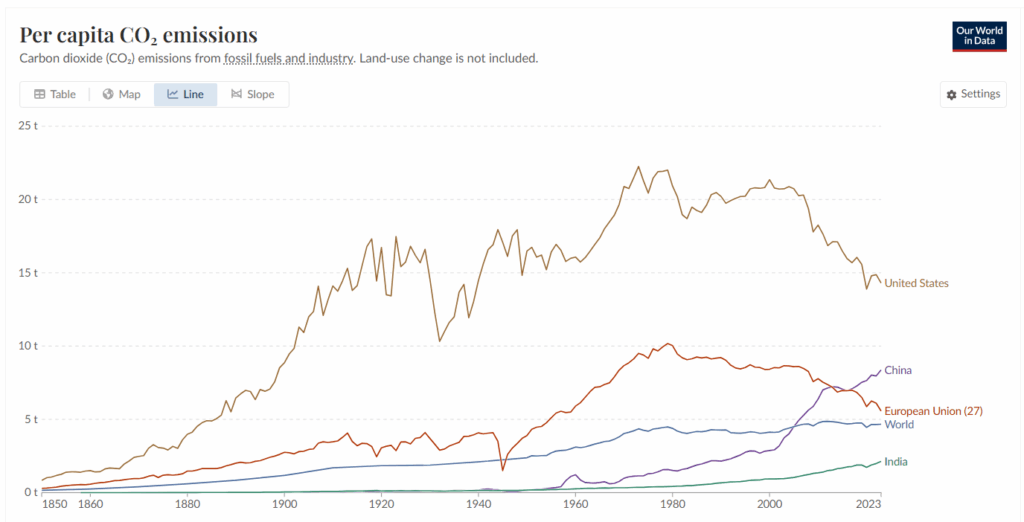
Source: Our World In Data
Data Table (Per Capita CO2 Emissions in tonnes per person)
| Country/Region | 1860 | 1960 | 2023 |
| China | 1.2 | 8.4 | |
| European Union | 0.6 | 5.9 | 5.6 |
| India | <0.1 | 0.3 | 2.1 |
| United States | 1.5 | 16.1 | 14.3 |
| World | 0.2 | 3.1 | 4.7 |
Answer Key:
Question 1: The United States; In the last four decades, its per capita CO2 emissions have decreased.
Question 2: China, India, World; Answers will vary. (Example: I think their emissions will continue to increase as more people get access to electricity, cars and technology.)
Question 3: Answers will vary. (Example: The U.S. is shifting from high-emission energy sources like coal, to lower-emission energy sources like natural gas and wind. The government has also made laws to regulate and lessen CO2 emissions.)
Question 4: Answers will vary. (Example: Yes, I think it matters because it’s fairer to compare how much pollution each person makes, not just the country as a whole. It may look like a country has low emissions, but if the population is also low, it may mean that each person is using a whole lot of energy.)
Impacts Game – Hands-On
Instructions: Use the Impacts Game – Student Handout and the following Teacher Guide to conduct the lab activity.
Introduction
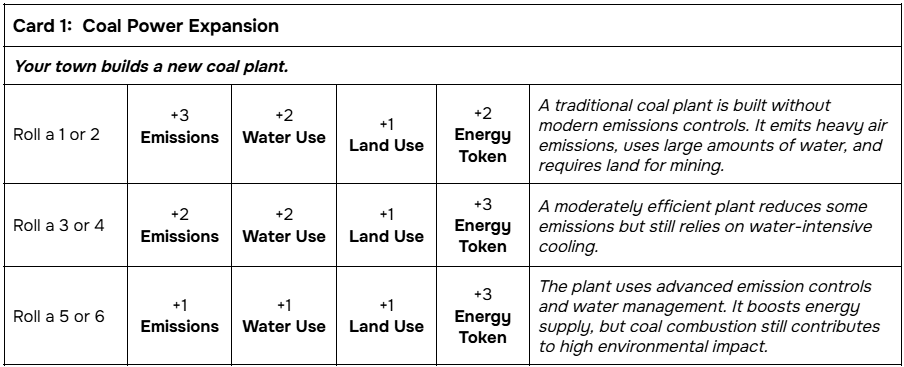
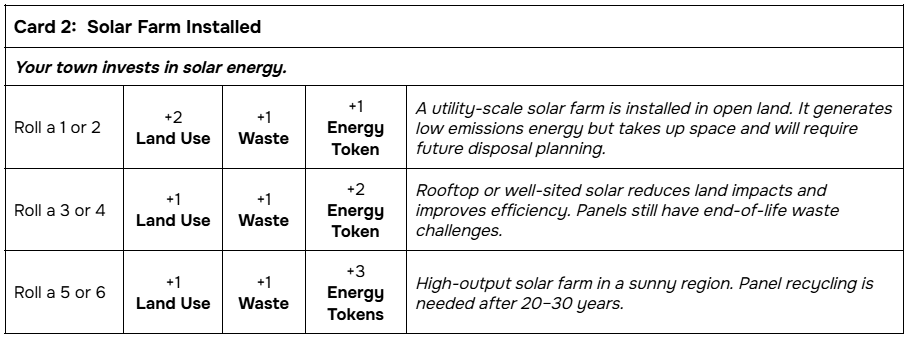
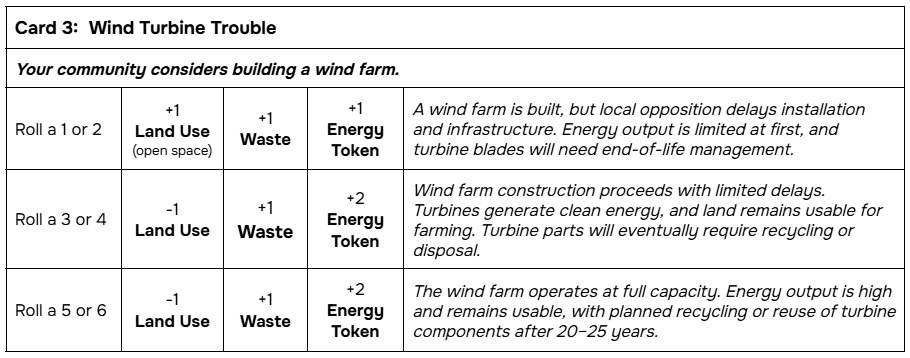
This fast-paced, engaging activity helps students explore the environmental trade-offs of different energy sources. In small groups, students roll dice to simulate real-world energy scenarios, gaining or losing energy tokens while tracking air emissions (referred to as “emissions” for this activity), water use, land use, and waste. After a set number of rounds, they compare results to see which group made the most sustainable choices. It’s a fun way to spark discussion and build awareness around energy and environmental impact.
Note on Terminology: The word pollution gets used a lot, but it’s not always clear what it means. In this activity, the focus is on the specific environmental impacts of different energy sources on our air, land, and water. Students will explore how each energy source affects the environment, beyond just calling it “clean” or “dirty.”
Student Objectives
Students will be able to
- Identify the environmental impacts associated with different energy sources.
- Analyze and compare the trade-offs between energy production and environmental sustainability.
- Track and interpret data from game outcomes to evaluate decision-making strategies.
- Collaborate in small groups to make informed choices based on scenario outcomes and group discussion.
Materials (per group)
- Student Handout
- 1 6-sided die
- Scenario cards (printed and cut out)
- ~25 Energy tokens (e.g. colored paper slips or small objects)
How to Play
- Each group receives
- A set of Scenario Cards
- The Student Handout (includes the Impact and Energy Tracker Sheet)
- 5 Energy tokens to start
- Place the Scenario Cards face down in a stack.
- When a player draws a Scenario Card, they should read it out loud, and then record the card name on the Tracker Sheet.
- The person sitting to the right of the card picker will roll the die to determine the outcome listed on the card.
- The person who rolled the die will then read the roll choice scenario out loud, and record Roll Choice description on the Tracker Sheet. They will also record impact and energy points on the Tracker sheet. This includes recording a gain or loss of energy tokens, adding emissions points, water use points, land use points, or waste points.
- After 4-8 rounds, or a set time, the group adds up their
- Total emissions points + total water use points + total land use points + total waste points = Total Environmental Impact
- Total energy points = Total Energy
- Student groups are successful if their environmental impact points do not exceed their total energy points!
- Students will work together in a group to complete the reflection questions on the Student Handout.
Extensions
- Add Scenario Cards based on extreme weather events, community protests, or new technology breakthroughs.
- Have students create their own Scenario Cards based on research.
- Use double dice rolls for more complexity (e.g. weather + energy policy)
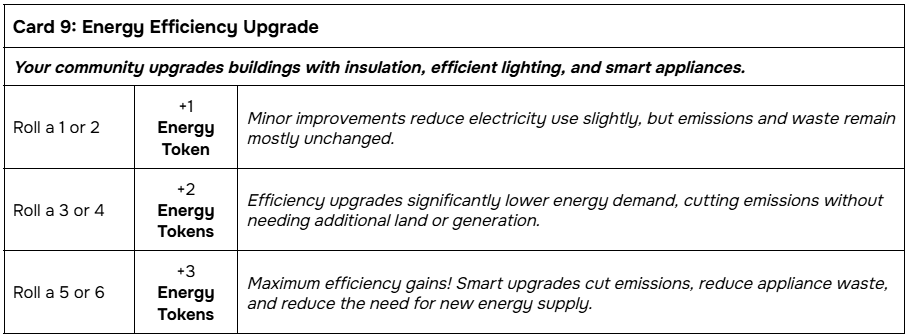
Scenario Cards

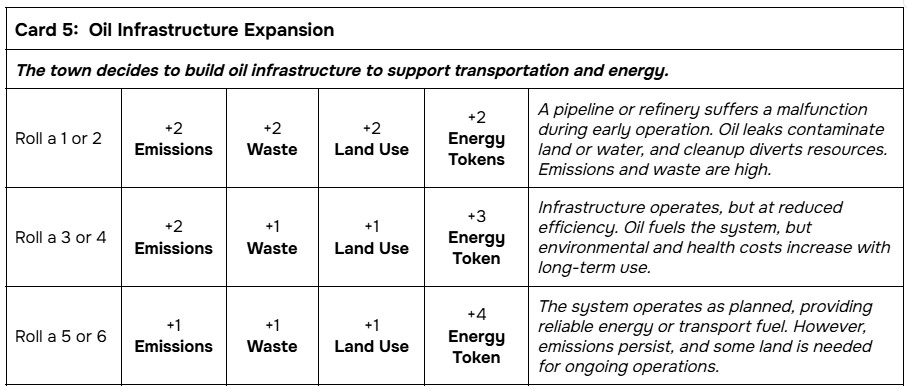
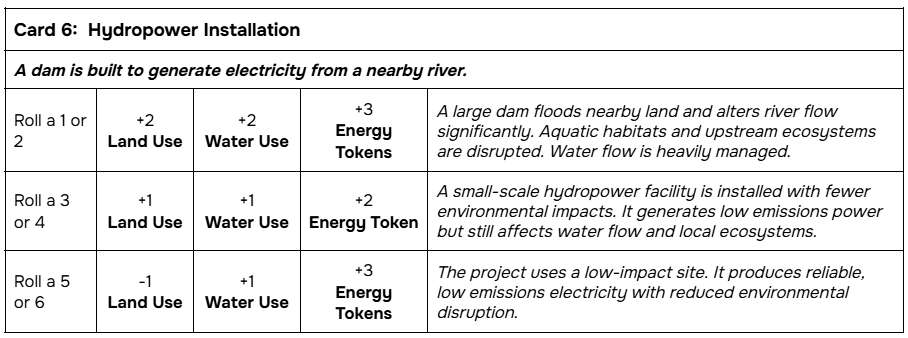
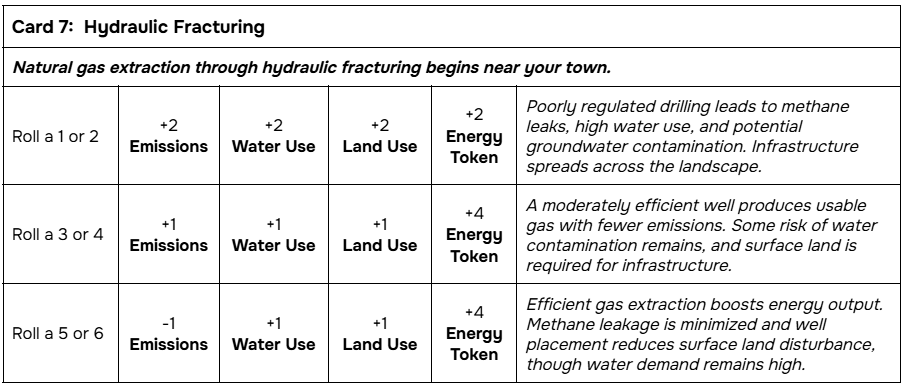
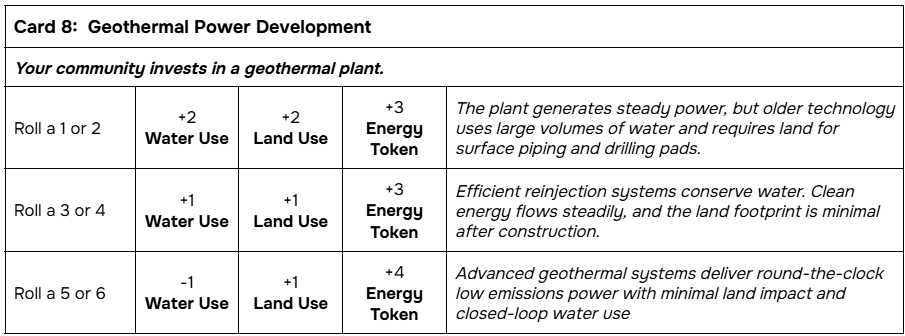

Answer Key
The Student Guide contains the Impacts Game – Student questions.
Reflection Questions Answer Key
Question 1: Answers will vary. (Example: This game shows how energy choices can have both good and bad effects. In real life, communities and governments have to make the best choice that balances energy that is affordable and available, and energy that is good for the environment.)
Question 2: Answers will vary. (Example: I was surprised that energy from solar and wind also has big environmental impacts, like land use and water use.)
Question 3: Answers will vary. (Example: People can be careful not to waste energy and make buildings and machines that use energy more efficiently.)
Question 4: Answers will vary. (Example: Tracking our points made us really think about each decision, and how fast pollution and waste could add up if poorer choices were made.)
Exit Ticket
Instructions: Access the Exit Ticket and have students reflect on and answer the prompt.