

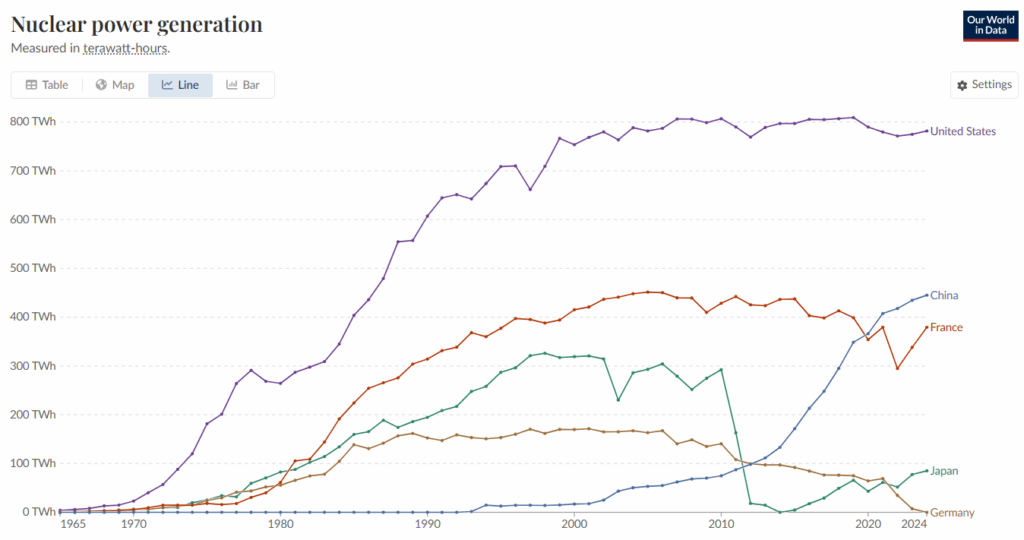
Source: Our World In Data
Data Table
| 1980 | 2000 | 2020 | 2024 | |
|---|---|---|---|---|
| China | 0 TWh | 16.74 TWh | 366.20 TWh | 445.17 TWh |
| France | 61.25 TWh | 415.16 TWh | 353.83 TWh | 379.27 TWh |
| Germany | 55.59 TWh | 169.61 TWh | 64.38 TWh | 0 TWh |
| Japan | 82.59 TWh | 319.12 TWh | 43.00 TWh | 84.91 TWh |
| United States | 264.33 TWh | 753.89 TWh | 789.88 TWh | 781.98 TWh |
Instructions: Study the graph and data table above to answer the questions.
Question 1
Compare the trends in nuclear energy production for Germany and China after the year 2000. What differences in national energy strategy do these trends suggest?
Question 2
The U.S. has consistently been the top producer of nuclear energy, but its output has plateaued since the early 2000s. What might be the reasons for this plateau despite the country’s large number of reactors?
Question 3
Japan’s nuclear energy production dropped sharply after 2010. What event most likely caused this decline, and how do you think it affected Japan’s energy policy?
Question 4
If current trends continue, which country is most likely to increase its global share of nuclear energy production over the next decade, and why?
Question 5
Do you think the global trend in nuclear power will lean toward expansion or decline in the coming decades? Explain your reasoning.