

Bell Ringer
Instructions: Select one of the Bell Ringers for students to reflect on and answer.
Vocabulary List
Instructions: Go over important terms and their definitions before watching the Introduction to Efficiency video. The student vocabulary list can be found in the Student Guide and Introduction to Energy Efficiency – Starter Pack.
| Word | Definition | Example |
|---|---|---|
| Demand | noun; the amount of energy people want and are able to use at a given time | “We built the global energy system . . . for just one purpose – to meet the human demand for energy.” |
| Efficiency | noun; using less energy to do the same task or produce the same result, without wasting resources | “Efficiency and conservation – smarter use of energy – have many benefits.” |
| Conservation | noun; the careful use of resources to avoid waste and protect them for the future | “Efficiency and conservation – smarter use of energy – have many benefits.” |
| Conventional facilities | noun phrase; traditional power plants or energy systems that are widely used and based on established technologies | “Efficiency can make existing conventional facilities, like a coal plant, power more people . . .” |
| Emissions | noun; pollutants or gases released into the air | “ . . . with fewer emissions per person – carbon and everything else.” |
| Infrastructure | noun; the physical systems used to produce, transport, and deliver energy, such as power plants, pipelines, and electrical grids | “Lower electricity demand means less new energy infrastructure . . .” |
| Capital | noun; money or resources used to build or improve things like equipment, buildings or projects | “ . . . less land use, less capital required.” |
| Imports | noun; goods or resources brought into one country from another | “Lower oil demand means fewer energy imports, greater security, and can help moderate rising prices.” |
| Supply | noun; the amount of energy available to be used | “One [big challenge to energy efficiency] is on the supply side.” |
| Incentivize | verb; to encourage a person, company, or group to take action by offering a benefit or reward | “It’s hard to incentivize energy producers to sell less energy.” |
| Upfront cost | noun phrase; the money that must be paid at the beginning of a project or purchase | “Some efficiency measures have an upfront cost that may take a few years to pay back.” |
| Cultural norm | noun phrase; a shared belief or behavior that is common and accepted in a group or society | “If energy awareness becomes a cultural norm, efficiency will too” |
Quiz and Cloze Notes
Instructions: Review key concepts after watching the Introduction to Efficiency video. The Student Guide and Introduction to Energy Efficiency – Starter Pack contain the quiz and cloze notes.
Quiz Answer Key: Q1:B Q2:C Q3:A Q4:C
Cloze Notes Answer Key: demand, efficiency, emissions, infrastructure, upfront, incentives, cultural
Data Set
Instructions: Provide students with the Introduction to Energy Efficiency – Data Set for data literacy and analysis practice.
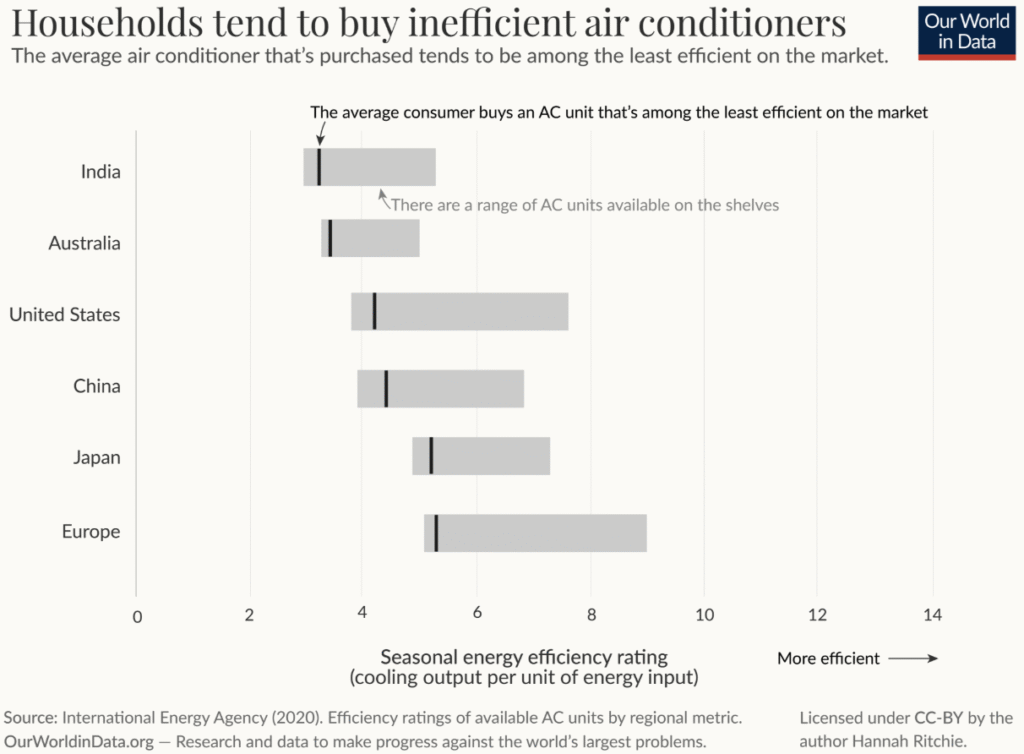
In 2022, air conditioning used approximately 7% of the world’s electricity. If the number of AC units in the world triples by 2050, will energy demand triple too? It depends on how efficient they are.
A key barrier is upfront costs. Efficient units often pay off because they are cheaper to run, but this doesn’t help if consumers can’t afford the higher cost upfront. Another barrier is the lack of efficiency standards in some countries, along with a lack of a consistent labeling system that makes efficiency ratings clear to the consumer buying the system.
Typical Efficiency Upgrade Costs
The table below shows the typical price differences U.S. homeowners see when choosing higher-efficiency options compared to standard systems. These ranges reflect common residential installations and represent incremental cost, not total system price. Incremental cost means the extra money you pay to get a more efficient system compared to a basic system, not the full price of the system. SEER stands for Seasonal Energy Efficiency Ratio, and measures the cooling efficiency of an air conditioner or heat pump. The higher the SEER rating, the more energy efficient the system is.
| Cooling Efficiency Level | Typical Added Cost |
|---|---|
| 14–15 SEER (Standard) | Baseline |
| 16–17 SEER | $800 – $1,500 |
| 18–19 SEER | $1,800 – $3,000 |
| 20+ SEER | $3,500 and up |
Answer Key: Question 1: (Sample Student Response: The average air conditioner that people buy is much less efficient than the most efficient models available. In every region shown, the black line (average purchased unit) is close to the lower end of the efficiency range, while much more efficient units are already on the market but are not commonly purchased.)
Question 2: (Sample Student Response: (1) More efficient air conditioners cost more to buy initially, which many households cannot afford, even if the systems save money over time. (2) In some countries, efficiency labels are unclear or missing and there may be weak efficiency standards, making it hard for consumers to compare options or prioritize efficiency.)
Question 3: (Sample Student Response: Regions like Europe and Japan appear to have access to higher-efficiency air conditioners compared to regions like India and Australia. This suggests that higher-income regions may be better able to afford efficient models. Also, stronger government efficiency standards likely push manufacturers and consumers toward more efficient options.)
Question 4: (Sample Student Response: Global electricity use would increase much more slowly than the number of air conditioners. Even if the number of air conditioners tripled, high-efficiency 20+ SEER units would use far less electricity per unit, helping prevent electricity demand from tripling and reducing strain on power grids and emissions.)
Question 5: Answers will vary. (Examples: Efficiency and long-term savings, because a more efficient unit costs less to run and saves money over time; Upfront cost, because budget limits affect what people can realistically purchase; or a balance of affordability now and lower energy bills later.)
Energy Efficiency and Trade-Offs Hands-On
Instructions: Use the Energy Efficiency and Trade-Offs Hands-On – Student Handout and the following Teacher Guide to conduct the activity.
Introduction
This activity introduces students to the concept of energy efficiency through a hands-on design challenge and real-world decision-making. Students begin with a simple physical demonstration to experience how smarter design can accomplish the same task with less effort. They then apply this idea to household appliances, using energy data and costs to explore how efficiency, comfort, and budget constraints interact. This activity emphasizes that energy efficiency is not just about using less energy, but about making thoughtful choices and trade-offs.
Student Objectives
Students will be able to
- Explain energy efficiency as accomplishing the same task using less energy.
- Compare devices using annual energy use (kWh/year) to determine relative efficiency.
- Identify more and less efficient household appliances.
- Make decisions that balance energy use, cost, and comfort.
- Describe why real-world energy choices often involve trade-offs rather than perfect solutions.
Materials
- Student Handout
- 2 sheets of paper (per student group)
- Stopwatch or timer (per student group)
Procedure
- Engage: Paper Fan Test (Efficiency as Design)
- Divide students into groups of 2 or 3 and provide them with the Student Handout, two sheets of paper, and a stopwatch or timer.
- Introduce and discuss the idea that efficiency is about smarter design, not working harder.
- Students will follow the instructions in the Student Handout and conduct the Paper Fan Test, constructing a more efficient paper fan by design (as opposed to just a flat piece of paper).
- Facilitate a whole-class discussion where student groups will show their designs and connect the folded paper fan to higher efficiency.
- Explain: Connecting the Model to the Real World
- Guide students to the next part of the Student Handout, explaining that appliances can also be designed to do the same job while using different amounts of electricity (energy).
- Introduce the key rule students will use throughout the lesson: Lower kilowatt-hours (kWh) per year means higher efficiency.
- Using the provided appliance table in the Student Handout, students will classify devices as more or less efficient based on their annual energy use. Emphasize that this step mirrors the flat versus folded paper comparison: same task, different energy required.
- Apply: Home Energy Design Challenge (Option A or B)
Choose either Option A or Option B, depending on grade level and time.- In Option A, students select exactly one appliance per category while staying under a set budget and annual energy limit.
- In Option B, students design a small home system with multiple choices, quantities, and cooling strategies, working with higher budget and energy constraints.
- For both options, students follow directions on the Student Handout to record choices, total energy use, costs, and reasoning.
- Circulate to prompt discussion about trade-offs, especially when students must choose between lower cost and higher efficiency.
- Reflect: Making Sense of Trade-Offs
- Conclude with reflection questions on the Student Handout that guide students to evaluate their decisions.
- Discuss which choices saved the most energy for the money, where students chose comfort or convenience over efficiency, and how changing electricity prices might affect their decisions.
- Emphasize that in real life, people rarely get everything they want at once. Energy decisions require balancing efficiency, cost, and needs.
Exit Ticket
Instructions: Access the Exit Ticket and have students reflect on and answer the prompt.