

Introduction
In this activity, you will design a simplified model of an electric grid. You will use color-coded yarn to represent different voltage levels and show how electricity travels from a power plant to homes, schools, and businesses. This project will help you understand how electricity moves through the grid, and why voltage changes along the way.
Part 1: The Electrical Power Transmission System
Instructions: Read the section below, and answer the following comprehension questions.
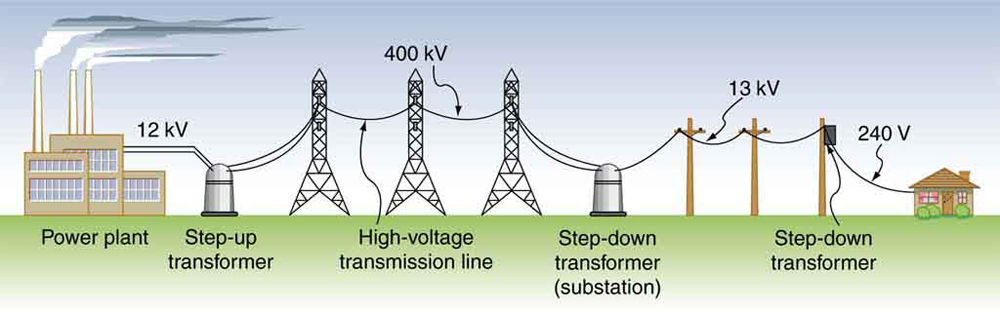
Transformers adjust electrical voltages at different stages of the power grid. Electricity is produced at power plants at voltages typically between 10 and 30 kilovolts (kV). For long-distance transmission, the voltage is increased to very high levels, often 230 kV to 765 kV, and sometimes even higher for special long-distance HVDC lines, to reduce energy losses.
When electricity reaches a regional substation near the point of use, the voltage is stepped down and sent through local distribution lines at about 5 to 25 kV. Finally, smaller transformers reduce the voltage again to the levels needed for homes and businesses, such as 120-240 volts for residences or 208–480 volts for commercial and industrial users.
High voltage is great for moving electricity efficiently over long distances, but it’s not safe to use directly in neighborhoods or buildings. Very high voltage can jump through the air (arc), overheat equipment, and seriously injure people. That’s why the grid includes multiple transformers and substations: they gradually lower the voltage to safe levels before it reaches homes, schools, and other places where people live and work.
Key Terms
Transmission Lines: High-voltage lines that move electricity long distances.
Distribution Lines: Lower-voltage lines that bring electricity to homes and buildings.
Transformer: A device that changes (steps up or steps down) voltage.
Substation: A facility where voltage is transformed and electricity is routed.
Voltage: The electrical “pressure” that pushes electrons through wires.
Grid: A system of connected power plants, lines, and equipment that delivers electricity to users.
Comprehension Questions
- Why do we use high voltage to transmit electricity long distances?
- How do you think the efficiency of the grid would change if we used low voltage lines for long-distance transmission? Explain your reasoning.
- How do transformers change the voltage of electricity as it moves through the power grid?
- In what way do substations act as “decision points” in the grid? What kinds of decisions or changes occur there?
- What safety concerns are related to high voltage electricity?
- Why might different types of buildings (homes, schools, factories) require different voltage levels? What does this tell you about how electricity is used?
- What could happen to the grid if a transformer in the transmission system failed? How might this affect customers further down the line?
Part 2: Planning Your Grid
The electric grid is built with a lot of redundancy, which means electricity has many different paths it can take to reach homes and buildings. Because the grid is highly interconnected, a failure in one small, low-voltage line, such as a line serving a single house, usually affects only that area and not the entire city.
Other transmission systems rely on fewer pathways, so when one part fails, many users can lose service at once. The grid’s built-in redundancy keeps small failures from becoming big outages.
Materials
- Yarn in 4 colors:
- Red: highest voltage (230-765 kV)
- Orange: high voltage (10-30 kV)
- Yellow: medium voltage (5-25 kV)
- Green: low voltage (120-480 V)
- Large poster paper or cardboard box opened up to lay flat
- Tape
- Scissors
Required Components of Your Electric Grid Model
| Component | Quantity | Notes |
|---|---|---|
| Power Plants | 2-3 | Label energy sources (e.g., natural gas, solar, hydro, etc.) |
| Step-Up Transformers | 2-3 | One per power plant |
| Transmission Lines | 3-4 | Red yarn; long distance |
| Regional Substations | 2-3 | Connect to population areas |
| Distribution Transformers | 3-5 | Step down to safe voltages |
| Medium Voltage Lines | 2-3 per substation | Yellow yarn |
| Low Voltage Lines | 1-2 per transformer | Green yarn |
| Houses | 6-10 | Residential loads |
| Schools | 1-2 | Higher-demand buildings |
| Commercial Buildings | 4-6 | Mixed energy needs |
Rough Draft: Sketch
Before building your model, sketch a simple layout of your electric grid here. Be creative!
Planning Questions include:
- Where will your power plants be located?
- How will electricity travel from the plants to the substations?
- Where does voltage need to be stepped up? Where does voltage need to be stepped down?
- Where will your distribution lines run to reach each building?
- What color yarn will be used in each section?
- If transmission lines in one part of your grid were damaged, how would electricity reroute to get to where it’s needed?
Part 3: Build Your Electric Grid Model
- Use the white paper as your base.
- Draw and label all the required elements.
- Use yarn to create pathways. Remember:
- Red: highest voltage (230-765 kV)
- Orange: high voltage (10-30 kV)
- Yellow: medium voltage (5-25 kV)
- Green: low voltage (120-480 V)
- Add a key showing what each color means.
- Title your diagram using big letters.
- Make sure everything is neat, visible, and secure. Use the assessment rubric (included below) to ensure all components are included.
Part 4: Reflection Questions
- How would your grid need to change if your town suddenly doubled in population? Identify at least two parts of the system that might need upgrades and explain why.
- If you had to add a solar, hydro, wind, or geothermal energy source to your grid, where would you place it, and why? How would it connect to the existing transmission system?
- If a storm damaged one of your transmission lines, how would electricity reroute (or fail to reroute) in your model? What design changes could make your grid more resilient?
- How does your model show the balance between safety and efficiency in the grid? Give a specific example involving voltage choices.
- Think about the buildings you included (house, school, commercial building). How might their electricity use patterns differ, and how would that influence grid design or transformer placement?
Assessment Rubric
| Criteria | Excellent | Proficient | Developing |
|---|---|---|---|
| Grid Components | All required components included, clearly labeled, and accurately represented. | All required components included, mostly labeled and accurately represented. | Missing or unclear components or labels. |
| Voltage Representation | Yarn colors used correctly throughout with accurate voltage transitions. | Mostly correct yarn usage throughout with minor errors. | Several inaccuracies with voltage transitions or color use. |
| Organization & Design | The layout is neat, logical, and easy to follow. | The layout is mostly neat, logical, and clear. | The layout is difficult to follow or incomplete. |
| Reflection & Reasoning | Choices are explained clearly and demonstrate strong understanding of main concepts. | Choices are explained clearly and demonstrate understanding of main concepts, with minor gaps. | Explanations show partial or limited understanding of main concepts. |