

Bell Ringer
Instructions: Select one of the Bell Ringers for students to reflect on and answer.
Vocabulary
Instructions: Go over important terms and their definitions before watching the Introduction to Coal video. Student vocabulary list can be found in the Student Guide and Introduction to Coal – Starter Pack.
| Word | Definition | Example |
|---|---|---|
| Coal | noun; a black or brownish-black solid combustible substance burned as an energy source | “Today, coal is the world’s leading electricity source, and global use continues to rise.” |
| Domestic | adjective: belonging, originating in, or related to one’s own country | “Nearly every major country has an available domestic coal reserve.” |
| Reserve | noun: something that can be produced at today’s prices with today’s technology | “Nearly every major country has an available domestic coal reserve.” Note: Reserves change with price and technology. |
| Mine | verb: to get or extract a resource (ores, minerals or aggregates) from the earth | “Easy to mine, easy to transport, easy to store and easy to turn into electricity.” |
| Sequester | verb: to store (for example, carbon dioxide) typically as a part of a subsurface disposal | “The best coal plants capture some of this, but most don’t and there are only a few coal plants in the world that capture and sequester some of their CO2 .” |
| Emissions | noun: substances discharged into the local air or atmosphere | “This means that burning coal produces significant CO2 emissions.” |
Quiz & Cloze Notes
Instructions: Review key concepts after watching the Introduction to Coal video. The Student Guide and Introduction to Coal – Starter Pack contain the quiz and cloze notes.
Quiz Answer Key: Q1:D Q2:C Q3:C Q4:B
Cloze Notes Answer Key: available, electricity, affordable, developing, poverty, coal, pollution, countries
Data Set
Instructions: Provide students with the Introduction to Coal – Data Set for data literacy and analysis practice.
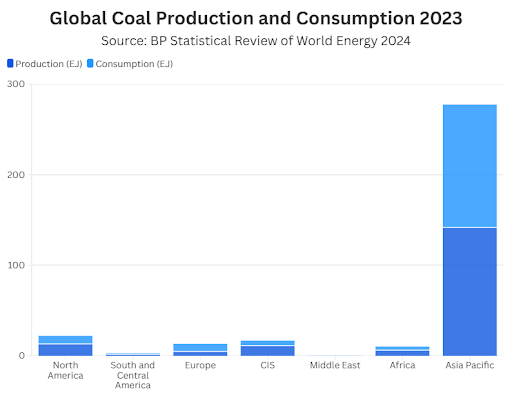
| Region | Production (exajoules*) | Consumption (exajoules) |
|---|---|---|
| North America | 13.21 | 8.83 |
| South and Central America | 1.69 | 1.16 |
| Europe | 4.88 | 8.39 |
| CIS (Commonwealth of Independent States)** | 11.34 | 5.49 |
| Middle East | 0.09 | 0.38 |
| Africa | 6.15 | 4.08 |
| Asia Pacific | 141.88 | 135.70 |
*Exajoule (EJ): The amount of energy equal to one quintillion (1,000,000,000,000,000,000 or 1018) joules.
**Commonwealth of Independent States (CIS): a group of 10 countries (like Russia and Kazakhstan) that used to be part of the Soviet Union.
Answer Key: Question 1: Europe, Middle East Question 2: Asia Pacific
Question 3: Answers will vary. (Example: The Middle East has an abundance of other cheap and available energy sources, such as oil.)
Question 4: Answers will vary. (Example: The Asia Pacific region includes China and India, the two largest developing countries in the world.)
Question 5: Answers will vary.
Mining Simulation Hands-On
Instructions: Use the Mining Simulation Hands-On – Student Handout and the following Teacher Guide to conduct the lab activity.
Introduction
This hands-on, two-part simulation engages students in exploring the real-world complexities of coal mining and coal-based power generation. In Part 1: Coal Mining Simulation, students take on the role of mining companies, making economic decisions as they extract simulated coal from layered materials. In Part 2: Power Generation Simulation, students transition to energy producers, using the coal they mined to generate electricity while tracking emissions. They can be taught independently or combined for an extended lab.
Student Objectives
Part 1: Coal Mining Simulation
- simulate surface coal mining to extract two types of “coal” buried in layers.
- simulate land restoration after mining and identify its challenges.
- demonstrate and practice economic skills
- balance economic and environmental trade-offs.
Part 2: Power Generation Simulation
- simulate coal-based energy production while exploring its environmental impact.
- evaluate the effectiveness of a carbon capture strategy in reducing pollution.
- analyze trade-offs and engage in discussion about real-world energy decisions.
Materials
Part 1: Coal Mining Simulation (per group)
- Student Handout
- One clear container
- Spoons and/or popsicle sticks (students will choose)
- Paper or plastic cups (for collecting extracted layers)
- Timer or stopwatch (for timing excavation)
- Optional: Play money ($20)
Layering Materials
- Licorice, 1” chunks (lignite coal)
- Chocolate chips (sub-bituminous coal)
- Oats (coal-bearing layer)
- Rice (transition rock layer)
- Shredded paper (subsoil, rock)
- Small marshmallows (topsoil)
- Cotton balls (surface vegetation)
Layering Instructions
- Start with a bottom layer of oats.
- Add a layer of chocolate chips.
- Add a layer of licorice pieces.
- Cover with more oats.
- Add a layer of rice.
- Layer in shredded paper.
- Add small marshmallows.
- Top it off with cotton balls.
Part 2: Power Generation Simulation (per group)
- Student Handout
- Two paper or plastic cups (or any small containers)
- Chocolate chips and licorice pieces from Part 1 can be reused to represent coal – each group will need approximately a handful.
- Dried beans or other small objects (beads, candy, etc.) to represent emissions – each group will need approximately two handfuls.
- Spoons, tongs or chopsticks (teacher or student)
- Timer or stopwatch
Part 1: Coal Mining Simulation Procedure
Set Up Instructions
1. Prep: Prepare mining containers for student groups according to layering instructions.
Activity Instructions
2. Distribute Materials: Provide each group of 1–3 students with a copy of the Student Handout.
3. Simulation Overview: Inform students that they are acting as companies involved in a surface coal mining project. Each group will begin with $30 in startup funds.
4. Purchasing Mining Property
- Each group must purchase a “mining property.”
- If all containers are the same size:
- A full container costs $8.
- If a group chooses to mine on only half of the surface area of the container, they pay $4.
- Important: If a group disturbs the portion of a container they did not pay for, they will be fined $8.
- If containers vary in size:
- Assign costs at your discretion based on surface area. Larger containers should have a higher cost.
5. Buying Equipment: Each group must also purchase mining equipment.
- Popsicle stick: $3
- Spoon: $6
6. Time-Based Mining Costs: Mining time must be purchased in advance.
- Each minute of mining costs $1. Students may buy up to 5-10 minutes, depending on what they can afford after expenses.
7. Earning Revenue: Students will earn money by mining and selling coal.
- Licorice piece: $1 each
- Chocolate chip: $2 each
Mining Instructions
1. Excavation Guidelines
- Students must excavate one layer at a time to reach the layer containing the “coal” (represented by licorice and chocolate chips).
- Dig down from the top down only – no mixing or tunneling through layers without removal.
- Mining tools (popsicle stick or spoon) should be used carefully to remove each layer in sequence, just as in real-world surface mining.
2. Handling Excavated Material
- Removed layers must be placed to the side in separate paper or plastic cups.
- Students should avoid mixing the layers to make land reclamation (restoring the land) easier and more accurate later on.
3. Mining Time
- Within their purchased time limit, students will work to extract as many licorice pieces (worth $1 each) and chocolate chips (worth $2 each) as possible.
4. Calculating Profit
- At the end of the time limit, students will calculate their gross profit based on the value of mined resources.
5. Land Reclamation
- Students must carefully rebuild the layers they disturbed during excavation (set a time limit, 5-10 minutes). Reclamation quality is graded as follows:
- Excellent (layers nearly identical to original): $2 charge
- Good (some disruption but layers mostly intact): $5 charge
- Poor (obvious mixing or land shape changes): $10 charge
6. Final Accounting
- Students will calculate their total profit or loss, factoring in:
- Property and equipment costs
- Mining time
- Reclamation penalties
7. Reflection and Analysis
- Students will complete the reflection and analysis questions on the worksheet.
Additional Rules & Reminders
- Hands-Off Policy: Students must not use their fingers or hands during excavation. Only purchased tools may touch the materials.
- Tool Breakage: If a mining tool breaks, it is no longer usable. A replacement must be purchased using the group’s remaining funds.
- Winning the Simulation: The team with the highest profit at the end of the activity is considered the winner—they have successfully run a profitable mining operation.
Part 2: Power Generation Simulation Procedure
Set Up Instructions
- Materials Distribution: Provide each student group with the Student Handout. Alternatively, students can use two sheets of paper labeled:
- Power Plant Output
- Emissions Output
- Simulated Equipment: A cup will represent the coal furnace. The cup will hold both coal, represented by the chocolate chips and licorice pieces, along with emissions, represented by the other small object (dried beans, candy, etc.) mixed together.
Activity Instructions: Power vs. Emissions
- Burning Coal: Students will “burn coal” by transferring one piece at a time (e.g. chocolate chip, licorice) from the furnace (cup) to the Power Plant Output area.
- Transfers must be made using a slightly challenging tool like a spoon, tongs, or chopsticks – this simulates effort and inefficiencies.
- Emissions Generation: For each coal piece moved to the Power Plant Output, students must also place two pieces of emissions (dried beans, candy, etc.) onto the Emissions Output sheet.
- Time Limit: Set a 60-second timer. Students attempt to transfer as many coal pieces as possible within the time limit.
- Data Recording: At the end of the round, students will record the number of pieces in Power Plant Output (representing electricity produced) and the number of pieces in Emissions Output (representing environmental impact).
Conclusion
Reflection and Analysis: Once both rounds are complete, students analyze the data and complete the reflection questions on their handout, discussing the trade-offs between energy generation and emissions and real-world implications of coal-based energy production.
Exit Ticket
Instructions: Access the Exit Ticket and have students reflect on and answer the prompt.