

Bell Ringer
Instructions: Select one of the Bell Ringers for students to reflect on and answer.
Vocabulary
Instructions: Go over important terms and their definitions before watching the Introduction to Hydropower video. Student vocabulary list can be found in the Student Guide and Introduction to Hydropower – Starter Pack.
| Word | Definition | Example |
|---|---|---|
| Ideal | adjective; the best possible or just right for a certain purpose | “Hydro is the ideal electricity resource and that’s why we’ve developed pretty much all of it.” |
| Gravity | noun; the invisible force that pulls all objects toward one another | “Weather moves water uphill, and gravity brings it down through the turbines.” |
| Dam | noun; a large structure built across a river to hold back water | “The biggest power plants in the world are dams . . .” |
| Turbine | noun; a machine that spins when water, air or steam flows through it to generate electricity | “[Dams] can spin up the turbines almost instantly whenever we need the power.” |
| Base-load power | noun phrase; the minimum amount of electricity a city or country needs continuously | “Hydro can be always on base-load power, or it can follow electricity demand by the minute . . .” |
| Agriculture | noun; the practice of growing plants and raising animals for food, clothing and other things we need | “As population and development increase, so do water demands for other things, like agriculture.” |
| Emissions | noun; pollutants released into the air, usually from burning fuel | “Hydro . . . can follow electricity demand by the minute, all with zero emissions.” |
| Limited | adjective; only a certain amount available | “The places to build hydropower are limited.” |
| Environmental | adjective; related to nature and the world around us, like the air, water, land, animals and plants | “. . . damming a river has environmental, social, and economic impacts that not everyone is ready to bear.” |
| Social | adjective; related to people, communities, and the way they live and interact with each other | “. . . damming a river has environmental, social, and economic impacts that not everyone is ready to bear.” |
| Economic | noun phrase; related to money, jobs, businesses, and how people earn and spend | “. . . damming a river has environmental, social, and economic impacts that not everyone is ready to bear.” |
| Impact | noun; the effect or change something has on a person, place or thing | “. . . damming a river has environmental, social, and economic impacts that not everyone is ready to bear.” |
Quiz and Cloze Notes
Instructions: Review key concepts after watching the Introduction to Hydropower video. The Student Guide and Introduction to Hydropower – Starter Pack contain the quiz and cloze notes.
Quiz Answer Key: Q1:D Q2:B Q3:D Q4:C
Cloze Notes Answer Key: gravity; turbines; electricity; expensive; cheap; developed; used; limited
Data Set
Instructions: Provide students with the Introduction to Hydropower – Data Set for data literacy and analysis practice.
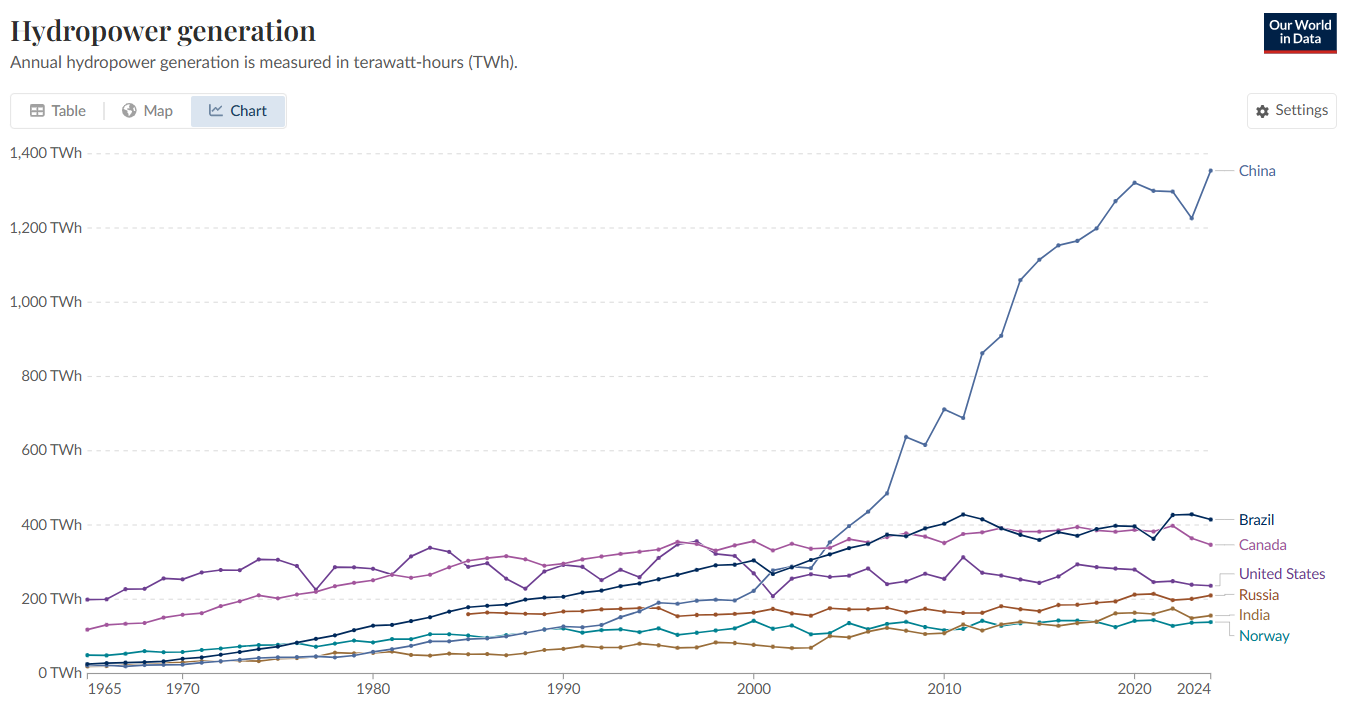
Answer Key: Question 1: China; 1332.22 TWh increase (subtract 22.10 from 1354.43)
Question 2: Brazil (389.32 TWh); Canada (228.64 TWh); Russia (210.35 TWh); India (137.04 TWh); Norway (89.05 TWh); United States (37.35 TWh).
Question 3: Answers will vary: (Example: Norway’s hydropower generation only increased 89.95 TWh while Brazil’s hydropower generation increased 389.32 TWh. It shows that hydropower has been a consistent and steady energy source for Norway for a long time and that large investments in new hydropower infrastructure weren’t needed. Whereas Brazil had significant room to grow and they heavily invested in new infrastructure over time.)
Question 4: Answers will vary. (Example: China’s population and energy needs have grown quickly, so the country likely invested in large-scale energy projects, like dams. The big increase in hydropower suggests that China had many places to build dams and chose to develop them to meet rising energy demand.)
Question 5: Answers will vary.
Build a Waterwheel – Hands-On
Instructions: Use the Build a Waterwheel Hands-On – Student Handout and the following Teacher Guide to conduct the lab activity.
Introduction
In this hands-on engineering challenge, students will explore the principles of energy transformation by designing and building their own working waterwheel. Using a limited set of materials, they will convert the potential energy of flowing water into mechanical energy capable of lifting weights, applying creativity, problem-solving, and teamwork along the way.
Materials Needed
Note: In the design process, students will create their own design and decide what specific materials they will need. The material quantities below can be provided to each group of students as a “materials pack” as they brainstorm. They will not use every piece but will decide what would go best with their design to reach the end goal.
- Student Handout
- 12-16 oz Plastic Cup (1-2)
- Plastic Spoons (5-6)
- Medicine cups (5-6)
- String (1-2 ft)
- Tape (1 roll)
- Scissors (1-2 pairs)
- Pencil/wooden skewer (for axis) (1)
- Plastic bottle lids (1-2)
- Pennies or equivalent weights (3)
- Water source (a sink or large container of water) (1)
- Stopwatch (1)
- Measuring cup (1)
Students Will Be Able To
- Design and construct a functional waterwheel using provided materials to convert water power into mechanical motion.
- Test and measure the performance of their waterwheel, including the ability to lift a specified weight.
- Analyze and explain how energy is transformed from potential energy in water to mechanical energy in a rotating wheel.
- Evaluate their design for efficiency and suggest modifications to improve performance based on collected data.
Procedure
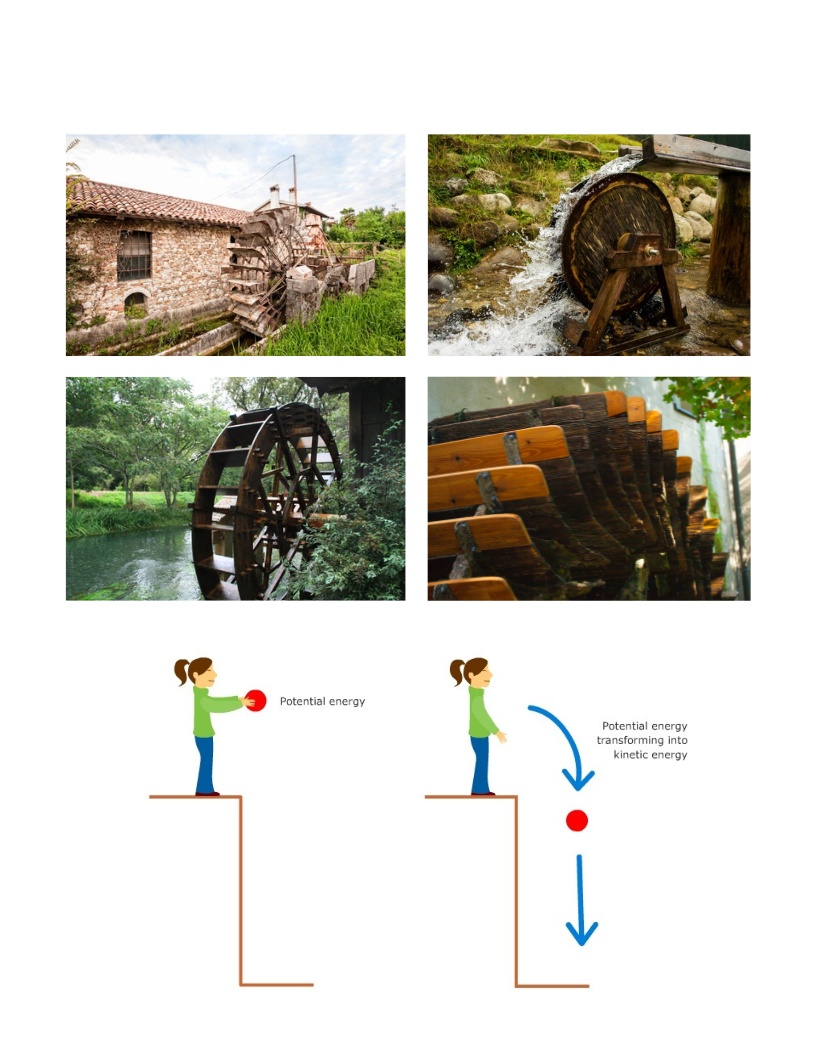
1. Introduction to Energy Transformation: Before starting the lab, use the pictures of waterwheels and energy transformation diagram (included below) to discuss the principles of energy transformation, focusing on how potential energy from water can be converted into mechanical (kinetic) energy to turn a turbine. Explain how waterwheels have historically been used to perform tasks like grinding grain and generating electricity.
2. Design Phase: Before building, introduce students to the design challenge, along with the Student Handout and material packs that they will have to work with. Divide students into groups and instruct them to brainstorm designs for a waterwheel that can lift at least three pennies (or equivalent weights).
Consider the size and shape of the paddles, the axis of rotation, and how the wheel will be supported. Using the Experimental Design Form in the Student Handout students can formulate the design question, sketch out their designs and clearly list the materials they think they will need to ensure successful construction in the Research section. Once students have completed the design phase, and formulated their Hypothesis (stating the task(s) they believe their specific design will be able to accomplish), they can begin constructing their waterwheel.
3. Construction Phase: Instructions for students who may be struggling with a design:
- Use plastic lids as the wheel base.
- Attach plastic spoons to the lid to act as paddles using tape or glue, ensuring they are evenly spaced.
- Create an axle using a pencil or dowel, securing it through the center of the lid.
- Attach one end of the string to the axle, and the other end to a small cup or medicine cup where pennies will be placed.
4. Testing Phase:
- Place the waterwheel in a sink or large container, ensuring it is aligned with the water flow.
- Gradually increase the water flow and observe the wheel’s motion.
- Measure the time it takes for the wheel to lift the pennies a certain height.
- Record observations and adjust the design as necessary for optimal performance.
5. Data Collection and Analysis: In the last section of the Experimental Design Form in the Student Handout, record the number of pennies lifted, the time taken, and any changes made to the design during testing.
Assessment
- Submit a lab report detailing the design process, observations, and conclusions. This can include a neat and clean version of the Experimental Design Form (Student Handout).
- Answer reflection questions thoroughly.
- Assessment Rubric
| Category | Advanced Exceeding Standards | Criteria Standards for this task | Concerns Areas that need attention |
| Design and Creativity | The student demonstrate evident design and planning. – Innovative Design: Considers multiple design elements. | ||
| Construction Quality | The waterwheel is constructed with precision. – Functions smoothly without adjustments. – Is sturdy and doesn’t fall over. | ||
| Testing and Data Collection | Thorough and accurate data collection. – Clear observations – Detailed records | ||
| Analysis and conclusion | Detailed analysis with insightful conclusions. – Strong connection to energy concepts. |
Student Examples:


Exit Ticket
Instructions: Access the Exit Ticket and have students reflect on and answer the prompt.