

Bell Ringer
Instructions: Select one of the Bell Ringers for students to reflect on and answer.
Vocabulary
Instructions: Go over important terms and their definitions before watching the Introduction to Electricity video. Student vocabulary list can be found in the Student Guide and Introduction to Electricity – Starter Pack.
| Word | Definition | Example |
|---|---|---|
| Atom | noun; the smallest building block of matter, with a center called a nucleus, surrounded by electrons | “Atoms, of course, are tiny building blocks that make up every substance in the universe.” |
| Substance | noun; a kind of matter made up of atoms, which can be solids, liquids, or gases | “Atoms, of course, are tiny building blocks that make up every substance in the universe.” |
| Positive charge | noun phrase; a type of electric charge, which happens when something has more protons than electrons | “In the center of every atom is a nucleus with a positive electrical charge.” |
| Electron | noun; a tiny, negatively charged particle that moves around the nucleus of an atom | “Around [the positively charged nucleus] are electrons with a negative charge.” |
| Negative charge | noun phrase; a type of electric charge, which happens when something has more electrons than protons | “Around [the positively charged nucleus] are electrons with a negative charge.” |
| Electromagnetic force | noun phrase; a kind of force that happens between objects with electric charge, that can either pull together or push apart | “Positive and negative charges attract, and it’s this electromagnetic force that holds the atom together . . .” |
| Gravity | noun; the invisible force that pulls all objects toward one another | “. . . it’s this electromagnetic force that holds the atom together – sort of like [how] gravity holds planets in orbit around the Sun.” |
| Orbit | noun; the oval-shaped path an object takes as it moves around another object | “In some things, electrons bounce randomly from one orbit to the next.” |
| Charged particle | noun phrase; a tiny piece of matter that has a positive or negative electric charge | “Remember that electrons are charged particles. They’re essentially like super tiny magnets . . .” |
| Electricity | noun; a form of energy that comes from the movement of charged particles, especially electrons | “Electricity happens when we get electrons to line up and all flow together.” |
| Ampere | noun; a unit used to measure electric current – how much electricity is flowing per second | “To get one ampere of electricity requires over six quintillions of [electrons] all flowing per second.” |
| Quintillion | noun; a number that is a 1 followed by 18 zeros – 1,000,000,000,000,000,000 | “To get one ampere of electricity requires over six quintillions of [electrons] all flowing per second.” |
Quiz & Cloze Notes
Instructions: Review key concepts after watching the Introduction to Electricity video. The Student Guide and Introduction to Electricity – Starter Pack contain the quiz and cloze notes. Click here to play the Kahoot!
Answer Key: Q1:A Q2:D Q3:D Q4:B
Cloze Notes Answer Key: electricity, electrons, nucleus, positively charged, negatively charged, magnets, ampere
Data Set
Instructions: Provide students with the Introduction to Electricity – Data Set for data literacy and analysis practice.
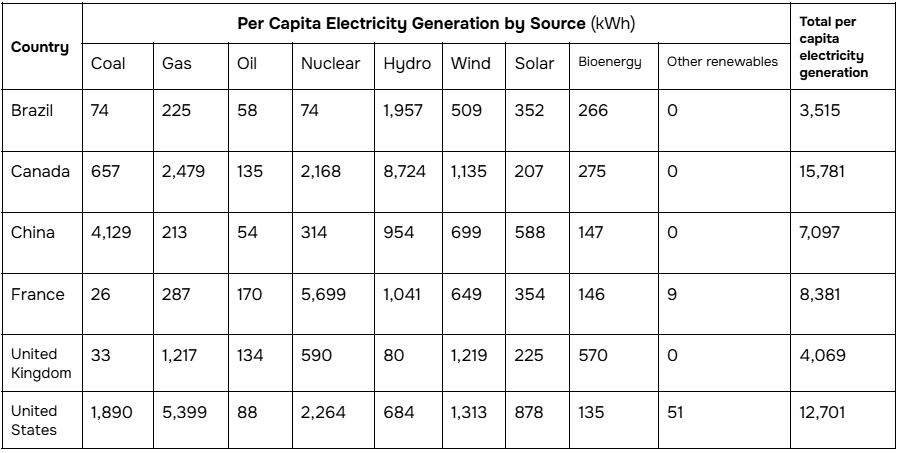
Note: Measured in kilowatt-hours; “other renewables” include geothermal, tidal and wave generation
Source: Our World In Data
Answer Key:
Question 1: Canada – Hydro; China – Coal; France – Nuclear; United Kingdom – Wind; United States – Gas
Question 2: Answers will vary. (Example: Each country’s natural resources, economy, geography, and technology affect which energy sources work best for them.)
Question 3: Canada produces the most electricity per person. Answers will vary. (Example: If they produce more than they use, they could sell the extra electricity to other countries, or store it for emergencies.)
Question 4: France and the United States generate electricity from “Other renewables.” Answers will vary. (Example: The other countries may not have the right environment, such as volcanic activity or strong tides, or they may not have the technology or economic resources to implement use of these energy sources.)
Question 5: Answers will vary.
Play-Doh Circuits Hands-On
Instructions: Use the Play-Doh Circuits Hands-On – Student Handout and the following Teacher Guide to conduct the lab activity.
Introduction
In this lab, students will work individually or in groups to create and test parallel and series electrical circuits, and discover how they are alike and different. Each step requires careful reading, precision in following instructions, and critical thinking and problem-solving as they observe the results. Students will also learn about conductors and insulators, and test various materials to determine their role in an electrical circuit. Extension activities focused on solving Ohm’s Law math problems and understanding simple circuit diagrams are also included.
Student Objectives
Students will be able to
- Construct and test both series and parallel circuits and correctly identify the effects of component placement on circuit functionality.
- Distinguish between conductors and insulators by testing everyday materials and observing whether the circuit is complete when each material is used.
- Apply Ohm’s law to solve problems involving voltage, current, resistance, and power in simple circuit scenarios.
- Read and draw basic circuit diagrams using standard electrical symbols including representation of power cells, wires, switches, and loads (such as light bulbs), for both series and parallel circuits.
Materials
- Student Handout
- 5mm LED light diodes – 3-5 per individual/group for the first test, and an additional 3-5 for the remaining tests. Note: Diodes used for the first test will light up briefly, so groups will need to burn out a few diodes to observe the spark.
- 9-volt battery – 1 per individual/group.
- Play-Doh – 1 pack per individual/group.
- Pair of alligator clips – 1 per individual/group.
- Paper clips – 2 per individual/group.
- Popsicle stick – 1 (two halves) per individual/group.
- Plastic straw – 2 pieces per individual/group.
- Pennies – 2 per individual/group.
Answer Key
The Student Guide contains the Play-Doh Circuits Hands-On – Student directions and questions.
Part 1: Testing a Parallel Circuit Answer Key
1.3A. positive, anode
1.3B. negative, cathode
1.7A. Yes.
1.7B. Answers will vary. Example: I think the second diode will not light up if placed in the play-doh incorrectly, but the first diode will stay on.
1.7C. Answers will vary. Example: The second diode will not light up because the positive current will not be connected to the positive lead of the diode (the anode), and the negative current will not be connected to the cathode.
1.8A. Only one.
1.8B. The one that was flipped.
1.9A. Yes.
1.10A. Only one.
1.10B. The one that was flipped.
1.10C. A. Stay on.
Part 2: Testing a Series Circuit Answer Key
2.3A. Answers will vary. Example: I think that the second diode will not light up if placed in the play-doh incorrectly, and the first diode will also go out.
2.3B. Answers will vary. Example: When inserted incorrectly, the second diode will break the connection of the electric current, causing the first diode to also go out.
2.3C. Both.
2.3D. Neither.
2.5A. Yes.
2.5B. B. It got weaker.
2.6A. All the lights
2.6B. Neither.
2.6C. B. will go out
2.6D. A. It gets weaker.
2.6E. Answers will vary. Example: In a parallel circuit, each diode has its own path for the electric current to flow. When one diode is flipped, the current for that diode is blocked, but the others stay on because the current is still flowing. In a series circuit, the current is flowing in one line through each diode. If one diode is flipped, the electric current for the whole circuit is blocked, so all the diodes go out.
Part 3: Testing Conductors & Insulators Answer Key
Make a prediction. Student answers will vary.
Correct Response: Penny (Conductor); Plastic Straw (Insulator); Wood (Insulator); Paper Clip (Conductor)
3.2A. Yes.
3.2B. Conductors.
3.2C. Answers will vary. Example: When the diode leads connected to the pennies, the diode lit up, showing that the electric current flowed through the pennies.
3.3A. No.
3.3B. Insulator.
3.3C. Answers will vary. Example: When the diode leads connected to the plastic, the diode did not light up, showing that the plastic blocked the electric current from flowing.
3.4A. No.
3.4B. Insulators.
3.4C. Answers will vary. Example: When the diode leads connected to the wood, the diode did not light up, showing that the wood blocked the electric current from flowing.
3.5A. Yes.
3.5B. Conductor.
3.5C. Answers will vary. Example: When the diode leads connected to the paperclips, the diode lit up, showing that the electric current flowed through the paperclips.
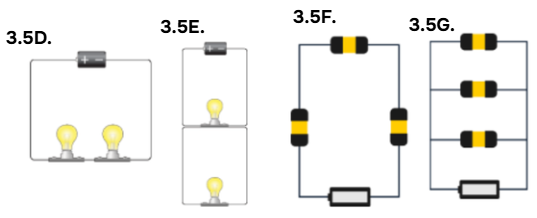
3.5D. Series 3.5E. Parallel 3.5F. Series 3.5G. Parallel
Part 4: Ohm’s Law – Math Activity Answer Key
4.1
V = I x R
2A x 5Ω = 10V
4.2
R = V / I
12V / 3A = 4Ω
4.3
Answer: I = V / R
10V / 20Ω = 0.5A
4.4
R = V / I
15V / 0.5A = 30Ω
4.5
20Ω + 30Ω = 50Ω (total resistance)
4.6
I = V / R (total)
10Ω = 30Ω = 40Ω
20V / 40Ω = 0.5A
4.7
P = V2 / R
202 = 400V
400V / 5Ω = 80W
4.8
P = V2 / R
122 = 144 V
144V / 4Ω = 36W
Part 5: Introduction to Circuit Diagrams Answer Key
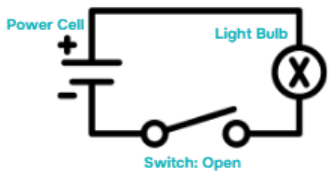
5.2 Answers will vary
Example: The light bulb is currently “off.” The electric circuit is open, blocking the current from flowing through.
5.3
Example (closed switch)
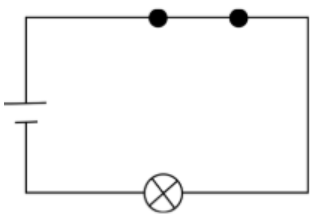
5.4
Example
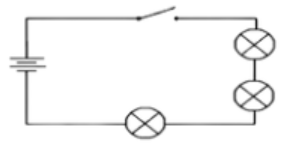
5.5
Example
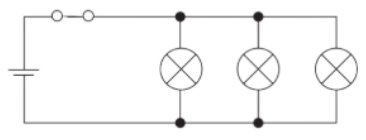
PhET Lab Extension – Circuit Construction DC
Instructions: Use the PhET Lab Extension – Student Handout and the following Teacher Guide to conduct the lab activity.
Introduction
This PhET Circuit Construction Kit: DC simulation guide gives students a visual and interactive way to explore electric circuits. Students build series and parallel circuits, investigate conductors and insulators, measure electric current, and examine how voltage, resistance, and current are related through guided inquiry.
Student Objectives
Students will be able to:
- Build functional series and parallel circuits.
- Compare how series and parallel circuits behave when bulbs are added or removed.
- Explain why bulbs have different brightness in series and parallel circuits.
- Classify everyday materials as conductors or insulators based on whether they allow electric current to flow.
- Measure electric current using a virtual ammeter.
- Investigate how resistance affects the flow of electric current in a circuit.
- Investigate how changing voltage affects electric current while keeping resistance constant.
- Use experimental data to discover and apply Ohm’s Law (V=IR).
Pacing Guide
| Part 1: Testing a Series Circuit | 20-30 minutes |
| Part 2: Testing a Parallel Circuit | 15-20 minutes |
| Part 3: Insulators and Conductors | 15-20 minutes |
| Part 4: Current, Resistance, and Voltage | 20-30 minutes |
If time is limited, Parts 1-3 provide a strong conceptual introduction to circuits, while Part 4 serves as a more advanced extension into quantitative electrical relationships (Ohm’s Law).
Teacher Notes
- This activity is designed as a guided inquiry. The screenshots within the student handout allow students to independently build increasingly complex circuits while making observations and collecting evidence. Throughout the investigation, students will make predictions and compare those predictions with the simulation results.
- Students may accidentally disconnect or delete components while building circuits. The simulation allows them to easily reconnect wires or remove incorrect components using the scissors and trash tools.
Answer Key
Part 1: Testing a Series Circuit
Part 1B – A: The first circuit with only one bulb; Part 1B – B: Both bulbs go out immediately.
Part 1C – A: The two-bulb circuit; Part 1C – B: All three bulbs go out.
Part 1C – C: No. As long as the circuit remains closed, all three bulbs will stay lit. The location of the bulbs does not affect whether current flows.
Part 1C – D: Yes, all three bulbs stayed lit.
Part 1C – E: No. Removing one bulb opens the circuit, preventing current from flowing through any of the bulbs; Part 1C – F: All of the bulbs went out.
Part 2: Testing a Parallel Circuit
Part 2B – A: will; Part 2B – B: will not; Part 2B – C: Answers will vary.
Part 2B – D: They stayed lit.
Part 2B – E: In a parallel circuit, each bulb has its own path to the battery. Removing one bulb only breaks one branch. In a series circuit, there is only one path to the battery, so removing one bulb opens the entire circuit.
Part 2B – F: Series Circuit: Student drawing should show five bulbs on separate branches connected across the battery. Parallel Circuit: Student drawing should show five bulbs connected one after another in a single loop.
Part 3: Insulators and Conductors
Part 3A – Data Table 1:
| Item | Did the bulb light up? (Yes/No) | Did electric current flow through the item? (Yes/No) | Is the item a conductor or an insulator? |
| Dollar bill | No | No | insulator |
| Paper clip | Yes | Yes | conductor |
| Coin | Yes | Yes | conductor |
| Wire | Yes | Yes | conductor |
| Eraser | No | No | insulator |
| Pencil | Yes | Yes | conductor |
| Thin pencil | Yes | Yes | conductor |
Part 3A – A: don’t allow; Part 3A – B: allow
Part 4: Current, Resistance, and Voltage
Part 4A – (A-C): Answers will vary.
Part 4A: Data Table 2: The current will be the same for every location in the circuit (0.90A).
Part 4B – A: Answers will vary.
Part 4B – Data Table 3:
| Resistance (Ohms) | Current (Amps) |
| 10 Ohms | 0.90 |
| 5 Ohms | 1.80 |
| 20 Ohms | 0.45 |
| 30 Ohms | 0.30 |
| 40 Ohms | 0.22 |
| 50 Ohms | 0.18 |
Part 4B – B: As resistance increases, current decreases, and vice versa (if the voltage stays the same).
Part 4B – C: increases; decreases
Part 4C – Data Table 4: Students should find that dividing 9 by the resistance gives the current (Current = 9/Resistance).
Part 4C – A: Students should find that multiplying the resistance by the current always gives 9 (Resistance x Current = 9). The number 9 represents the battery voltage (9V).
Part 4D – A: Answers will vary.
Part 4D – Data Table 5:
| Voltage (Volts) | Resistance (Ohms) | Current (Amps) |
| 3 | 10 | 0.30 |
| 6 | 10 | 0.60 |
| 9 | 10 | 0.90 |
| 15 | 10 | 1.50 |
| 18 | 10 | 1.80 |
| 21 | 10 | 2.10 |
Part 4D – B: increased; increased
Part 4D – C: Yes. Because the resistance remains constant, the current increases proportionally as the voltage increases.
Part 4D – D: Students should determine that: Voltage / Resistance = Current; or equivalently: Voltage = Current x Resistance.
Part 4D – E: Current = Voltage / Resistance
Part 4D – F: Resistance = Voltage / Current
Exit Ticket
Instructions: Access the Exit Ticket and have students reflect on and answer the prompt.