

Introduction
In this activity, students will explore how different energy sources are selected and prioritized in the real world by applying four key criteria: affordable, available, reliable, and sustainable. Working in small groups, they will analyze energy cards and make decisions based on these pillars, sparking critical thinking and discussion. This activity encourages evidence-based reasoning and collaboration about energy use and its impact.
Student Objectives
Students will be able to
- Evaluate and categorize different energy sources based on the four energy pillars.
- Justify their energy choices based on evidence and reasoning related to real-world and local energy needs and trade-offs.
- Communicate their group’s 3 top energy choices and explain the reasoning behind their decisions.
Materials
- Student Handout per student
- Deck of Energy Source Cards per student (each student will receive 4 cards of each energy source)
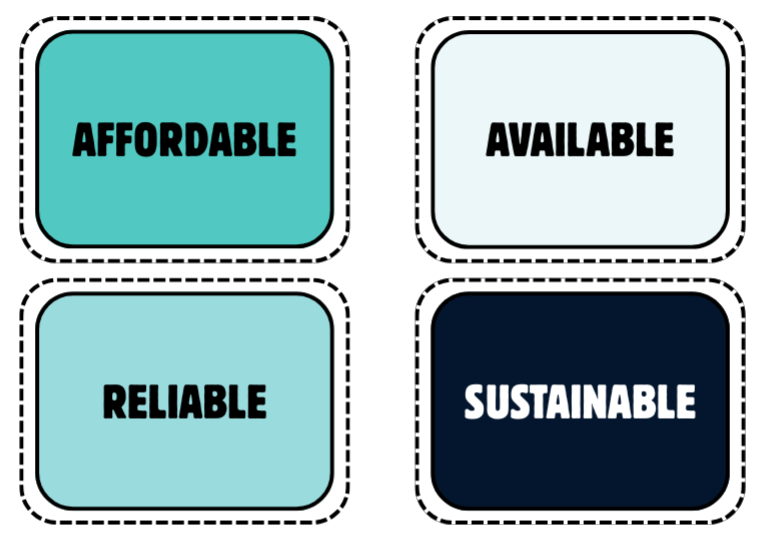
- One set of Pillar Cards per group (Affordable, Available, Reliable, Sustainable)
- Sheet of writing paper (per team) to draft their “Power Proposal.”
Procedure:
- Begin the class with a discussion on the “Four Pillars of Energy Decisions.” (Optional: Show students the video: Introduction to Energy Choices).
- Clearly define the Four Pillars. Students can give examples of things in their everyday lives that match each criteria.
- Affordable: Not costing too much and within most people’s budget.
- Available: Something that can be easily used or accessed when needed.
- Reliable: Able to be trusted to work well or do what is expected.
- Sustainable: Not harmful to the planet and able to last a long time.
- Arrange students into groups of 2-4.
- Have each group arrange the four Pillar Cards at the top of their table.
- Then, starting with one energy resource, students will place a card of that energy source beneath each Pillar they think it matches. For example, if the students started with the energy source “Coal”, their arrangement would look something like this:
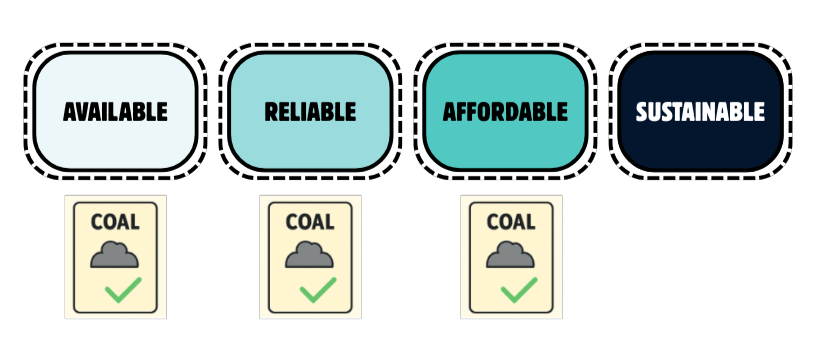
Coal is affordable, available, and reliable. However, it is not sustainable due to its high emissions.
- Students will continue through each energy source, matching Energy Cards to the Pillars. Encourage students to thoroughly discuss each choice. They can also connect the energy source to local conditions. For example, solar would be available if students lived in an area that got a lot of sun throughout the year, but unavailable if they lived in an area that is often cloudy or rainy. In order to place a card beneath a pillar, they need to all agree and be able to explain the reasoning behind their decision.
- Students will also fill out the Energy Source Evaluation Chart on the Student Handout as they make their decisions.
- Once students have completed going through each energy source, they will independently answer the reflection questions, including explaining what would be their top 3 energy sources for their community.
- Each team will then work together to create a “Power Proposal” for their community, and pitch it to the teacher and the rest of the class. The teacher and/or classmates can then vote on the most realistic and thoughtful proposal based on the rubric attached below.
Energy Source Evaluation Chart
Local conditions will change student answers and reasoning will vary. The chart below is to help teachers evaluate student responses and generate discussion.
| Energy Source | Affordable | Available | Reliable | Sustainable |
|---|---|---|---|---|
| Coal | Yes | Yes | Yes | No |
| Oil | Yes | Yes | Yes | No |
| Natural Gas | Yes | Yes | Yes | No |
| Solar | Debatable | Location-dependent | No | Debatable |
| Wind | Yes | Location-dependent | No | Debatable |
| Hydro | Debatable | Location-dependent | Yes | Yes |
| Nuclear | Debatable | Location-dependent | Yes | Debatable |
| Geothermal | Debatable | Location-dependent | Yes | Yes |
Power Proposal Rubric
| Category | Excellent | Needs Improvement |
|---|---|---|
| Use of the Four Pillars | Clearly applies all four pillars to each energy source in proposal decisions | Mentions the four pillars sporadically with little explanation |
| Reasoning and Evidence | Strong reasoning with clear examples and facts | Weak or missing reasoning with unclear examples and few facts |
| Clarity of Proposal | Proposal is well-organized and easy to understand | Hard to follow or unclear |
| Teamwork and Participation | All team members contribute and support the final idea | One or two members dominate, while others are not involved |
Cards to Print
Pillar Cards
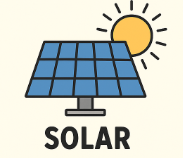
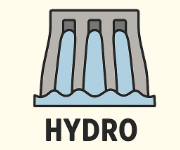
Energy Source Cards
 |  |  |  |
 |  |  |  |
| | | |
| | | |