

How Air Starts Moving – Student Guide
Summary
Students complete data tables for four scenarios: a daytime sea breeze, a nighttime land breeze, a sunny foothill next to a shaded valley, and an approaching cold front. They use their answers to predict which way the wind moves. A key concepts table shows how warmer or cooler air changes molecule speed, density, and pressure. Each scenario ends with a short written response, and two engineering questions ask what makes a location a good fit for a wind farm.
Introduction
Have you ever wondered why the wind blows? The movement of air begins with the Sun. As sunlight warms Earth’s surface, some places heat up faster than others.
When air becomes warmer, its molecules move faster and spread farther apart. This makes the air less dense than the surrounding cooler air, causing it to rise.
When air becomes cooler, its molecules move slower and move closer together. This makes the air more dense than the surrounding warmer air, causing it to sink.
As warm air rises, it can create an area of lower air pressure near the surface. Cooler, denser air sinks and can create an area of higher air pressure near the surface.
Air moves from areas of higher pressure toward areas of lower pressure. This movement of air is called wind.
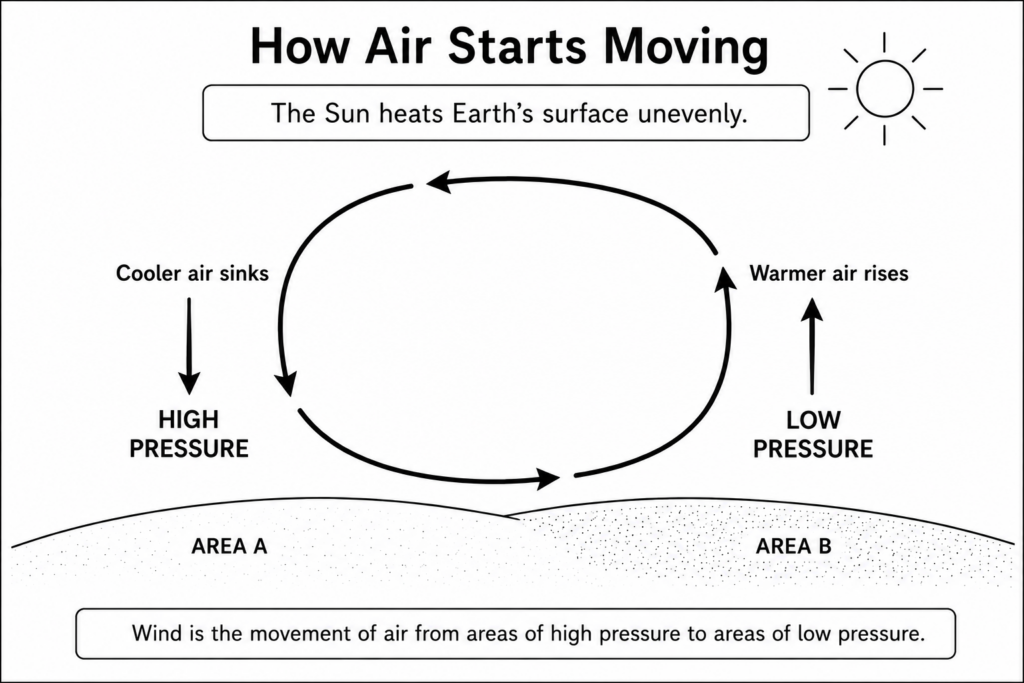
In this investigation, you will analyze several real-world scenarios to discover how differences in temperature create differences in air pressure that cause wind to form.
Key Concepts
As you work through each scenario, remember these relationships:
| If the air is… | the molecules move… | resulting in ____ density… | causing the air to… | resulting in ____ pressure. |
|---|---|---|---|---|
| warm | faster | lower | rise | lower |
| cool | slower | higher | sink | higher |
Remember, air naturally moves from areas of higher pressure to areas of lower pressure.
Scenario 1: Ocean vs. Land (Dry)
On a sunny afternoon, the land heats up much faster than the nearby ocean. As a result, the air over the land becomes much warmer than the air over the ocean. This temperature difference creates differences in air pressure, causing a sea breeze to form.
The air over the ocean near the coastline is 68°F, while the air over the coastal land is 90°F.
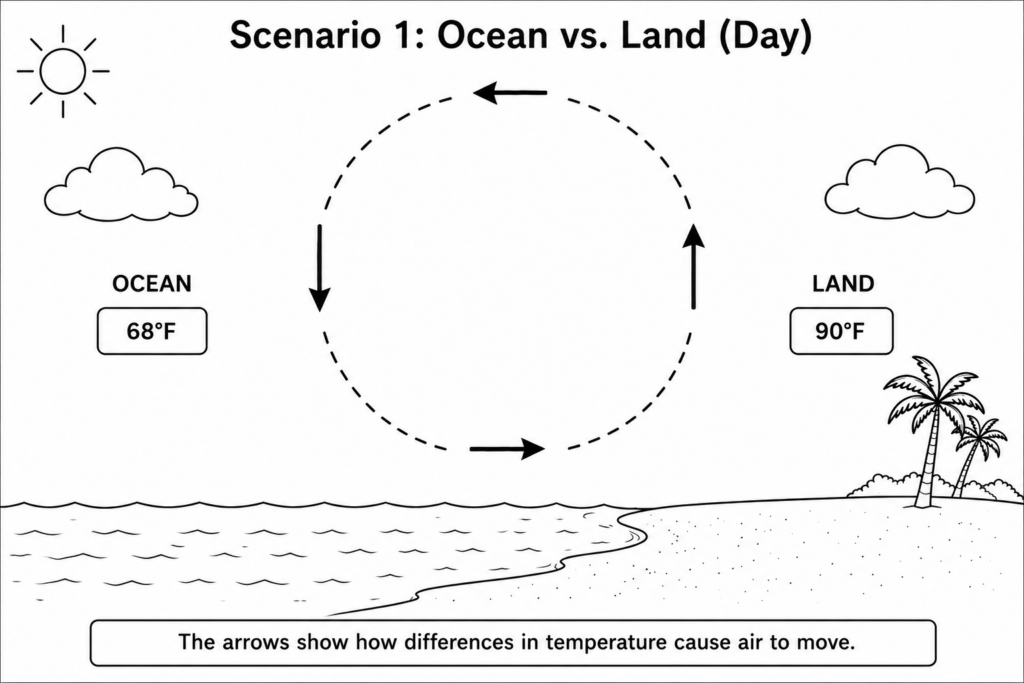
Complete the table.
Scenario 1 Table
| Air over the Ocean | Air over the Land | |
|---|---|---|
| Temperature | 68°F | 90°F |
| Molecules: Faster or Slower | ||
| Warmer or Cooler | ||
| Rises or Sinks | ||
| Density (higher or lower) | ||
| Pressure (higher or lower) |
1. Based on the information from the table and diagram, in which direction does the air move near Earth’s surface?
- From the ocean toward the land
- From the land toward the ocean
2. If you were standing on the beach, would the wind feel warm or cool? Explain your reasoning.
Scenario 2: Ocean vs. Land (Night)
After sunset, the land cools much faster than the nearby ocean. As a result, the air over the ocean becomes warmer than the air over the land. This temperature difference creates differences in air pressure, causing a land breeze to form.
The air over the ocean near the coastline is 72°F, while the air over the coastal land is 60°F.
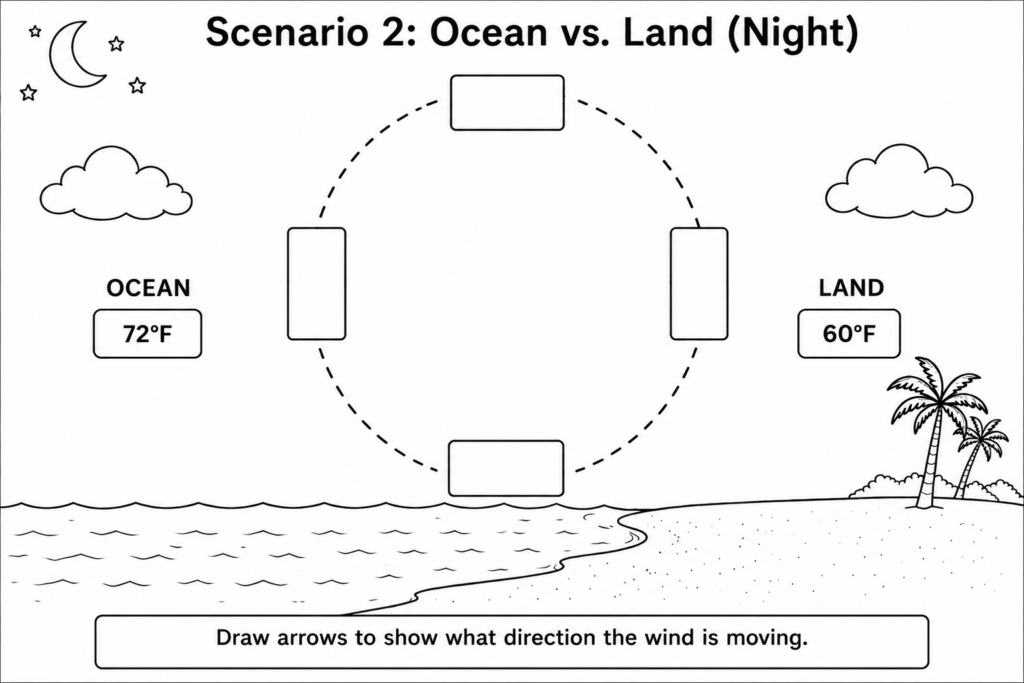
Complete the table.
Scenario 2 Table
| Air over the Ocean | Air over the Land | |
|---|---|---|
| Temperature | ||
| Molecules: Faster or Slower | ||
| Warmer or Cooler | ||
| Rises or Sinks | ||
| Density (higher or lower) | ||
| Pressure (higher or lower) |
1. Based on the information from the table and diagram, in which direction does the air move near Earth’s surface?
- From the ocean toward the land
- From the land toward the ocean
2. How is the direction of the surface wind at night different from the direction of the surface wind during the day? Explain why the direction changes.
Scenario 3: Foothill vs. Valley (Day)
On a sunny afternoon, a foothill receives direct sunlight, while the nearby valley floor stays in shadow for part of the day. The sunny slope warms the air above it more than the shaded valley floor warms the air above it. This temperature difference creates differences in air pressure, causing a breeze to develop.
The air over the sunny foothill slope is 82°F, while the air over the nearby shaded valley floor is 66°F.
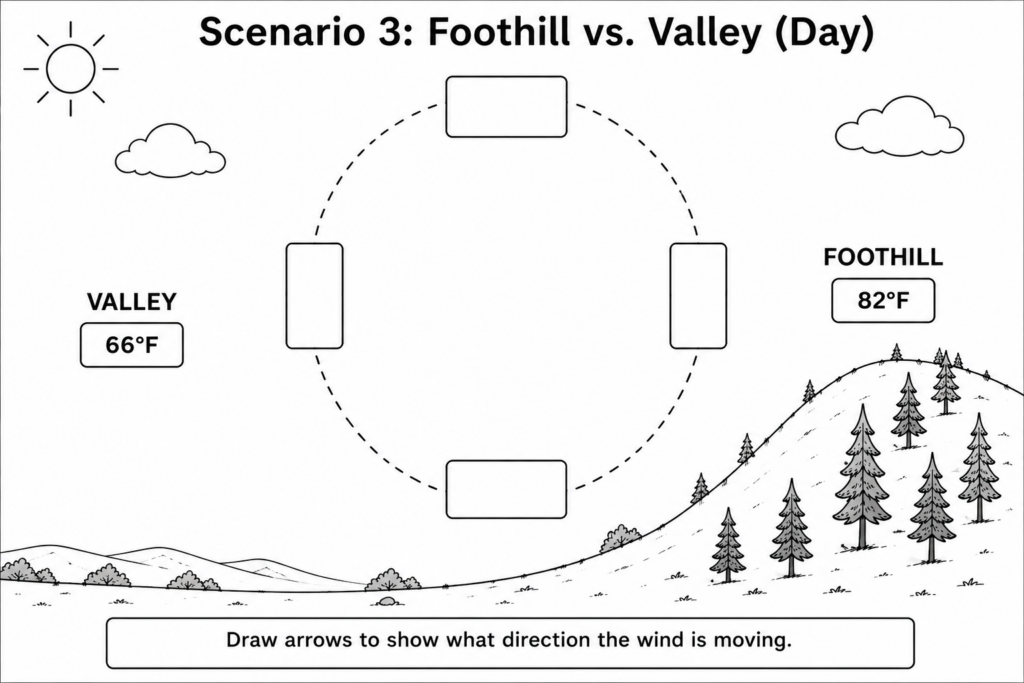
Complete the table.
Scenario 3 Table
| Air over the Foothill | Air over the Valley | |
|---|---|---|
| Temperature | ||
| Molecules: Faster or Slower | ||
| Warmer or Cooler | ||
| Rises or Sinks | ||
| Density (higher or lower) | ||
| Pressure (higher or lower) |
1. Based on the information from the table and diagram, in which direction does the air move near Earth’s surface?
- From the foothill toward the valley
- From the valley toward the foothill
2. At night, the air near the foothill becomes cooler than the air near the valley. How would you expect the direction of the surface wind to change? Explain your reasoning.
3. In Scenarios 1–3, differences in temperature caused wind to form. Explain how wind forms using these words: temperature, molecules, density, and pressure.
Scenario 4: A Cold Front Approaches
A weather map shows a cold front approaching Springfield. A cold front is the boundary between a mass of cooler air and a mass of warmer air. The triangles along the cold front point in the direction the front is moving.
The cooler air mass is 58°F, while the warmer air mass is 84°F.
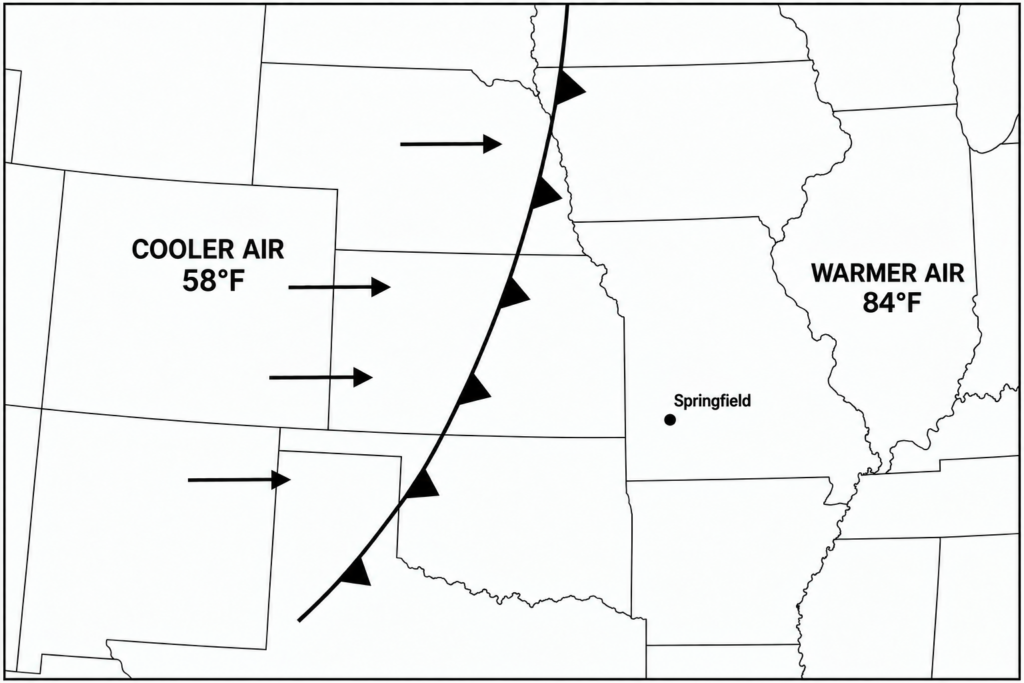
Complete the table.
Scenario 4 Table
| Cold Air Mass | Warm Air Mass | |
|---|---|---|
| Temperature | ||
| Rises or Sinks | ||
| Density (higher or lower) | ||
| Pressure (higher or lower) |
1. Based on the information from the table and diagram, which air mass will rise above the other?
- The warm air mass will rise above the cold air mass
- The cold air mass will rise above the warm air mass
2. Would you expect the temperature in the city to increase or decrease? Explain your reasoning.
Engineering Connection: Wind Energy
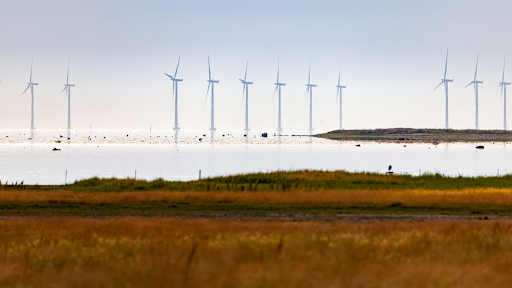
Engineers carefully study wind patterns when choosing locations for wind farms. The local winds explored in this investigation are one example of how differences in temperature and air pressure can cause air to move. However, wind can also be caused by larger regional and global pressure patterns. Wind farms are built on locations where winds are strong and consistent enough to generate electricity.
Question 1
Based on Scenarios 1 and 2, would you expect coastal areas to experience wind during the day, at night, or both? Explain how differences in the way land and water heat and cool create these winds.
Question 2
Local temperature differences are only one cause of wind. Engineers also study larger regional wind patterns. What wind characteristics would engineers need to study before deciding whether a location is suitable for a wind farm? Explain why.